

Archive position — measured, not model output
0 likes on Devpost
2,263 of the 7,850 archived projects have more likes, and 5,587 share exactly 0 — so this project's #5,626 place in the like-ranked listing is a tie-break inside that group, not a ranking.
Projects (log scale)
Likes on Devpost. ▲ marks this project's group.
Show the figures
| Likes | Projects | Share of archive |
|---|---|---|
| 0 | 5,587 | 71.2% |
| 1 | 1,758 | 22.4% |
| 2 | 284 | 3.6% |
| 3–4 | 132 | 1.7% |
| 5–9 | 75 | 1.0% |
| 10+ | 14 | 0.2% |
 User Stories BotA demo video on every pull request
Get a demo video on every new feature
GitHub App that watches your pull requests and records a narrated, captioned demo.
Save time on demo prep and make informed decisions faster with a video walkthrough of every new feature.
Executive Summary
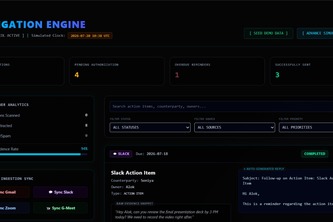
The description states that Obigation Engine (Autonomous Agent) is a self-reported autonomous AI agent designed to extract, track, and proactively fulfill obligations from Slack, Gmail, and Zoom communications. It claims to operate invisibly in the background, using LLMs for extraction and proactive fulfillment of commitments. The project was built as a hackathon submission over four days using FastAPI, React, Python, OpenAI, and various enterprise APIs.
The author states that the system uses official APIs to monitor communications, passes raw text through LLMs to identify promises and deadlines, and can draft personalized apology messages when obligations are missed. The team reports building a dashboard with real-time synchronization and time-travel simulation capabilities.
Key commercial due-diligence questions include: What is the actual product-market fit? How does it differ from existing task management tools? Is there any evidence of traction or customer interest beyond the hackathon?
The single most important open question is whether this concept has sufficient commercial viability to warrant further investment or partnership consideration, given that no revenue, customers, or adoption data are provided.
What The Product Actually Is
The description states that Obigation Engine is an autonomous AI agent that:
- Seamlessly ingests Slack, Gmail, and Zoom communications
- Extracts action items without user intervention
- Tracks obligations and deadlines
- Proactively fulfills commitments by drafting personalized messages when deadlines are missed
- Operates invisibly in the background
The author describes it as a "fully autonomous AI Chief of Staff" that uses official APIs (Gmail, Slack Server-to-Server, Zoom) to continuously monitor communications.
The system is claimed to:
- Pass raw text and cloud transcripts through LLMs for NLP
- Identify promises, deadlines, priorities, and counterparties
- Draft personalized apology emails or Slack messages when obligations are missed
- Allow users to simply "Approve" and send the message on their behalf
Positioning & Claim Evolution
The description states that the product was inspired by the need to eliminate cognitive load of task management in chaotic communication environments. The author claims it addresses a gap where users must manually write down commitments from Slack, Gmail, and Zoom.
The positioning evolved from:
- Initial inspiration: "What if an AI agent could just listen to our communication streams, understand exactly what we promised, and actively manage those obligations for us?"
- Product evolution: From simple chatbot wrappers to "truly autonomous agent" that operates invisibly in the background
- Key claim: "The true power of AI isn't in conversational chatbots, but in invisible, autonomous agents that connect existing software ecosystems"
Target Customer & ICP
The description states that the target customer is "developers and students" who experience chaotic information streams from Slack channels, Gmail inboxes, and Zoom standups.
The author claims their product addresses users who make promises like "I'll send that by 3 PM" or "I'll push that code tonight" and struggle with manually tracking these commitments.
The ICP appears to be individuals in knowledge work environments who:
- Use Slack, Gmail, and Zoom extensively
- Make frequent verbal commitments in digital communications
- Experience cognitive load from task management
Business Model & Pricing Evidence
Not evidenced. The description does not contain any information about pricing models, monetization strategies, or business model details.
Technical & Delivery Signals
The description states that the system was built using:
- Backend: Python with FastAPI
- Frontend: React, Vite, TailwindCSS
- AI/ML: OpenAI LLMs for NLP
- APIs: Google Cloud, Slack API, Zoom API
- Authentication: OAuth flows for enterprise ecosystems
Key technical claims include:
- Uses official APIs (Gmail, Slack Server-to-Server, Zoom) to monitor communications
- Built chunking mechanisms to handle context window limitations with Zoom transcripts
- Implemented fallback mechanisms for OpenAI API quota limits
- Developed a time-travel simulation engine for dashboard demonstration
- Built in just 4 days using AI coding agents (Codex 5.6)
Traction & Maturity Signals
Not evidenced. The description states that this was built as a hackathon submission over four days and does not contain any information about:
- Revenue or customers
- Product adoption or usage metrics
- Market traction
- Business development activities
- Any form of commercial deployment or pilot programs
Competitive Context
Not evidenced. The description does not contain any information about:
- Direct competitors
- Indirect substitutes
- Market size or growth trends
- Competitive positioning
- Differentiation from existing tools
Open Questions & Risks
The description states that the project was built in a weekend and encountered several technical challenges:
- OAuth & API Complexities with three enterprise ecosystems (Google, Slack, Zoom)
- Context window limitations with Zoom transcripts requiring chunking mechanisms
- AI quota limits forcing pivot to fallback mechanisms
Key risks include:
- Unproven commercial viability of the concept
- Technical complexity of integrating with multiple enterprise APIs
- Potential privacy and security concerns from monitoring communications
- Limited evidence of product-market fit beyond hackathon context
- No revenue, customer or traction data available
Questions the description leaves open
- What specific problem are you solving that existing task management tools don't address?
- How do you plan to handle privacy and security concerns with monitoring user communications?
- What is your go-to-market strategy for reaching target customers beyond the hackathon?
- Have you validated demand from potential users beyond the development team?
- What specific metrics or KPIs will indicate product success?
- How do you plan to scale beyond the current API integrations (Slack, Gmail, Zoom)?
- What is your path to profitability and sustainable business model?
Overall Assessment
Not evidenced. The description does not contain any information about:
- Financial performance or projections
- Valuation or funding history
- Strategic fit for potential partners
- Investment requirements or use of funds
- Any commercial viability metrics
The project is described as a hackathon submission with no evidence of traction, revenue, customers or adoption beyond the development team's own claims. The author states that this was built in four days and does not contain any information about product-market fit, competitive positioning, or business model validation.
User Stories BotA demo video on every pull request
Get a demo video on every new feature
GitHub App that watches your pull requests and records a narrated, captioned demo.
Save time on demo prep and make informed decisions faster with a video walkthrough of every new feature.
Source
Submitted to the OpenAI 2026 hackathon on Devpost. Project home on Devpost. Back to the full gallery on Devpost.
This competitive analysis was produced by top-founders.com (opens in a new tab)
Generated by a language model from this project's public Devpost page — its tagline, the author's own write-up and any built-with tags listed there — as captured in August 2026. Short quotations are the author's words. It is an opinion on the idea as a business, not on the people behind it, and it reflects the description as published then. If the project has moved on, request a correction below. The analysis is not independent research and contains no verified traction, revenue or customer data.
An independent guide by KFG International LLC — not affiliated with, endorsed by, or connected to Devpost or OpenAI.