

Archive position — measured, not model output
0 likes on Devpost
2,263 of the 7,850 archived projects have more likes, and 5,587 share exactly 0 — so this project's #7,585 place in the like-ranked listing is a tie-break inside that group, not a ranking.
Projects (log scale)
Likes on Devpost. ▲ marks this project's group.
Show the figures
| Likes | Projects | Share of archive |
|---|---|---|
| 0 | 5,587 | 71.2% |
| 1 | 1,758 | 22.4% |
| 2 | 284 | 3.6% |
| 3–4 | 132 | 1.7% |
| 5–9 | 75 | 1.0% |
| 10+ | 14 | 0.2% |
 User Stories BotA demo video on every pull request
Get a demo video on every new feature
GitHub App that watches your pull requests and records a narrated, captioned demo.
Save time on demo prep and make informed decisions faster with a video walkthrough of every new feature.
Executive Summary
What the company appears to be
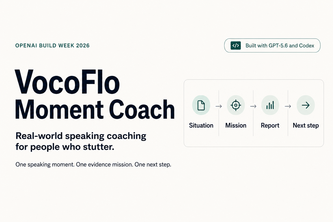
VocoFlo Moment Coach is a self-reported web application built as a hackathon project (Devpost submission) that uses GPT-5.6 to guide people who stutter through one specific speaking moment at a time, aiming to separate fear from facts and provide evidence-based next steps.
What changed
The author states this was developed during Build Week for the OpenAI 2026 hackathon. It is described as a beta version with a bounded architecture, structured prompts, and local storage of completed missions.
Single most important open question — the commercial due-diligence read
Is there any evidence that VocoFlo Moment Coach has traction, revenue, or adoption beyond its self-reported beta? If not, how does this affect its potential for growth or investment?
What The Product Actually Is
The description states that VocoFlo Moment Coach is a responsive web application built with Next.js, React, TypeScript, and the OpenAI API using GPT-5.6.
It is designed to help people who stutter by guiding them through one real speaking moment at a time, generating an evidence-based mission and providing coaching feedback after the user reports what happened.
The system enforces:
- One bounded mission per session;
- Up to four GPT responses maximum;
- Structured prompts for mission generation and report-back coaching;
- Browser-local storage of completed threads;
- A clear final close to prevent open-ended chatbot behavior.
It is not a medical diagnostic tool or fluency-promoting device, but rather an educational beta coaching experience.
Evidence
- Built with Next.js, React, TypeScript, OpenAI API, GPT-5.6.
- Uses browser-local storage.
- Enforces hard limits on responses and missions.
- Separates facts from assumptions in its coaching process.
- Not a medical tool or fluency-promoting device.
Inference The product appears to be a prototype or beta version, not a commercial offering with scale or monetization yet.
Positioning & Claim Evolution
The author claims that VocoFlo Moment Coach takes a different approach from generic speaking tools by focusing on one real speaking moment at a time, helping users compare fear predictions with actual outcomes.
It positions itself as:
- A bounded, evidence-based coach;
- Not a general advice chatbot;
- Focused on reducing self-monitoring and control during speech.
The larger direction mentioned is to help people who stutter become less governed by checking, predicting, controlling, correcting, avoiding, and reacting to speech — implying an educational journey beyond just one session.
Evidence
- Claims to guide one real speaking moment at a time.
- Separates fear from facts.
- Avoids generic advice or technique collections.
- Defines method, boundaries, and structured response requirements.
Inference The positioning suggests a niche market with a strong emotional and psychological component. However, no evidence of customer validation or product-market fit is provided.
Target Customer & ICP
The description states that the target audience includes people who stutter, specifically those who enter speaking situations already monitoring themselves — predicting difficult words, checking how they sound, trying to control each sentence, and reacting to pauses or blocks.
It does not name specific personas or segments beyond this group.
Evidence
- Targets people who stutter.
- Addresses self-monitoring behaviors in speech.
- Focuses on reducing fear-based prediction and reaction.
Inference The ICP is narrow and highly specialized. No evidence of broader segmentation or targeting beyond individuals with this condition.
Business Model & Pricing Evidence
There is no mention of pricing, monetization, or business model in the description.
The product is described as a beta, and the author notes that it is intentionally text-first and not yet fully developed for production use.
Evidence
- Described as a beta.
- No pricing information provided.
- No indication of revenue streams or monetization plans.
Inference No evidence exists to suggest any business model or pricing strategy. The project appears to be in early development with no commercial traction.
Technical & Delivery Signals
The application is built using:
- Next.js
- React
- TypeScript
- OpenAI API (GPT-5.6)
- Vercel deployment
- Browser-local storage
It uses structured validation for model responses, and the prompts are adapted to enforce:
- Bounded missions;
- Evidence-grounding rules;
- Response limits;
- Safety boundaries.
Codex was used primarily for implementation assistance including architecture, frontend, API, prompt builders, tests, documentation, and deployment preparation.
Evidence
- Built with Next.js, React, TypeScript.
- Uses GPT-5.6 via OpenAI API.
- Implements structured validation.
- Enforces response limits.
- Codex was used in development.
- Deployed on Vercel.
- Stored locally in browser.
Inference The technical stack is standard for modern web apps and AI integrations, but there is no evidence of scalability or infrastructure beyond a single developer's prototype.
Traction & Maturity Signals
There is no evidence of traction, revenue, customers, or adoption beyond the self-reported beta version created during Build Week.
The author notes that this is an intentionally limited beta and that planned features such as speech recording or analysis are not yet included.
Evidence
- Described as a beta.
- No mention of users, usage metrics, or customer data.
- No evidence of product-market fit or user engagement.
- Planned future features not implemented in current version.
Inference The project is at an early stage with no demonstrated traction or maturity. It lacks any signs of commercial viability or market validation.
Competitive Context
There are no references to competitors or competitive positioning within the description.
The author does not discuss existing tools for people who stutter, nor does it compare VocoFlo Moment Coach to other speaking coaches or AI-based therapy platforms.
Evidence
- No mention of competitors.
- No discussion of market landscape or differentiation.
Inference No evidence exists to assess competitive positioning or whether similar products already exist in the space.
Open Questions & Risks
Key risks and open questions include:
- Lack of traction: No evidence of users, adoption, or revenue.
- Unproven market demand: No validation that people who stutter need this specific type of coaching.
- Limited scope: The current version is a beta with no advanced features like speech analysis or persistent personalization.
- No commercial model: No indication of how the product will be monetized.
- Self-reported only: All claims are unverified and based on internal development experience.
Evidence
- No traction, customers, or revenue data.
- Beta-only status.
- No pricing or monetization strategy.
- No external validation or user feedback.
Inference The lack of any commercial signals raises concerns about viability and scalability. The product may be too early-stage to evaluate for investment or partnership.
Questions the description leaves open
- What is the actual size and nature of the target market for people who stutter?
- Have you conducted any user research or interviews with individuals who stutter?
- How do you plan to validate demand beyond this beta version?
- Is there a path toward monetization, and what are your assumptions about pricing?
- What is the long-term vision for VocoFlo beyond the current beta?
- Are there any partnerships or collaborations in place with organizations serving people who stutter?
- How do you intend to scale beyond a single developer’s work?
Overall Assessment
There is no evidence of commercial traction, revenue, or customer adoption.
The project is described as a self-reported beta, built during a hackathon, with no indication of product-market fit, monetization strategy, or scalability.
Given the lack of verified data and the early-stage nature of the product, any investment or partnership decision would be based on speculative potential rather than demonstrated value.
Evidence
- No revenue, customers, or traction.
- Beta-only status.
- No commercial model or pricing strategy.
Inference This is a very early-stage idea with no clear path to profitability or market validation. It may be suitable for incubation or early-stage funding if the founders can demonstrate traction and product-market fit in future iterations.
User Stories BotA demo video on every pull request
Get a demo video on every new feature
GitHub App that watches your pull requests and records a narrated, captioned demo.
Save time on demo prep and make informed decisions faster with a video walkthrough of every new feature.
Source
Submitted to the OpenAI 2026 hackathon on Devpost. Project home on Devpost. Back to the full gallery on Devpost.
This competitive analysis was produced by top-founders.com (opens in a new tab)
Generated by a language model from this project's public Devpost page — its tagline, the author's own write-up and any built-with tags listed there — as captured in August 2026. Short quotations are the author's words. It is an opinion on the idea as a business, not on the people behind it, and it reflects the description as published then. If the project has moved on, request a correction below. The analysis is not independent research and contains no verified traction, revenue or customer data.
An independent guide by KFG International LLC — not affiliated with, endorsed by, or connected to Devpost or OpenAI.