

Archive position — measured, not model output
0 likes on Devpost
2,263 of the 7,850 archived projects have more likes, and 5,587 share exactly 0 — so this project's #3,661 place in the like-ranked listing is a tie-break inside that group, not a ranking.
Projects (log scale)
Likes on Devpost. ▲ marks this project's group.
Show the figures
| Likes | Projects | Share of archive |
|---|---|---|
| 0 | 5,587 | 71.2% |
| 1 | 1,758 | 22.4% |
| 2 | 284 | 3.6% |
| 3–4 | 132 | 1.7% |
| 5–9 | 75 | 1.0% |
| 10+ | 14 | 0.2% |
 User Stories BotA demo video on every pull request
Get a demo video on every new feature
GitHub App that watches your pull requests and records a narrated, captioned demo.
Save time on demo prep and make informed decisions faster with a video walkthrough of every new feature.
Executive Summary
What the company appears to be
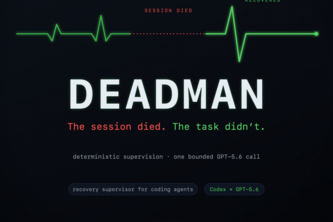
Deadman is a local safety supervisor for autonomous coding agents, designed to detect, diagnose, and recover from stuck or unresponsive processes in development workflows. It operates as a command-line tool that monitors Codex sessions on macOS and Linux, using GPT-5.6 for bounded diagnosis and deterministic code for recovery actions.
What changed
The project was built as part of the OpenAI 2026 hackathon. The author describes it as an experimental system to address silent failures in autonomous coding loops — where a single stuck process can halt all useful progress without clear indication to developers. It introduces a structured control loop: Observe → Detect → Diagnose → Recover → Verify → Report.
Single most important open question
Is there any evidence of real-world usage or adoption beyond the hackathon demo, and does Deadman have a viable path to product-market fit in developer tooling?
What The Product Actually Is
The description states that Deadman is a local safety supervisor for Codex coding sessions, operating as a command-line interface (CLI) tool. It uses:
- Process supervision via
psutiland OS-level process trees. - GPT-5.6 for bounded diagnosis, with typed action recommendations.
- Deterministic code to validate ownership, execute recovery, and verify results.
- SQLite for durable incident logging.
- Typer, Rich, Pydantic, and other Python libraries for implementation.
It supports multiple CLI modes:
deadman run— supervises non-interactive commands.deadman agent— launches an interactive Codex TUI in a supervised PTY.deadman attach— supervises an already-running Codex TUI.deadman watch,replay,demo, andreport— for evaluation without control.
The system is not a hosted service; it runs locally on developer machines. It is built to be cross-platform, though interactive supervision is limited to macOS and Linux.
Inference: The product is a developer tool, not an enterprise SaaS or marketplace. It is self-contained and designed for local use in autonomous agent workflows.
Positioning & Claim Evolution
The author states that Deadman was built around the question:
“How can an independent supervisor detect that an autonomous coding loop is genuinely stuck, recover only what is safe to recover, and prove that the intervention worked?”
This positions Deadman as a safety layer for autonomous agents, not a replacement or enhancement of those agents.
Claims include:
- It detects silent failures in long-running processes.
- It uses GPT-5.6 for diagnosis but does not grant it control over system resources.
- Recovery is safe, verifiable, and deterministic.
- Escalation (failure to act) is a valid outcome, not a bug.
Inference: The positioning is focused on trustworthiness and safety in autonomous workflows, not performance or feature richness. It is a control layer, not an agent itself.
Target Customer & ICP
The description states that Deadman is built for developers working with autonomous coding agents, particularly those using Codex. It is designed to be used in local development environments and supports workflows involving:
- Interactive TUI sessions.
- Non-interactive command execution.
- Session attachment and observation.
It targets users who:
- Run long-running or autonomous coding tasks.
- Are concerned with process hangs, silent failures, or unresponsive agents.
- Want a safe, verifiable, and deterministic recovery mechanism.
Inference: The ICP is likely developer tooling enthusiasts, autonomous agent researchers, or early adopters of Codex-based workflows. No evidence of enterprise adoption or customer segmentation beyond this.
Business Model & Pricing Evidence
The project description does not state a business model, pricing strategy, or monetization plan. It is presented as a hackathon submission and a developer tool, with no mention of:
- Revenue streams.
- Paid features.
- Subscription models.
- Customer acquisition.
Inference: No evidence of a commercial business model exists in the description.
Technical & Delivery Signals
The system is built using:
- Python
- Typer for CLI
- Rich for terminal UI
- Pydantic for validation
- psutil for process supervision
- OpenAI API (GPT-5.6) for diagnosis
- SQLite for logging
- Cross-platform support for macOS, Linux, and Windows (interactive mode limited to macOS/Linux)
Key technical features:
- Separation of intelligence (GPT) from authority (deterministic code).
- Typed GPT responses.
- Process ownership checks before recovery.
- Verification of outcomes.
- Replay and demo workflows without credentials.
Inference: The architecture is well-thought-out for a developer tool, with strong emphasis on safety and determinism. It shows technical maturity in process supervision and AI integration.
Traction & Maturity Signals
The description states:
- It was built for the OpenAI 2026 hackathon.
- A demo was conducted showing recovery of a hung Codex TUI.
- It includes a test suite covering multiple workflows.
- It supports deterministic replay and credential-free evaluation.
However, there is no evidence of:
- Customer adoption or usage beyond the hackathon.
- Revenue or ARR.
- Product-market fit.
- Any real-world deployment or feedback.
Inference: The project is at an early stage (hackathon prototype) with no demonstrated traction. It is a proof-of-concept, not a product in production.
Competitive Context
The description does not mention any direct competitors. However, it is positioned within the broader space of:
- Developer tooling for autonomous agents.
- Process supervision and observability tools.
- AI agent safety and control layers.
It is not clear if there are existing tools in this niche, as no competitive analysis or market positioning is provided.
Inference: No evidence of a competitive landscape exists. The project appears to be in a nascent or unoccupied space.
Open Questions & Risks
- No commercial traction — it's a hackathon submission with no real-world usage.
- Limited scope — only supports macOS and Linux for interactive mode; Windows support is planned but not implemented.
- Highly niche use case — targets developers using Codex, which may be a small subset of the broader developer community.
- No monetization strategy — no indication of how it would generate revenue.
- Dependency on GPT-5.6 — a proprietary model with unclear availability or cost for commercial use.
Inference: The project is experimental and not yet ready for market. Risks include lack of adoption, scalability issues, and unclear path to monetization.
Questions the description leaves open
- What is the actual usage or feedback from developers who tried this beyond the hackathon?
- How does Deadman plan to scale beyond macOS/Linux support?
- Is there a roadmap for monetization or product-market fit?
- What are the limitations of GPT-5.6 in diagnosis, and how is it bounded to avoid unsafe actions?
- How does Deadman integrate with other autonomous agent frameworks beyond Codex?
Overall Assessment
Not evidenced — The project description provides no evidence of:
- Revenue or ARR.
- Customer traction or adoption.
- Market demand.
- Product-market fit.
It is a proof-of-concept built for a hackathon, with no indication of commercial viability or scalability. It may be of interest to early-stage investors in developer tooling or AI agent safety, but only if there is a clear path to product-market fit and traction beyond the prototype stage.
Inference: Not ready for investment or partnership at this time. A follow-up evaluation would require evidence of real-world usage or a more developed commercial strategy.
User Stories BotA demo video on every pull request
Get a demo video on every new feature
GitHub App that watches your pull requests and records a narrated, captioned demo.
Save time on demo prep and make informed decisions faster with a video walkthrough of every new feature.
Source
Submitted to the OpenAI 2026 hackathon on Devpost. Project home on Devpost. Back to the full gallery on Devpost.
This competitive analysis was produced by top-founders.com (opens in a new tab)
Generated by a language model from this project's public Devpost page — its tagline, the author's own write-up and any built-with tags listed there — as captured in August 2026. Short quotations are the author's words. It is an opinion on the idea as a business, not on the people behind it, and it reflects the description as published then. If the project has moved on, request a correction below. The analysis is not independent research and contains no verified traction, revenue or customer data.
An independent guide by KFG International LLC — not affiliated with, endorsed by, or connected to Devpost or OpenAI.