

Archive position — measured, not model output
1 like on Devpost
505 of the 7,850 archived projects have more likes, and 1,758 share exactly 1 — so this project's #1,698 place in the like-ranked listing is a tie-break inside that group, not a ranking.
Projects (log scale)
Likes on Devpost. ▲ marks this project's group.
Show the figures
| Likes | Projects | Share of archive |
|---|---|---|
| 0 | 5,587 | 71.2% |
| 1 | 1,758 | 22.4% |
| 2 | 284 | 3.6% |
| 3–4 | 132 | 1.7% |
| 5–9 | 75 | 1.0% |
| 10+ | 14 | 0.2% |
 User Stories BotA demo video on every pull request
Get a demo video on every new feature
GitHub App that watches your pull requests and records a narrated, captioned demo.
Save time on demo prep and make informed decisions faster with a video walkthrough of every new feature.
Executive Summary
What the company appears to be
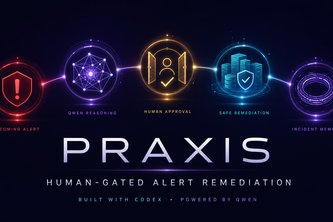
Praxis is a self-reported project that describes itself as an alert-to-remediation autopilot with a human approval gate. It uses OpenAI Codex and GPT-5.6, built end-to-end on Alibaba Cloud Function Compute, and is designed for on-call engineers to triage alerts, root-cause issues, draft remediations, and execute only after human approval.
What changed
The author states that this project was submitted to the OpenAI 2026 hackathon. No evidence of prior development or product evolution beyond this submission is provided.
Single most important open question
Is there any evidence of real-world usage, customer feedback, or operational deployment beyond the author’s own development and testing?
What The Product Actually Is
The description states that Praxis:
- Ingests signed operational alerts.
- Uses Qwen models to classify and root-cause them.
- Gathers read-only evidence.
- Drafts a risk-labelled remediation plan.
- Executes only after human approval.
- Runs approved actions against an isolated target.
- Records every step in an auditable decision trail.
- Stores reusable incident memory.
- Is deployed on Alibaba Cloud Function Compute.
- Has a live, public read-only dashboard.
Inference The system is described as a state machine with strict fail-closed logic to prevent unintended execution. It integrates AI for triage and remediation while maintaining human oversight.
Not evidenced No actual product, customer base, or operational deployment details are provided beyond the author’s own development process.
Positioning & Claim Evolution
The author claims Praxis is:
- An alert-to-remediation autopilot.
- Built end-to-end with OpenAI Codex and GPT-5.6.
- Designed to reduce 3am pages for on-call engineers.
- A system that stops before executing anything unless a human explicitly approves.
Inference The positioning is focused on reducing alert fatigue and automating remediation while maintaining safety through human approval.
Not evidenced No prior versions, market feedback, or competitive positioning beyond the author’s own claims are provided.
Target Customer & ICP
The description states:
- The target audience is on-call engineers.
- It addresses the problem of repetitive 3am pages for issues already solved.
Inference The product is aimed at SREs or DevOps teams managing operational alerts and incident response.
Not evidenced No evidence of actual customers, customer interviews, or specific use cases beyond the author’s own experience.
Business Model & Pricing Evidence
The description does not state:
- Any pricing model.
- Revenue streams.
- Monetization strategy.
- Subscription or usage-based models.
Inference Given that this is a hackathon submission and no commercial product is described, there is no evidence of a business model.
Not evidenced No information on how the project would monetize or scale beyond the author’s own use case.
Technical & Delivery Signals
The description states:
- Built with: Codex, GPT-5.6, Qwen models, Alibaba Cloud Function Compute.
- Uses FastAPI, Python, Uvicorn, Tablestore, and Qwen Cloud.
- The system is deployed on Alibaba Cloud Function Compute.
- Includes automated tests (850+), deploy tooling, and architecture decision records (ADRs).
- Designed with a strict, fail-closed state machine.
Inference The technical stack suggests a modern, cloud-native approach with AI integration. The use of Codex and GPT-5.6 implies an agent-based system.
Not evidenced No information on scalability, performance, or production-grade infrastructure beyond the author’s own development setup.
Traction & Maturity Signals
The description states:
- This is a hackathon submission.
- Built by one person (Khristian Kopachelli).
- No mention of users, customers, or real-world deployment.
Inference This is an early-stage prototype or proof-of-concept. There is no evidence of traction or product-market fit.
Not evidenced No data on usage, adoption, revenue, or customer feedback.
Competitive Context
The description does not mention:
- Competitors.
- Market positioning.
- Prior art in alert automation or incident response tools.
Inference The author does not provide context about existing solutions in the market for alert triage and remediation.
Not evidenced No competitive analysis, market size, or differentiation from other tools is provided.
Open Questions & Risks
- Unverified claims: All information is self-reported and unverified.
- Single-person development: No team, no external validation.
- No traction or customers: No evidence of real-world usage or adoption.
- Hackathon project: Likely a prototype, not a product ready for market.
- AI model dependency: Reliance on GPT-5.6 and Codex may not scale or be production-ready.
- Limited scope: The system is described as focused on one specific use case (on-call alerts) with no indication of broader applicability.
Questions the description leaves open
- What is the actual problem you’re solving, and how do you know it’s real?
- Have you tested this in a real operational environment or with other engineers?
- How does the system handle edge cases or failures that aren’t covered by your current design?
- What are the limitations of using GPT-5.6 and Codex for production-level automation?
- Are there any plans to scale beyond a single developer’s use case?
- How do you plan to monetize this, if at all?
Overall Assessment
Not evidenced.
The description is entirely self-reported and lacks any evidence of traction, revenue, customers, or product-market fit. It appears to be a hackathon project by one individual with no indication of commercial viability or scalability.
Confidence Low This analysis is based solely on the author’s own account, which is unverified and does not contain any data about real-world adoption, performance, or business metrics.
User Stories BotA demo video on every pull request
Get a demo video on every new feature
GitHub App that watches your pull requests and records a narrated, captioned demo.
Save time on demo prep and make informed decisions faster with a video walkthrough of every new feature.
Source
Submitted to the OpenAI 2026 hackathon on Devpost. Project home on Devpost. Back to the full gallery on Devpost.
This competitive analysis was produced by top-founders.com (opens in a new tab)
Generated by a language model from this project's public Devpost page — its tagline, the author's own write-up and any built-with tags listed there — as captured in August 2026. Short quotations are the author's words. It is an opinion on the idea as a business, not on the people behind it, and it reflects the description as published then. If the project has moved on, request a correction below. The analysis is not independent research and contains no verified traction, revenue or customer data.
An independent guide by KFG International LLC — not affiliated with, endorsed by, or connected to Devpost or OpenAI.