

Archive position — measured, not model output
1 like on Devpost
505 of the 7,850 archived projects have more likes, and 1,758 share exactly 1 — so this project's #1,699 place in the like-ranked listing is a tie-break inside that group, not a ranking.
Projects (log scale)
Likes on Devpost. ▲ marks this project's group.
Show the figures
| Likes | Projects | Share of archive |
|---|---|---|
| 0 | 5,587 | 71.2% |
| 1 | 1,758 | 22.4% |
| 2 | 284 | 3.6% |
| 3–4 | 132 | 1.7% |
| 5–9 | 75 | 1.0% |
| 10+ | 14 | 0.2% |
 User Stories BotA demo video on every pull request
Get a demo video on every new feature
GitHub App that watches your pull requests and records a narrated, captioned demo.
Save time on demo prep and make informed decisions faster with a video walkthrough of every new feature.
Executive Summary
What the company appears to be
PraxisRelay is a self-reported project that claims to offer an AI-assisted system for managing project continuity and truth across AI tools. It is described as a Node.js application with a browser interface, built using GPT-5.6 and deterministic validation layers. The author states it is designed for domain experts who do not write code.
What changed
The description does not indicate any prior version or evolution; it is presented as a prototype submitted to a hackathon.
Single most important open question
Is there evidence of real-world usage, traction, or adoption beyond the author’s own development and testing?
What The Product Actually Is
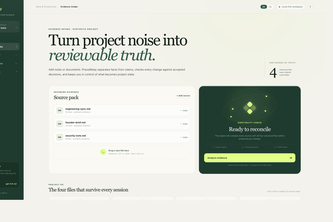
The description states that PraxisRelay is a dependency-free Node.js application with a custom browser interface. It ingests project notes and compares them against four canonical files: Project Charter, Current State, Decision Log, and Open Questions.
It uses GPT-5.6 to extract material claims and label them as FACT, ASSERTION, HYPOTHESIS, or UNKNOWN. These outputs are then validated by a deterministic guardrail layer, which checks exact quotations, evidence links, protected decisions, replacement targets, and write boundaries.
The system is designed so that only human-approved changes propagate into the next AI session. It supports both English and Russian interfaces and avoids third-party runtime dependencies.
Inference The product appears to be a prototype built for internal use or demonstration, not a commercial offering.
Positioning & Claim Evolution
The author states that PraxisRelay focuses on inspectable state transition, aiming to make AI-assisted work durable and inspectable. It is positioned as a tool for domain experts who do not write code, distinguishing itself from tools built for software teams.
It claims to be a solution to the problem of "buried decisions," "hypotheses later returned as facts," and "reappearing mistakes" in AI-assisted workflows.
Inference The positioning reflects an author-driven narrative about improving continuity and truth in AI work, but no evidence exists that this is a widely adopted or tested approach.
Target Customer & ICP
The description states that PraxisRelay is deliberately understandable to domain experts who do not write code, suggesting a target audience of non-technical professionals working with AI tools in fields like legal work.
It also mentions that the system was developed based on real-world experience in legal work, and that it could be applied to other domains where "deep domain knowledge" is required.
Inference The ICP appears to be domain experts or professionals who need to maintain continuity and truth across AI-assisted workflows but lack coding skills. No evidence of actual customers or user feedback exists.
Business Model & Pricing Evidence
There is no evidence in the description of any business model, pricing structure, or monetization strategy.
The project is described as a prototype submitted for a hackathon, with no mention of revenue, subscriptions, or paid services.
Inference No commercial model has been defined or demonstrated.
Technical & Delivery Signals
PraxisRelay is built as a Node.js application with a browser interface, using the OpenAI Responses API with gpt-5.6-sol and strict JSON Schema output.
It uses deterministic validation to check quotations, line ranges, evidence links, protected decisions, and write boundaries. The system is designed to prevent silent writes and ensure that all facts are supported by evidence.
The prototype includes:
- A complete synthetic demo
- Critical logic tests
- A secret scan
- Judge instructions
- An under-three-minute demo video
Inference The technical architecture shows a clear separation of model reasoning, validation, and human review. However, no evidence exists that this has been scaled or deployed in production.
Traction & Maturity Signals
The description states that the project is a prototype submitted to the OpenAI 2026 hackathon. It includes accomplishments such as:
- A complete source-to-transfer product loop
- Exact evidence and line-range verification for every factual claim
- Human-reviewable changes across all four canonical files
- Deterministic blocking of returned rejected decisions
However, no evidence of real-world usage, adoption, or traction is provided.
Inference The project shows maturity in prototype form but lacks any indication of market traction or user engagement.
Competitive Context
The description states that most close products are built for coding agents or software teams. PraxisRelay is positioned as different, focusing on domain experts rather than developers.
It does not mention specific competitors, nor does it provide a competitive analysis.
Inference The competitive landscape is not described, and no evidence of existing similar tools or market positioning is available.
Open Questions & Risks
- The project is presented as a prototype, with no evidence of commercial deployment or user adoption.
- There is no indication of funding, headcount, or business traction.
- The system’s use of GPT-5.6 (a non-existent model version) raises questions about the veracity of technical claims.
- The author states that the project was built using Codex, but no evidence of external validation or independent testing is provided.
Inference The lack of real-world usage and commercial viability makes this a high-risk proposition for investment or partnership.
Questions the description leaves open
- What is the actual use case or problem that PraxisRelay solves in practice?
- Has it been tested with domain experts outside of the author’s own experience?
- Is there any evidence of user feedback, pilot programs, or early adopters?
- How does the system handle edge cases or ambiguous inputs?
- What is the long-term vision for scaling beyond a prototype?
- Are there plans to monetize or commercialize the product?
Overall Assessment
The description presents PraxisRelay as a self-contained prototype submitted to a hackathon, with no evidence of revenue, customers, or traction.
It is described as a tool for domain experts and non-technical users, but there is no indication of market demand or adoption.
Assessment Not evidenced. The project shows potential in concept and prototype form, but lacks any commercial due-diligence signals. It is not ready for investment or partnership without further evidence of traction, user validation, or business model development.
User Stories BotA demo video on every pull request
Get a demo video on every new feature
GitHub App that watches your pull requests and records a narrated, captioned demo.
Save time on demo prep and make informed decisions faster with a video walkthrough of every new feature.
Source
Submitted to the OpenAI 2026 hackathon on Devpost. Project home on Devpost. Back to the full gallery on Devpost.
This competitive analysis was produced by top-founders.com (opens in a new tab)
Generated by a language model from this project's public Devpost page — its tagline, the author's own write-up and any built-with tags listed there — as captured in August 2026. Short quotations are the author's words. It is an opinion on the idea as a business, not on the people behind it, and it reflects the description as published then. If the project has moved on, request a correction below. The analysis is not independent research and contains no verified traction, revenue or customer data.
An independent guide by KFG International LLC — not affiliated with, endorsed by, or connected to Devpost or OpenAI.