

Archive position — measured, not model output
1 like on Devpost
505 of the 7,850 archived projects have more likes, and 1,758 share exactly 1 — so this project's #2,189 place in the like-ranked listing is a tie-break inside that group, not a ranking.
Projects (log scale)
Likes on Devpost. ▲ marks this project's group.
Show the figures
| Likes | Projects | Share of archive |
|---|---|---|
| 0 | 5,587 | 71.2% |
| 1 | 1,758 | 22.4% |
| 2 | 284 | 3.6% |
| 3–4 | 132 | 1.7% |
| 5–9 | 75 | 1.0% |
| 10+ | 14 | 0.2% |
 User Stories BotA demo video on every pull request
Get a demo video on every new feature
GitHub App that watches your pull requests and records a narrated, captioned demo.
Save time on demo prep and make informed decisions faster with a video walkthrough of every new feature.
Executive Summary
What the company appears to be
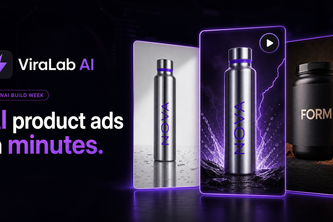
ViraLab AI is a self-reported AI-powered content creation and publishing tool for ecommerce sellers. The author states it allows users to upload a product photo, generate marketing content (images and videos), improve prompts automatically with AI, store all content in one place, and publish directly to TikTok.
What changed
The project was built as a hackathon submission by a single founder (Elliott! Lyu) using modern web technologies. It is described as an experiment in workflow orchestration and AI application design, not yet a commercial product or platform with customers.
Single most important open question
Is there evidence of early traction, revenue, or customer feedback that would indicate demand for this type of tool beyond the author’s own use case?
What The Product Actually Is
The description states that ViraLab AI is a tool that helps ecommerce sellers create content faster by:
- Generating high-quality product images from a single uploaded photo
- Turning those images into short marketing videos
- Improving prompts automatically with AI
- Storing all generated content in one place
- Publishing directly to TikTok
It also mentions future features like AI-generated descriptions, captions, scheduling, Shopify integration, and multi-platform support.
Inference The tool appears to be a workflow automation platform that aggregates various AI services into a single interface for content creation and publishing. It is not described as a marketplace or SaaS platform with recurring revenue models.
Positioning & Claim Evolution
The author positions ViraLab AI as an “AI copilot” for ecommerce sellers, aiming to simplify the process of creating and publishing marketing content across platforms like TikTok.
Key claims from the description:
- Users can generate content in minutes instead of using five different apps
- The tool improves prompts automatically with AI
- It keeps all generated content in one place
- It supports direct publishing to TikTok
Inference The positioning reflects a shift toward integrated, AI-driven workflows for small business creators. However, the description does not indicate whether this is a new category or an evolution of existing tools.
Target Customer & ICP
The author identifies ecommerce sellers as the primary user base.
They state that users upload a single product photo and then generate content for TikTok, suggesting a focus on social commerce and influencer-style marketing.
There is no mention of:
- Specific business sizes (e.g., solo entrepreneurs vs. agencies)
- Industry verticals beyond general ecommerce
- Use cases outside of TikTok or social media
Inference The ICP likely includes small to mid-sized online retailers who need fast, automated content creation for platforms like TikTok.
Business Model & Pricing Evidence
There is no evidence in the description of:
- Revenue streams
- Pricing models
- Monetization strategy
- Customer acquisition costs
- Subscription plans or usage-based pricing
The author describes building a tool to solve their own problem, not launching a commercial product.
Inference The business model remains undefined. It may evolve into a freemium or paid SaaS offering, but no such indication exists in the description.
Technical & Delivery Signals
The project was built using:
- Next.js and React
- TypeScript
- Supabase (for auth, storage, DB)
- OpenAI for prompt enhancement
- Multiple AI image/video models behind a single provider layer
- TikTok Login Kit and Content Posting API
- Trigger.dev for background job processing
- Vercel for deployment
Challenges mentioned include:
- Handling long-running AI jobs
- Managing multiple AI providers
- Integrating TikTok authentication and publishing
- Keeping UI responsive
Inference The technical stack suggests a modern, scalable architecture designed to support AI workflows. However, the lack of production data or performance metrics means no signal about real-world scalability or reliability.
Traction & Maturity Signals
No evidence of:
- Revenue
- Customers
- User engagement
- Product-market fit
- Growth metrics
- Retention rates
- Market validation
The project is described as a hackathon submission by one person, with no indication of prior traction or adoption.
Inference There is no maturity signal beyond the initial prototype. The tool has not yet entered a commercial phase or demonstrated real-world usage.
Competitive Context
The description does not mention:
- Competitors
- Market size
- Competitive advantages
- Differentiation from existing tools
However, it implies that current solutions require users to jump between multiple apps for content creation and publishing. This suggests a potential gap in the market for integrated AI workflows.
Inference ViraLab AI may address a pain point in the marketplace, but there is no evidence of competitive analysis or awareness of existing players.
Open Questions & Risks
- Single-founder project: No team or external validation
- No revenue or customer data: The tool has not yet monetized or validated demand
- Unproven scalability: The author notes challenges in handling AI jobs and integrations, but no evidence of how these were resolved at scale
- Unclear monetization path: No pricing or business model described
- Limited scope: Features are currently focused on TikTok; expansion plans are speculative
Inference This is a prototype with potential, but lacks commercial traction or viability indicators.
Questions the description leaves open
- What specific problems do you observe in how ecommerce sellers currently create content?
- Have you tested the tool with actual users beyond yourself?
- How do you plan to monetize this product if it becomes widely used?
- What are your plans for integrating other platforms (e.g., Instagram, Shopify)?
- Are there any legal or compliance issues related to TikTok publishing or AI-generated content?
- What is the expected timeline for moving from prototype to a commercial product?
Overall Assessment
Not evidenced.
The description provides no information on:
- Financials
- Traction
- Market opportunity
- Team strength
- Product readiness
- Commercial viability
This is a self-reported hackathon project by one individual, with no evidence of commercial progress or validation.
Confidence level Low
Next step
Further due diligence required to assess whether this represents a viable product or early-stage idea.
User Stories BotA demo video on every pull request
Get a demo video on every new feature
GitHub App that watches your pull requests and records a narrated, captioned demo.
Save time on demo prep and make informed decisions faster with a video walkthrough of every new feature.
Source
Submitted to the OpenAI 2026 hackathon on Devpost. Project home on Devpost. Back to the full gallery on Devpost.
This competitive analysis was produced by top-founders.com (opens in a new tab)
Generated by a language model from this project's public Devpost page — its tagline, the author's own write-up and any built-with tags listed there — as captured in August 2026. Short quotations are the author's words. It is an opinion on the idea as a business, not on the people behind it, and it reflects the description as published then. If the project has moved on, request a correction below. The analysis is not independent research and contains no verified traction, revenue or customer data.
An independent guide by KFG International LLC — not affiliated with, endorsed by, or connected to Devpost or OpenAI.