

Archive position — measured, not model output
1 like on Devpost
505 of the 7,850 archived projects have more likes, and 1,758 share exactly 1 — so this project's #2,191 place in the like-ranked listing is a tie-break inside that group, not a ranking.
Projects (log scale)
Likes on Devpost. ▲ marks this project's group.
Show the figures
| Likes | Projects | Share of archive |
|---|---|---|
| 0 | 5,587 | 71.2% |
| 1 | 1,758 | 22.4% |
| 2 | 284 | 3.6% |
| 3–4 | 132 | 1.7% |
| 5–9 | 75 | 1.0% |
| 10+ | 14 | 0.2% |
 User Stories BotA demo video on every pull request
Get a demo video on every new feature
GitHub App that watches your pull requests and records a narrated, captioned demo.
Save time on demo prep and make informed decisions faster with a video walkthrough of every new feature.
Executive Summary
What the company appears to be: Visit Zanzibar AI Travel Copilot is a self-reported AI-powered travel platform that integrates generative AI into an existing marketplace for Zanzibar tourism. The product is described as an extension to a pre-existing travel platform, adding an AI assistant that converts traveler intent into structured, bookable itineraries.
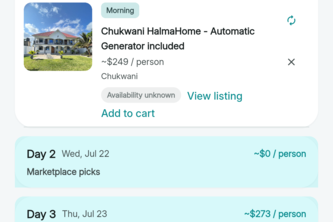
What changed: During OpenAI Build Week, the author added a GPT-5.6-powered AI Travel Copilot to an existing platform. This new functionality allows travelers to describe their trip in natural language and receive a day-by-day itinerary with integrated marketplace listings.
The single most important open question: Is there evidence of actual product-market fit or early traction beyond the self-reported development work? The description contains no data on revenue, users, bookings, or customer feedback.
What The Product Actually Is
The description states that Visit Zanzibar is an AI-assisted travel marketplace and community platform connecting travelers with verified local tourism partners. It supports:
- Hotels and vacation rentals
- Local tours and experiences
- Professional local guides
- Airport transfers and transportation
- Events and activities
- Community travel posts and short-form videos
- Collaborative journeys and trip blueprints
- Live trip memories
- Partner onboarding and identity verification
- Booking, messaging, reviews, notifications, and payments
The Build Week extension adds an AI Travel Copilot powered by GPT-5.6 that converts traveler intent into structured day-by-day itineraries connected to real marketplace entities.
Positioning & Claim Evolution
The author claims the platform aims to "transform travel planning from a collection of search results into an intelligent, personalized, and bookable journey." The positioning appears to be:
- A travel marketplace with AI-powered trip planning
- An intelligent travel companion that personalizes journeys
- A solution to fragmented travel planning across multiple platforms
The claim evolution shows the author starting with a basic marketplace platform and extending it with AI capabilities during OpenAI Build Week. There is no evidence of prior positioning or messaging beyond this single submission.
Target Customer & ICP
The description states that travelers visiting Zanzibar are the target customers, who often use "several disconnected platforms" to plan trips. The platform aims to connect travelers directly with verified local tourism partners in Zanzibar.
The author describes travelers as those who:
- Search for accommodations on one website
- Tours on another
- Transportation through messaging apps
- Local recommendations through social media
However, no specific customer segments or personas are defined beyond "travelers visiting Zanzibar."
Business Model & Pricing Evidence
The description states that the platform supports booking, messaging, reviews, notifications, and payments. It mentions Stripe and PayPal payment integrations.
No pricing information, revenue model details, or monetization strategy are provided in the self-reported description.
Technical & Delivery Signals
The product is described as a multi-platform solution consisting of:
- Flutter traveler and partner mobile applications
- Laravel API backend
- MySQL for transactional data
- Redis for caching, queues, and real-time infrastructure
- Cloudflare R2 for image and video storage
- WebSocket-based real-time messaging and notifications
- React-based administration platform
- Firebase services for mobile notifications
The author used GPT-5.6 and Codex during OpenAI Build Week to extend the existing application. The AI Travel Copilot is described as being integrated with existing marketplace data through structured API contracts.
Traction & Maturity Signals
Not evidenced. The description contains no information about:
- User base or customer numbers
- Revenue or booking volume
- Customer acquisition metrics
- Product usage data
- Market adoption
- Any form of traction beyond the author's own development work
Competitive Context
The description does not provide any information about competitors, market positioning relative to other travel platforms, or competitive advantages. It only describes the author's own product and its AI extension.
Open Questions & Risks
Risk 1: The platform is described as a single-person project built during a hackathon with no evidence of traction or commercial validation.
Risk 2: The AI integration appears to be an experimental extension rather than a core product feature, suggesting limited development investment beyond the hackathon period.
Risk 3: No information about customer feedback, user testing, or market validation exists in the description.
Risk 4: The author states they "retained responsibility for product decisions, architecture, data privacy, business rules, testing, and final implementation" but provides no evidence of any commercial or operational processes beyond development work.
Questions the description leaves open
- What is the actual user base or customer traction beyond the self-reported development work?
- How many bookings or transactions have occurred through the platform?
- What specific market problems are you solving, and how do you know?
- What is your go-to-market strategy for reaching travelers in Zanzibar?
- How do you plan to scale beyond a single-person development team?
- What is your path to profitability or commercial sustainability?
- How do you handle data privacy and compliance with local regulations?
- What are the key performance indicators you track for user engagement?
Overall Assessment
Confidence: Low
The self-reported description indicates a single-person project built during an OpenAI hackathon, with no evidence of commercial traction, revenue, customers or adoption beyond the author's own development work. The AI extension appears to be experimental rather than commercially validated.
The platform is described as an extension to an existing marketplace but provides no data on actual product-market fit or market validation. There is no evidence of any business metrics, user feedback, or commercial processes beyond the technical implementation described.
Assessment: Not evidenced. The description contains no information that would support a commercial due-diligence read beyond the author's own development work. Any potential investment or partnership opportunity would require additional evidence of traction, market validation, and commercial viability.
User Stories BotA demo video on every pull request
Get a demo video on every new feature
GitHub App that watches your pull requests and records a narrated, captioned demo.
Save time on demo prep and make informed decisions faster with a video walkthrough of every new feature.
Source
Submitted to the OpenAI 2026 hackathon on Devpost. Project home on Devpost. Back to the full gallery on Devpost.
This competitive analysis was produced by top-founders.com (opens in a new tab)
Generated by a language model from this project's public Devpost page — its tagline, the author's own write-up and any built-with tags listed there — as captured in August 2026. Short quotations are the author's words. It is an opinion on the idea as a business, not on the people behind it, and it reflects the description as published then. If the project has moved on, request a correction below. The analysis is not independent research and contains no verified traction, revenue or customer data.
An independent guide by KFG International LLC — not affiliated with, endorsed by, or connected to Devpost or OpenAI.