

Archive position — measured, not model output
0 likes on Devpost
2,263 of the 7,850 archived projects have more likes, and 5,587 share exactly 0 — so this project's #4,152 place in the like-ranked listing is a tie-break inside that group, not a ranking.
Projects (log scale)
Likes on Devpost. ▲ marks this project's group.
Show the figures
| Likes | Projects | Share of archive |
|---|---|---|
| 0 | 5,587 | 71.2% |
| 1 | 1,758 | 22.4% |
| 2 | 284 | 3.6% |
| 3–4 | 132 | 1.7% |
| 5–9 | 75 | 1.0% |
| 10+ | 14 | 0.2% |
 User Stories BotA demo video on every pull request
Get a demo video on every new feature
GitHub App that watches your pull requests and records a narrated, captioned demo.
Save time on demo prep and make informed decisions faster with a video walkthrough of every new feature.
Executive Summary
What the company appears to be
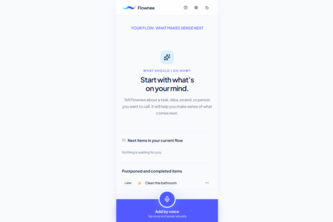
Flownee is a voice-first mobile app built as a progressive web app (PWA) that captures small, everyday intentions spoken by users and organizes them with AI. The app aims to reduce mental clutter by automatically recommending what makes sense next based on the user's current set of intentions.
What changed
The project evolved from an idea about capturing "little things" that don't fit into calendars into a functional PWA with voice input, local storage, and AI-powered task organization. It was built as part of a hackathon submission and includes automated testing, privacy protections, and a focus on simplicity and offline usability.
Single most important open question
Is there evidence of user adoption or validation beyond the team's own informal interviews? The description states that 10 informal interviews supported the problem, but no data on actual usage, retention, or product-market fit is provided.
Note: This analysis is based entirely on the self-reported project description supplied by the caller. No external verification or independent sources are available. All claims in this report are stated by the author and not independently confirmed.
What The Product Actually Is
The description states that Flownee is a voice-first mobile app designed to capture small, everyday intentions that users have but don't typically put into calendars. It allows users to speak naturally, transcribes speech using GPT-4o Transcribe, and converts the spoken input into editable tasks.
Key technical elements include:
- Built as a progressive web app (PWA) using Next.js, React, TypeScript, Tailwind CSS, and shadcn/ui-style components.
- Uses IndexedDB for local storage of confirmed transcripts, tasks, preferences, and plans.
- GPT-5.6 is used to separate intentions, estimate effort, identify assumptions, and recommend execution order.
- Audio recordings are processed via OpenAI API through protected server-side routes to avoid exposing API keys in the browser.
- The app does not require an account; all data stays in the browser.
- The most recent recommendation appears immediately upon reopening the app.
Inference: The product is described as a local-first, AI-powered task management tool that operates without requiring cloud-based accounts or external systems. It focuses on reducing decision fatigue through automated prioritization of user intentions.
Positioning & Claim Evolution
The description states that Flownee was inspired by the problem of "dozens of small intentions sitting in our heads" — things like calling a friend or planning an activity with kids — which are too minor for calendar entries but still create mental noise.
Flownee positions itself as:
- A tool that captures spontaneous thoughts naturally.
- An alternative to traditional task managers, voice assistants, and calendar apps.
- A solution focused on answering the question: “What should I do now?”
It claims to differ from existing tools by reasoning across all active intentions rather than creating isolated reminders or requiring manual organization.
Inference: The positioning evolved from a personal frustration (mental clutter) into a product that aims to solve this for busy adults, especially working parents. It emphasizes simplicity and AI-driven prioritization over complex productivity systems.
Target Customer & ICP
The description states that Flownee is designed for:
- Busy adults, particularly working parents.
- People who carry many small household, family, shopping, social, and administrative intentions in their heads.
Validation came from:
- Ten informal interviews with friends.
- Qualitative feedback during development and after launch.
Inference: The target customer segment appears to be individuals managing multiple daily responsibilities without a formal system for tracking spontaneous tasks. However, there is no evidence of quantitative user data or market segmentation beyond self-reported interview results.
Business Model & Pricing Evidence
There is no mention in the description of any pricing model, monetization strategy, or revenue streams.
The authors state:
- They plan to explore a sustainable paid model only after validating repeated use.
- Any business model must preserve Flownee's calm experience and not depend on selling personal task data.
- Long-term plans include optional integrations and personalization, but these are conditional on maintaining simplicity.
Inference: No commercial model has been implemented or tested. The team intends to validate product-market fit before considering monetization, which suggests early-stage development with no revenue evidence.
Technical & Delivery Signals
The app is built as a PWA using:
- Next.js, React, TypeScript, Tailwind CSS, shadcn/ui components.
- IndexedDB for local data persistence.
- GPT-4o Transcribe and GPT-5.6 for speech-to-text and task processing.
- Server-side routes to protect OpenAI API keys.
- Audio is processed only long enough for transcription and not saved afterward by default.
Key features include:
- Voice recording with cross-browser compatibility handling.
- Local-first architecture ensuring offline functionality.
- AI validation of outputs before committing to storage.
- 133 automated tests covering various aspects of the app (storage, AI contracts, server routes, recovery behavior, interface states).
Inference: The technical stack and delivery approach suggest a focus on reliability, privacy, and usability. The use of Codex for implementation and debugging indicates an agile development process with strong emphasis on code quality and testing.
Traction & Maturity Signals
There is no evidence of traction or user adoption beyond:
- Ten informal interviews.
- Qualitative feedback during and after development.
- A working prototype available at https://flownee-build-week.netlify.app.
- Testing guide and source code publicly accessible on GitHub.
The authors mention:
- The app works on physical Android and iPhone devices.
- It has been tested with 133 automated tests.
- It was submitted to the OpenAI 2026 hackathon.
Inference: No measurable traction, revenue, or customer base is evident. The project appears to be a functional prototype built in a short timeframe, likely for demonstration purposes rather than commercial deployment.
Competitive Context
The description does not provide explicit information about competitors or how Flownee compares to existing solutions in the market.
It contrasts Flownee with:
- Voice assistants (which create isolated reminders).
- Traditional task managers (which require manual organization).
- Calendar apps (which don’t capture spontaneous intentions).
Inference: The competitive landscape is not described. Based on its positioning, Flownee may compete with tools like Todoist, Things 3, or voice-based productivity apps, but no direct comparison or market differentiation is stated.
Open Questions & Risks
- No validated user base or adoption metrics: The only evidence of validation comes from informal interviews and internal testing.
- Unproven monetization strategy: No business model has been tested or implemented.
- Limited scalability concerns: As a PWA with local-first design, it may not scale well for broader enterprise or multi-user use cases.
- Dependency on AI models: Reliance on GPT-5.6 and other AI services introduces risk if those APIs change or become unavailable.
- Lack of formal product-market fit validation: The team plans to test with more users but hasn’t done so yet.
Inference: While the app is technically functional, its lack of real-world usage data and commercial viability raises significant concerns for investment or partnership consideration.
Questions the description leaves open
- What specific metrics or KPIs are you using to evaluate whether users actually adopt and continue using Flownee?
- How do you plan to validate the effectiveness of your AI recommendations in reducing decision fatigue over time?
- Have you conducted any A/B testing or usability studies beyond the informal interviews?
- What is your long-term roadmap for monetization, and how will it align with user experience?
- Are there any known limitations or edge cases in the voice recognition or AI processing that could affect reliability?
- How do you intend to expand beyond English and support localization for different languages/regions?
- What are the key assumptions underlying your product design decisions, and how have they been tested?
Overall Assessment
Not evidenced.
Note: There is no evidence of revenue, customers, or traction beyond the authors' own claims. The project appears to be a functional prototype built in a hackathon setting, with no indication of commercial viability or scalable business model. Any investment or partnership decision would require further validation of user demand and product-market fit.
User Stories BotA demo video on every pull request
Get a demo video on every new feature
GitHub App that watches your pull requests and records a narrated, captioned demo.
Save time on demo prep and make informed decisions faster with a video walkthrough of every new feature.
Source
Submitted to the OpenAI 2026 hackathon on Devpost. Project home on Devpost. Back to the full gallery on Devpost.
This competitive analysis was produced by top-founders.com (opens in a new tab)
Generated by a language model from this project's public Devpost page — its tagline, the author's own write-up and any built-with tags listed there — as captured in August 2026. Short quotations are the author's words. It is an opinion on the idea as a business, not on the people behind it, and it reflects the description as published then. If the project has moved on, request a correction below. The analysis is not independent research and contains no verified traction, revenue or customer data.
An independent guide by KFG International LLC — not affiliated with, endorsed by, or connected to Devpost or OpenAI.