

Archive position — measured, not model output
3 likes on Devpost
128 of the 7,850 archived projects have more likes, and 93 share exactly 3 — so this project's #215 place in the like-ranked listing is a tie-break inside that group, not a ranking.
Projects (log scale)
Likes on Devpost. ▲ marks this project's group.
Show the figures
| Likes | Projects | Share of archive |
|---|---|---|
| 0 | 5,587 | 71.2% |
| 1 | 1,758 | 22.4% |
| 2 | 284 | 3.6% |
| 3–4 | 132 | 1.7% |
| 5–9 | 75 | 1.0% |
| 10+ | 14 | 0.2% |
 User Stories BotA demo video on every pull request
Get a demo video on every new feature
GitHub App that watches your pull requests and records a narrated, captioned demo.
Save time on demo prep and make informed decisions faster with a video walkthrough of every new feature.
Executive Summary
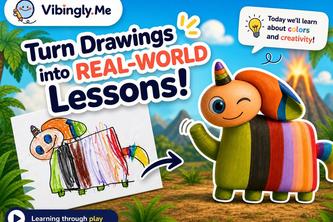
What the company appears to be: Vibingly.Me is a self-reported educational app for families that uses AI-generated content to turn children's drawings into interactive learning experiences. The author states it is built by one person (Adrian Michalski) and submitted as a hackathon project.
What changed: The product evolved from an initial video-generation focus to a real-world mission-based system with reward videos as incentives, after a mid-development pivot.
Single most important open question: Is there any evidence of actual user adoption or revenue generation beyond the author's prototype? The description states no traction data exists.
Analysis basis: This report is based entirely on the self-reported project description provided by the caller. It contains no verified financial, customer, or operational data. All claims are stated by the author and not independently confirmed.
What The Product Actually Is
- The description states Vibingly.Me is an app where parents upload child-drawn characters.
- These drawings come alive in a scene and assign real-world educational missions (e.g., counting apples, learning colors).
- Parents confirm mission completion; after five missions, a personalized 30-second video is generated.
- The core loop involves drawing → character comes alive → missions assigned → parent confirms → badges accumulate → reward video every fifth mission.
Inference: The app appears to be an interactive educational tool that blends digital storytelling with physical activity. It uses AI for generating characters, voiceovers, and videos, but the actual learning happens in real life.
Positioning & Claim Evolution
- The author claims the app helps children learn through play while avoiding early digital overexposure.
- It positions itself as a way to bridge the gap between traditional childhood activities and modern technology.
- The product evolved from an initial video-generation concept to a mission-based system with reward videos.
Inference: The positioning reflects a parental concern about balancing screen time with educational engagement. The pivot suggests the author recognized that gamification through real-world tasks was more compelling than pure digital content.
Target Customer & ICP
- The target customer is described as parents with young children (ages 1.5 and 5).
- The app is designed for family educational play during summer breaks or extended home time.
- No explicit segmentation beyond age groups or parental concerns is mentioned.
Inference: The ICP likely centers around parents seeking structured yet playful learning experiences for toddlers and preschoolers, possibly in a post-pandemic or screen-time-conscious environment.
Business Model & Pricing Evidence
- No pricing information, subscription models, or monetization strategy is provided.
- The author does not state whether the app will be sold, offered free, or funded through other means.
- There is no mention of partnerships, B2B, or enterprise use cases.
Inference: The business model remains undefined. It appears to be a prototype with unclear commercial viability at this stage.
Technical & Delivery Signals
- Built using Python (FastAPI), React + TypeScript, Supabase for memory, and Codex with GPT-5.6 Sol and Terra models.
- Uses Fal.ai for video generation and ffmpeg for stitching audio/video.
- Deployment on Hetzner VPS and Netlify frontend.
- The UI is described as persistent world with ephemeral interfaces summoned by an agentic system.
- Components are typed and deterministic, using a fixed registry of React components.
Inference: The technical stack reflects a hybrid approach combining AI agents (Codex), backend services (FastAPI), and frontend frameworks. The use of GPT models suggests a strong reliance on generative AI for content creation and interaction design.
Traction & Maturity Signals
- No evidence of revenue, users, or customer adoption is provided.
- The project was submitted as a hackathon entry.
- The author notes it was a one-person effort over a week-long period.
- There are no mentions of beta testing, user feedback loops, or product iterations beyond the initial prototype.
Inference: No traction signals exist. This is a prototype with no demonstrated market engagement or usage metrics.
Competitive Context
- No competitors or market analysis are mentioned in the description.
- The author does not reference existing tools for educational play or family learning apps.
- No comparison to similar products or platforms is made.
Inference: There is insufficient evidence to assess competitive positioning or market saturation. The app may be unique in its approach, but this cannot be confirmed without external data.
Open Questions & Risks
- The entire project was built by a single individual (1-person team).
- No revenue, customer base, or traction data exists.
- The product is described as a hackathon prototype with no indication of scalability or long-term development plans.
- Heavy reliance on AI tools (Codex, GPT models) raises questions about sustainability and intellectual property.
- Lack of formal business structure or legal entity is implied.
Inference: High risk due to lack of validation, limited team capacity, and unproven commercial potential. The project's future depends heavily on whether the author continues development beyond the prototype phase.
Questions the description leaves open
- What specific educational outcomes or learning goals does the app aim to achieve?
- How do you plan to validate user engagement and adoption beyond your own testing?
- Are there any plans for monetization, partnerships, or scaling beyond a personal prototype?
- What is the long-term vision for the product, and how will it evolve from this prototype?
- Have you considered privacy implications of collecting children's drawings and data?
Overall Assessment
- Not evidenced.
Confidence: Low. The description provides no evidence of traction, revenue, or validated market demand.
Assessment: This is a personal prototype submitted for a hackathon with no commercial or operational history. It lacks any measurable business metrics or user validation. Any investment or partnership would be speculative at this stage.
User Stories BotA demo video on every pull request
Get a demo video on every new feature
GitHub App that watches your pull requests and records a narrated, captioned demo.
Save time on demo prep and make informed decisions faster with a video walkthrough of every new feature.
Source
Submitted to the OpenAI 2026 hackathon on Devpost. Project home on Devpost. Back to the full gallery on Devpost.
This competitive analysis was produced by top-founders.com (opens in a new tab)
Generated by a language model from this project's public Devpost page — its tagline, the author's own write-up and any built-with tags listed there — as captured in August 2026. Short quotations are the author's words. It is an opinion on the idea as a business, not on the people behind it, and it reflects the description as published then. If the project has moved on, request a correction below. The analysis is not independent research and contains no verified traction, revenue or customer data.
An independent guide by KFG International LLC — not affiliated with, endorsed by, or connected to Devpost or OpenAI.