

Archive position — measured, not model output
1 like on Devpost
505 of the 7,850 archived projects have more likes, and 1,758 share exactly 1 — so this project's #2,178 place in the like-ranked listing is a tie-break inside that group, not a ranking.
Projects (log scale)
Likes on Devpost. ▲ marks this project's group.
Show the figures
| Likes | Projects | Share of archive |
|---|---|---|
| 0 | 5,587 | 71.2% |
| 1 | 1,758 | 22.4% |
| 2 | 284 | 3.6% |
| 3–4 | 132 | 1.7% |
| 5–9 | 75 | 1.0% |
| 10+ | 14 | 0.2% |
 User Stories BotA demo video on every pull request
Get a demo video on every new feature
GitHub App that watches your pull requests and records a narrated, captioned demo.
Save time on demo prep and make informed decisions faster with a video walkthrough of every new feature.
Executive Summary
What the company appears to be
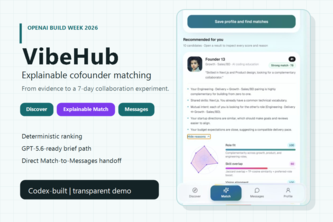
VibeHub is a self-reported social platform for "vibe-coding beginners, AI product creators, and early-stage founders." It aims to help users discover collaboration opportunities, match with potential cofounders or collaborators based on role complementarity and compatibility, and test these matches through short-term experiments powered by GPT-5.6.
What changed
The project description indicates a transition from an initial deterministic matching engine to one that integrates GPT-5.6 for generating structured collaboration briefs after candidate selection. This evolution was introduced during a hackathon context (OpenAI 2026) and includes a clearly labeled fallback mechanism when no valid API key is available.
Single most important open question
Is there evidence of any real-world usage, user feedback, or traction beyond the author’s solo development and demonstration?
What The Product Actually Is
The description states that VibeHub has four modules: Discover, Match, Messages, and Profile. It includes a "Build Week" feature using GPT-5.6 to generate an AI Collaboration Brief based on verified matching signals and bounded profile evidence.
It uses deterministic scoring for ranking candidates but applies GPT-5.6 only after selection to produce structured outputs like:
- Why the match might work
- What could fail
- How to begin conversation
- What to test together in seven days
The system is built with Next.js, React, TypeScript, Tailwind CSS, Prisma, and PostgreSQL (or SQLite for local dev). It integrates OpenAI’s Responses API via a server-side endpoint that can switch between live GPT-5.6 and a deterministic fallback.
Inference This suggests a hybrid architecture where explainability is maintained in the matching process, while AI enhances decision-making post-selection.
Positioning & Claim Evolution
The author positions VibeHub as a "social platform for vibe-coding beginners, AI product creators, and early-stage founders" aiming to bring software entrepreneurship within reach of more people.
It describes itself as part of a broader vision: a "project-based social network for the AI coding era", organized around what people are building, learning, using tools, and needing collaborators for.
The project evolved from a basic idea into a structured product during a hackathon, incorporating GPT-5.6 to improve collaboration workflows rather than replace deterministic matching.
Claim
VibeHub is designed to help solo founders move from discovery to explainable match to real conversation to small collaboration experiment.
Inference The positioning reflects an intent to democratize early-stage startup collaboration by lowering barriers through AI-assisted matching and bounded experimentation.
Target Customer & ICP
The description identifies three primary user groups:
- Vibe-coding beginners
- AI product creators
- Early-stage founders
It also mentions that the platform targets individuals who are "without traditional engineering backgrounds" and want to explore software creation with AI tools.
Claim
The target audience includes people entering AI-enabled entrepreneurship, especially those leaving established career paths.
Inference These users likely lack formal technical training but are interested in prototyping or building projects using AI assistance. They may be students, independent creators, or non-traditional entrepreneurs.
Business Model & Pricing Evidence
No explicit business model or pricing information is provided in the description.
The author mentions a future plan to add:
- Collaboration-outcome feedback
- Evaluation of brief quality against real founder conversations
- More control over shared evidence
- Packaging for iOS and Android
Claim
There is no stated revenue model, monetization strategy, or pricing structure.
Inference Given the lack of any commercial data or user acquisition metrics, it’s unclear whether this will evolve into a paid service or remain a prototype.
Technical & Delivery Signals
The system uses:
- Next.js 14
- React
- TypeScript
- Tailwind CSS
- Prisma ORM
- PostgreSQL (production), SQLite (local)
- GPT-5.6 via OpenAI Responses API
- Codex as primary engineering collaborator during development
It implements a clear trust boundary:
- Deterministic code decides rank
- Authenticated server code determines what evidence may be shared
- GPT-5.6 transforms evidence into collaboration plan
- Client renders only schema-validated fields
The architecture includes:
- A
/api/match/briefendpoint - Strict JSON Schema validation
- Hashed safety identifiers
- Store: false requests
- Mode switching between live and fallback GPT-5.6
Inference This shows a deliberate approach to balancing explainability, security, and AI integration — particularly in how it handles untrusted data inputs.
Traction & Maturity Signals
There is no evidence of:
- Revenue
- Customers
- User base
- Adoption metrics
- Product usage data
The project was built by one person (aluba Lu) over a short period (during a hackathon), and the only demonstration is a hosted demo with a deterministic fallback.
Claim
No traction or maturity indicators are evident beyond author’s solo development and submission to a hackathon.
Inference This is a prototype in early-stage development, likely not yet launched for public use.
Competitive Context
The description does not mention competitors directly. However, it implies a space where:
- AI-powered matching exists
- Social platforms for creators or founders exist
- Collaboration tools are emerging
It positions itself as part of the "AI coding era", suggesting alignment with trends in low-code, no-code, and AI-assisted entrepreneurship.
Inference
VibeHub may compete with or coexist alongside platforms focused on:
- Founder matching (e.g., CoFoundersLab)
- AI collaboration tools (e.g., GitHub Copilot, Cursor)
- Social networks for creators or startups
But no direct comparison or competitive differentiation is made.
Open Questions & Risks
- No real-world usage or feedback — The entire product appears to be a solo-built prototype with no evidence of adoption.
- Unverified claims about AI utility — While GPT-5.6 is used, there’s no data on how effective these briefs actually are in practice.
- Single-person development — The lack of team or external validation raises questions about scalability and long-term viability.
- Limited scope for feedback loops — No mechanism described for collecting or improving upon user outcomes from collaboration experiments.
- Unclear monetization path — No indication of how the platform would generate revenue.
Inference Without traction, customer data, or product-market fit evidence, this remains a speculative concept rather than a proven solution.
Questions the description leaves open
- What specific problems are you solving for users beyond just discovery?
- How do you plan to validate the effectiveness of GPT-5.6-generated collaboration briefs?
- Are there any early adopters or pilot users who have tested the platform?
- What is your roadmap for transitioning from a hackathon prototype to a scalable product?
- Do you have plans to collect and analyze feedback from actual collaboration experiments?
- How will you ensure data privacy and safety in a social platform where people share personal profiles and intentions?
Overall Assessment
Not evidenced
There is no evidence of revenue, customers, traction, or any commercial performance metrics. The project is described as a solo-built hackathon submission with no indication of market validation or product-market fit.
The author states that the platform is being built for "vibe-coding beginners, AI product creators, and early-stage founders", but there is no data to confirm either demand or execution capability beyond one individual’s effort.
Inference This is a speculative idea with potential, but not yet a viable investment or partnership opportunity. Further validation through real users, feedback, and measurable outcomes would be necessary before considering deeper due diligence.
User Stories BotA demo video on every pull request
Get a demo video on every new feature
GitHub App that watches your pull requests and records a narrated, captioned demo.
Save time on demo prep and make informed decisions faster with a video walkthrough of every new feature.
Source
Submitted to the OpenAI 2026 hackathon on Devpost. Project home on Devpost. Back to the full gallery on Devpost.
This competitive analysis was produced by top-founders.com (opens in a new tab)
Generated by a language model from this project's public Devpost page — its tagline, the author's own write-up and any built-with tags listed there — as captured in August 2026. Short quotations are the author's words. It is an opinion on the idea as a business, not on the people behind it, and it reflects the description as published then. If the project has moved on, request a correction below. The analysis is not independent research and contains no verified traction, revenue or customer data.
An independent guide by KFG International LLC — not affiliated with, endorsed by, or connected to Devpost or OpenAI.