

Archive position — measured, not model output
0 likes on Devpost
2,263 of the 7,850 archived projects have more likes, and 5,587 share exactly 0 — so this project's #6,104 place in the like-ranked listing is a tie-break inside that group, not a ranking.
Projects (log scale)
Likes on Devpost. ▲ marks this project's group.
Show the figures
| Likes | Projects | Share of archive |
|---|---|---|
| 0 | 5,587 | 71.2% |
| 1 | 1,758 | 22.4% |
| 2 | 284 | 3.6% |
| 3–4 | 132 | 1.7% |
| 5–9 | 75 | 1.0% |
| 10+ | 14 | 0.2% |
 User Stories BotA demo video on every pull request
Get a demo video on every new feature
GitHub App that watches your pull requests and records a narrated, captioned demo.
Save time on demo prep and make informed decisions faster with a video walkthrough of every new feature.
Executive Summary
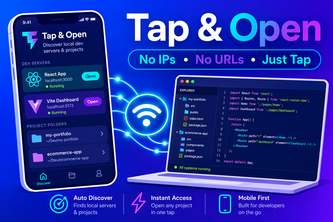
ProjectProbe is a developer tool that enables mobile access to local development environments and project folders without requiring IP addresses or URLs. The author describes it as a solution for developers who want to preview web apps and files on their phones while working from a computer, using only Wi-Fi connectivity.
The product consists of two components: a mobile app (Android first) and a macOS Companion that runs in the menu bar and exposes dev servers and folders via an API. The tool was built entirely with AI assistance (Codex), including the port scanner and Markdown viewer.
Key commercial due-diligence read
The description does not indicate any revenue, customers or adoption — only self-reported claims about a personal problem solved. There is no evidence of product-market fit, pricing, or business traction beyond the author's own experience.
What The Product Actually Is
The description states that ProjectProbe is:
- A mobile app (Android first) that scans local networks to discover dev servers and project folders.
- A macOS Companion app that sits in the menu bar and exposes ports and directories to the phone via a simple API.
- Built with native code, no third-party libraries or dependencies.
- Developed using AI coding tools (Codex), from the port scanner to the Markdown viewer.
The tool allows users to:
- See dev servers listed on their Mac from their phone.
- Tap to open dev servers in mobile Chrome.
- Browse project folders and preview files like Markdown or HTML directly from the phone.
Inference: The product is a cross-platform developer utility that bridges local development environments with mobile access, using minimal configuration and AI-assisted development.
Positioning & Claim Evolution
The author claims ProjectProbe:
- Solves a common pain point for developers — needing to type IP addresses or URLs to preview work on mobile.
- Offers a cable-like experience: plug in (same Wi-Fi), and instantly access everything.
- Is built entirely with AI, including systems programming components like port scanning.
The positioning is:
- A developer productivity tool for local dev environments.
- Positioned as a solution to workflow interruptions during development.
- Framed as a personal tool built by one developer for personal use, not yet commercialized.
Inference: The author positions this as a niche utility for developers who work locally and want seamless mobile access — but there is no evidence of broader market positioning or commercial intent beyond the hackathon submission.
Target Customer & ICP
The description states:
- The tool is built for developers.
- Specifically, it targets those who:
- Work on web apps with dev servers.
- Need to preview work on mobile devices.
- Use local development environments (e.g., Macs running dev servers).
- Want to avoid typing IP addresses or URLs.
There is no mention of:
- Specific roles (e.g., frontend vs backend developers).
- Industry verticals.
- Customer segments beyond "developer".
- Targeted use cases beyond previewing apps and files.
Inference: The ICP appears to be individual developers working in local environments, but no evidence supports a defined customer persona or segment beyond the author’s own experience.
Business Model & Pricing Evidence
The description does not state:
- Any pricing model.
- Revenue streams.
- Monetization strategy.
- Whether it is free, paid, or subscription-based.
- If there are plans to commercialize or monetize the tool.
Inference: No evidence of a business model or pricing structure. The tool appears to be a personal hackathon project with no indication of commercial intent.
Technical & Delivery Signals
The description states:
- Mobile app is built in pure native code, with no third-party libraries.
- macOS Companion runs silently in the menu bar and exposes dev servers via a simple API.
- The entire codebase was built using AI tools (Codex), including complex components like port scanners and HTTP probers.
- The tool uses a multi-phase port scanning strategy to balance speed and accuracy.
There is no mention of:
- Scalability or performance metrics.
- Security or privacy features.
- API documentation or extensibility.
- Integration with other tools or platforms.
Inference: The technical approach is lightweight, AI-assisted, and focused on solving a local dev problem. No evidence of enterprise-grade delivery or scalability.
Traction & Maturity Signals
The description states:
- The tool was built for a hackathon (OpenAI 2026).
- It is currently in active development (Android app).
- The author has no revenue, customers or adoption data.
- It is described as a personal tool, not yet commercialized.
There is no evidence of:
- Users or customer base.
- Adoption metrics.
- Product usage or retention.
- Market feedback or user testing.
Inference: No traction or maturity signals. The project is at the early-stage prototype or hackathon level, with no indication of product-market fit or commercial viability.
Competitive Context
The description does not mention:
- Competitors in the developer tool space.
- Similar tools for local dev access or mobile previewing.
- Market positioning relative to existing solutions.
Inference: No competitive context is provided. The author does not reference any existing tools or market dynamics, making it impossible to assess how ProjectProbe might fit into the broader ecosystem.
Open Questions & Risks
Key risks and open questions based on the description:
- No commercial traction or revenue — only a hackathon submission.
- Single-person team — no evidence of scaling or support structure.
- Unproven market demand — the tool is described as personal, not for a broader audience.
- No pricing or monetization strategy — unclear if it will ever be commercialized.
- Limited scope and maturity — built for one developer’s workflow, not yet tested in production or at scale.
Inference: The project is a prototype with no evidence of product-market fit, scalability, or commercial viability. It may be a useful personal tool but lacks indicators of broader business potential.
Questions the description leaves open
- What specific problem are you trying to solve for developers beyond your own?
- Have you tested this tool with other developers or in real-world use cases?
- Are there any plans to monetize the tool, and if so, what is your pricing model?
- How do you plan to scale beyond a single developer’s workflow?
- What are the security implications of exposing local development environments over Wi-Fi?
- Do you have any feedback or interest from other developers in using this tool?
- Are there plans to support additional platforms (e.g., Windows, Linux) or frameworks?
Overall Assessment
Not evidenced — The description does not provide any information on:
- Revenue or financials.
- Customer base or adoption.
- Market size or competitive landscape.
- Product-market fit or traction.
The tool is described as a personal hackathon project, built by one developer for personal use, with no indication of commercialization or market demand. It is not evident whether this has any investment or partnership potential beyond the author’s own experience.
Inference: Based on the self-reported description alone, there is no evidence to support a commercial due-diligence case for investment or partnership. The project is at an early stage and lacks key signals of viability or traction.
User Stories BotA demo video on every pull request
Get a demo video on every new feature
GitHub App that watches your pull requests and records a narrated, captioned demo.
Save time on demo prep and make informed decisions faster with a video walkthrough of every new feature.
Source
Submitted to the OpenAI 2026 hackathon on Devpost. Project home on Devpost. Back to the full gallery on Devpost.
This competitive analysis was produced by top-founders.com (opens in a new tab)
Generated by a language model from this project's public Devpost page — its tagline, the author's own write-up and any built-with tags listed there — as captured in August 2026. Short quotations are the author's words. It is an opinion on the idea as a business, not on the people behind it, and it reflects the description as published then. If the project has moved on, request a correction below. The analysis is not independent research and contains no verified traction, revenue or customer data.
An independent guide by KFG International LLC — not affiliated with, endorsed by, or connected to Devpost or OpenAI.