

Archive position — measured, not model output
1 like on Devpost
505 of the 7,850 archived projects have more likes, and 1,758 share exactly 1 — so this project's #2,179 place in the like-ranked listing is a tie-break inside that group, not a ranking.
Projects (log scale)
Likes on Devpost. ▲ marks this project's group.
Show the figures
| Likes | Projects | Share of archive |
|---|---|---|
| 0 | 5,587 | 71.2% |
| 1 | 1,758 | 22.4% |
| 2 | 284 | 3.6% |
| 3–4 | 132 | 1.7% |
| 5–9 | 75 | 1.0% |
| 10+ | 14 | 0.2% |
 User Stories BotA demo video on every pull request
Get a demo video on every new feature
GitHub App that watches your pull requests and records a narrated, captioned demo.
Save time on demo prep and make informed decisions faster with a video walkthrough of every new feature.
Executive Summary
What the company appears to be
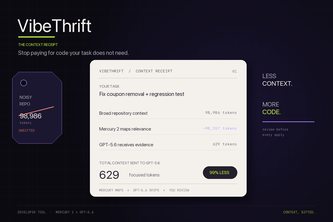
VibeThrift is a self-reported developer tool that aims to make AI coding more context-efficient by using two distinct AI components: Mercury 2 for repository investigation and GPT-5.6 for implementation planning. It operates as a VS Code/Cursor extension, CLI, and dashboard with the goal of reducing token usage for AI models while maintaining transparency and developer control.
What changed
The project description indicates an evolution from conceptual idea to a working prototype including a VS Code extension, CLI, and interactive dashboard. The author states they built it using Codex and GPT-5.6 as development collaborators, and that the tool supports end-to-end workflows from task prompt to repository mapping, focused evidence creation, and native diff review.
Single most important open question
Is there any evidence of actual usage or adoption by developers beyond the author’s own development work?
What The Product Actually Is
The description states that VibeThrift is a VS Code and Cursor developer tool designed to make AI coding more context-efficient, transparent, and reviewable. It uses:
- Mercury 2 as a broad-context investigator.
- GPT-5.6 as the final reasoning model.
- A workflow involving:
- Describing a coding task in the VibeThrift chat.
- Mapping repository context.
- Creating a compact context memo via Mercury 2.
- Generating an implementation plan with GPT-5.6.
- Reviewing native diffs before applying changes.
- Inspecting token estimates and usage.
It includes:
- A VS Code/Cursor extension for the main workflow.
- A Node.js orchestration layer that maps repository files, filters low-value or sensitive files, and creates focused evidence packets.
- A CLI and dashboard for inspecting forecasting logic and demonstrating workflows.
The tool is described as having three connected surfaces: the extension, the orchestration layer, and the CLI/dashboard.
Positioning & Claim Evolution
The author positions VibeThrift as a smart thrift store for coding context, aiming to avoid sending entire repositories to AI models. The name and metaphor suggest that it selectively filters out irrelevant files and dependencies, keeping only what is useful.
Key claims:
- VibeThrift reduces GPT input tokens from ~99,000 (broad context) to ~629 (focused), a claimed ~99% reduction.
- It makes token and cost trade-offs visible per task.
- It keeps developer control through review and approval steps.
- It separates list-price forecasts from provider-reported usage.
- It warns when context is truncated and reports omitted files.
The positioning evolves from a simple idea ("What if an AI coding assistant could inspect a large repository without forcing the final reasoning model to read the entire thing?") to a full product with:
- A working extension.
- An end-to-end workflow.
- Developer experience considerations (e.g., no need to leave editor).
- Cost transparency and context relevance reporting.
Target Customer & ICP
The description states that VibeThrift is built for developers using VS Code or Cursor, particularly those working with large repositories where AI tools often pull in irrelevant context. It targets users who want:
- More efficient AI coding workflows.
- Transparent cost tracking.
- Control over what context is sent to models.
- Reviewability of proposed changes.
There is no explicit mention of enterprise customers or specific verticals beyond developer tooling. The ICP appears to be individual developers or small teams working in large codebases, though this is inferred from the use case rather than stated directly.
Business Model & Pricing Evidence
Not evidenced.
The description does not contain any information about:
- Revenue streams.
- Pricing models.
- Monetization strategy.
- Customer acquisition costs.
- Subscription tiers or usage-based pricing.
No commercial details are provided beyond the self-reported tool functionality.
Technical & Delivery Signals
The author reports building VibeThrift with:
- Codex and GPT-5.6 as core development collaborators.
- Mercury 2 for repository investigation.
- A VS Code/Cursor extension, Node.js orchestration layer, and a CLI/dashboard.
Technical components include:
- Context filtering (secrets, lockfiles, dependencies, generated assets).
- Native diff review.
- Token estimation and cost forecasting.
- SecretStorage for provider keys.
- Persistent chats for related work.
- Truncation warnings and omitted-file reporting.
The system is described as separating the roles of Mercury 2 (investigation) and GPT-5.6 (reasoning), with explicit controls over context input to the final model.
Traction & Maturity Signals
Not evidenced.
There is no mention of:
- Customers or users.
- Revenue or monetization.
- Product adoption metrics.
- Customer feedback or testimonials.
- Market traction or growth indicators.
The project is described as a working prototype, but there is no evidence of real-world usage or impact beyond the author’s own development.
Competitive Context
Not evidenced.
There is no mention of:
- Competitors.
- Market positioning relative to other AI coding tools.
- Differentiation from existing solutions.
- Industry trends or competitive dynamics.
The description does not place VibeThrift within a broader marketplace context.
Open Questions & Risks
Inferences based on self-reported claims:
- Unverified Performance Claims: The 99% token reduction is presented as a demo result, but there is no evidence that this performance holds across real-world repositories or use cases.
- Single Developer Team: With only one team member (Prithvi Haran), the risk of limited scalability and lack of product-market fit validation is high.
- No Commercial Evidence: No revenue, customers, or traction data are provided — all claims are self-reported.
- Unproven Developer Adoption: While a working prototype exists, there is no evidence that developers actually adopt or use it beyond the author’s own workflow.
- Dependency on Unverified Models: The tool relies heavily on Mercury 2 and GPT-5.6, which are not independently verified for performance or availability.
Questions the description leaves open
- What is your actual usage data or feedback from developers who have tried the tool?
- How do you plan to validate the token reduction claims across different types of repositories?
- Are there any known limitations in how Mercury 2 handles large or complex codebases?
- What are the current challenges in scaling this beyond a single developer’s workflow?
- Do you have plans for integrating with CI/CD pipelines or team-level analytics?
- How do you intend to monetize the tool, and what is your go-to-market strategy?
- What are the key assumptions behind your cost forecasting logic?
Overall Assessment
Not evidenced.
There is no information available regarding:
- Valuation.
- Funding history.
- Strategic partnerships.
- Market opportunity size.
- Financial projections or business model viability.
This analysis is based entirely on a self-reported project description. The tool appears to be a conceptual prototype with a working implementation, but there is no evidence of traction, revenue, or commercial viability. Any investment or partnership decision would require further due diligence into actual usage, market demand, and scalability.
User Stories BotA demo video on every pull request
Get a demo video on every new feature
GitHub App that watches your pull requests and records a narrated, captioned demo.
Save time on demo prep and make informed decisions faster with a video walkthrough of every new feature.
Source
Submitted to the OpenAI 2026 hackathon on Devpost. Project home on Devpost. Back to the full gallery on Devpost.
This competitive analysis was produced by top-founders.com (opens in a new tab)
Generated by a language model from this project's public Devpost page — its tagline, the author's own write-up and any built-with tags listed there — as captured in August 2026. Short quotations are the author's words. It is an opinion on the idea as a business, not on the people behind it, and it reflects the description as published then. If the project has moved on, request a correction below. The analysis is not independent research and contains no verified traction, revenue or customer data.
An independent guide by KFG International LLC — not affiliated with, endorsed by, or connected to Devpost or OpenAI.