

Archive position — measured, not model output
0 likes on Devpost
2,263 of the 7,850 archived projects have more likes, and 5,587 share exactly 0 — so this project's #4,142 place in the like-ranked listing is a tie-break inside that group, not a ranking.
Projects (log scale)
Likes on Devpost. ▲ marks this project's group.
Show the figures
| Likes | Projects | Share of archive |
|---|---|---|
| 0 | 5,587 | 71.2% |
| 1 | 1,758 | 22.4% |
| 2 | 284 | 3.6% |
| 3–4 | 132 | 1.7% |
| 5–9 | 75 | 1.0% |
| 10+ | 14 | 0.2% |
 User Stories BotA demo video on every pull request
Get a demo video on every new feature
GitHub App that watches your pull requests and records a narrated, captioned demo.
Save time on demo prep and make informed decisions faster with a video walkthrough of every new feature.
Executive Summary
What the company appears to be
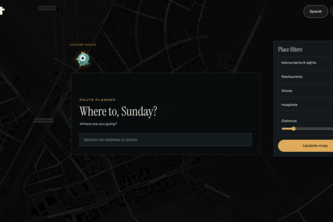
Flit is a voice-first navigation companion built as a web application, designed to provide contextual, guided experiences during travel by narrating nearby landmarks and places along a user’s route.
What changed
The project was submitted to the OpenAI 2026 hackathon. It represents an early-stage prototype or proof-of-concept with no evidence of commercial traction or revenue.
Single most important open question
Is there any indication that Flit has begun to attract users, generate revenue, or scale beyond a single developer’s hackathon effort?
What The Product Actually Is
The description states that Flit is a voice-first route companion, built using React, Tailwind CSS, Leaflet.js, and Cloudflare Workers. It uses Google Places for destination autocomplete and place discovery, and Gemini for route assistant capabilities.
It allows users to:
- Plan routes from their current location to a chosen destination.
- Navigate via driving, walking, or simulation.
- Receive voice narration of nearby places (landmarks, restaurants, stores, hospitals).
- Ask follow-up questions about those places.
- Use natural voice commands and interruptions.
- View an interactive map with place indicators.
The system supports text-to-speech using ElevenLabs or Google, and transcription via ElevenLabs or Groq. It caches audio and place data in Cloudflare D1 and R2 to reduce API usage.
Inference The product is a web-based application that integrates mapping, voice interaction, and AI-driven place discovery — likely intended for mobile or desktop use.
Positioning & Claim Evolution
The author states that Flit solves the gap between traditional maps (which tell where to turn) and what is around you. It positions itself as a voice-first route companion that turns navigation into a guided experience.
It claims to:
- Offer a personal, informative, and accessible journey.
- Support natural voice commands and interruptions.
- Provide contextual conversation that remembers recent exchanges.
- Deliver route-aware place discovery, showing photos and details.
- Enable grounded chat about places on the active route.
Inference The positioning is focused on enhancing the travel experience through AI-guided, conversational navigation — not just a tool for directions but for storytelling and engagement with the environment.
Target Customer & ICP
The description does not clearly define a target customer or ideal customer profile (ICP). It implies that Flit is intended for users who:
- Navigate regularly.
- Want more than basic directions.
- Prefer voice interaction over text or visual interfaces.
- Are interested in exploring places along their route.
Inference The likely ICP includes travelers, tourists, commuters, and explorers who value contextual information during movement. However, no segmentation or persona data is provided.
Business Model & Pricing Evidence
There is no evidence of a business model or pricing strategy in the description. No mention of monetization, subscriptions, freemium tiers, or paid features.
Inference The project appears to be an early-stage prototype with no commercial implementation yet.
Technical & Delivery Signals
The project was built using:
- Frontend: React, React Router 7, Tailwind CSS, Leaflet.js
- Backend: Cloudflare Workers, D1 (SQLite), R2 (object storage)
- AI/ML Tools: Codex, Gemini, Google Places API, Google Routes API
- Voice Tech: ElevenLabs and Groq for TTS and transcription
It includes:
- Voice interruption handling.
- Route-aware place discovery.
- Contextual chat with conversation history.
- Cached audio and place summaries.
- Persistent route history.
Inference The technical stack suggests a modern, serverless approach using cloud infrastructure. The voice UX is described as complex, indicating attention to user experience design.
Traction & Maturity Signals
There is no evidence of traction or maturity beyond the hackathon submission:
- No customer base.
- No revenue data.
- No product usage metrics.
- No public launch or marketing efforts.
- No funding rounds or investor interest mentioned.
The project is described as a hackathon submission, and no further development or deployment details are given.
Inference This is an early-stage prototype, likely not yet in production or used by real users.
Competitive Context
The description does not mention competitors. However, based on the stated functionality:
- It overlaps with navigation apps like Google Maps, Apple Maps, Waze.
- It introduces a voice-first, AI-guided experience that could differentiate from standard map tools.
- It may compete with niche travel guides or voice assistants focused on local exploration.
Inference There is no clear competitive analysis in the description. The product’s differentiation lies in its voice-first interface and contextual narration, but it lacks evidence of market positioning or competitive response.
Open Questions & Risks
- No commercial traction: The project is a hackathon submission with no signs of adoption.
- Unproven user engagement: No data on how many users interacted with the prototype.
- Limited scalability assumptions: The tech stack suggests a small-scale MVP, not a scalable SaaS product.
- Voice UX complexity: While noted as a challenge, it is unclear if this was fully resolved or tested in real-world conditions.
- No monetization strategy: No indication of how revenue will be generated.
Inference The project lacks commercial viability indicators and may not have progressed beyond concept stage.
Questions the description leaves open
- What is the intended user base for Flit, and how did you identify them?
- How do you plan to monetize this product if it remains free or low-cost today?
- Have you conducted any user testing or gathered feedback on voice interaction?
- Is there a roadmap beyond the hackathon prototype?
- What are your plans for scaling the AI assistant and place discovery features?
- Are there any partnerships or integrations with mapping, travel, or voice service providers?
Overall Assessment
Not evidenced.
There is no evidence of revenue, customers, traction, or a clear business model to support an investment or partnership decision.
The project is described as a hackathon submission, and the author states that it is not independently verified.
Confidence level Low — this is a self-reported prototype with no commercial signals.
User Stories BotA demo video on every pull request
Get a demo video on every new feature
GitHub App that watches your pull requests and records a narrated, captioned demo.
Save time on demo prep and make informed decisions faster with a video walkthrough of every new feature.
Source
Submitted to the OpenAI 2026 hackathon on Devpost. Project home on Devpost. Back to the full gallery on Devpost.
This competitive analysis was produced by top-founders.com (opens in a new tab)
Generated by a language model from this project's public Devpost page — its tagline, the author's own write-up and any built-with tags listed there — as captured in August 2026. Short quotations are the author's words. It is an opinion on the idea as a business, not on the people behind it, and it reflects the description as published then. If the project has moved on, request a correction below. The analysis is not independent research and contains no verified traction, revenue or customer data.
An independent guide by KFG International LLC — not affiliated with, endorsed by, or connected to Devpost or OpenAI.