

Archive position — measured, not model output
0 likes on Devpost
2,263 of the 7,850 archived projects have more likes, and 5,587 share exactly 0 — so this project's #4,144 place in the like-ranked listing is a tie-break inside that group, not a ranking.
Projects (log scale)
Likes on Devpost. ▲ marks this project's group.
Show the figures
| Likes | Projects | Share of archive |
|---|---|---|
| 0 | 5,587 | 71.2% |
| 1 | 1,758 | 22.4% |
| 2 | 284 | 3.6% |
| 3–4 | 132 | 1.7% |
| 5–9 | 75 | 1.0% |
| 10+ | 14 | 0.2% |
 User Stories BotA demo video on every pull request
Get a demo video on every new feature
GitHub App that watches your pull requests and records a narrated, captioned demo.
Save time on demo prep and make informed decisions faster with a video walkthrough of every new feature.
Executive Summary
What the company appears to be
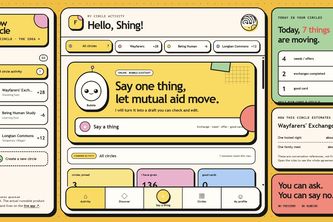
Flow Circle is a self-reported social platform designed to help people form and manage small, trust-based communities (called "circles") where members can ask for help, offer support, and record exchanges using a system of mutual credit and care badges. It is described as an experiment in non-consumption, direct exchange, and community-building.
What changed
The project was submitted to the OpenAI 2026 hackathon by a single founder (Query Zoe), who describes it as a prototype built with GPT-5.6 in Codex. There is no evidence of prior development, funding, or product launch beyond this submission.
The single most important open question
Does Flow Circle have real-world traction or usage patterns that suggest a viable market need, or is it still an untested concept?
Note: This analysis is based entirely on the self-reported description provided by the author. No independent verification, revenue data, customer base, or product performance metrics are available.
What The Product Actually Is
The description states that Flow Circle is a system for creating and managing small social groups ("circles") where people can post needs or offers in one sentence, record completed exchanges via mutual credit, and award care badges to recognize acts of support. It does not replace existing relationships but aims to make invisible labor visible and facilitate trust-building within defined community boundaries.
- Circles are described as small social groups with shared rules and contexts (e.g., traveling exchange circle, study circle).
- Needs and offers are posted as one-sentence invitations to conversation; they do not constitute contracts.
- Mutual credit records completed exchanges without creating personal debt or scoring systems.
- Care badges commemorate appreciation without payment or obligation.
The author states that the product was prototyped using GPT-5.6 in Codex and deployed as a static English demo for testing and storytelling.
Positioning & Claim Evolution
The author positions Flow Circle as an experiment in "non-consumption" — swapping instead of buying, creating rather than consuming — and emphasizes its role in making invisible labor visible while avoiding commodification or ranking.
- The project is framed as a “Don’t Do It Yourself” approach to exchange.
- It seeks to avoid turning care into piecework or personal debt.
- The goal is not to replace existing relationships but to enhance them through visibility and trust mechanisms.
- There is no mention of monetization, scalability, or commercial intent beyond initial testing.
These claims are self-reported and unverified. They reflect the author’s stated values and intentions rather than evidence of traction or adoption.
Target Customer & ICP
The description does not name specific customer segments or personas. However, it implies that Flow Circle targets individuals involved in informal economies, community-building efforts, or collaborative living situations.
- Circles are described as being formed around contexts like hosting, cooking, local knowledge, co-learning, and shared work.
- The author mentions testing with existing circles she is part of, including a co-learning community and an offline community where she lives long-term.
- There is no indication of any formal targeting strategy or segmentation beyond personal networks.
Not evidenced: No explicit customer profile, target market size, or ICP defined by the author.
Business Model & Pricing Evidence
There is no evidence of pricing, monetization, or business model in the description.
- The system is described as not involving payment or debt.
- Mutual credit is said to be used for tracking contributions and receipts within a circle.
- Care badges are described as commemorative, not financial.
- No revenue streams, subscriptions, or fees are mentioned.
Not evidenced: No indication of how Flow Circle intends to generate value or sustain itself financially.
Technical & Delivery Signals
The author reports that the product was built using Codex and GPT-5.6, with research conducted through interviews and case studies.
- A static English demo was deployed for testing and storytelling.
- Visual language and interaction prototypes were developed.
- No mention of technical architecture, scalability, or infrastructure beyond a prototype.
Inferred: The project is in early-stage development, likely a proof-of-concept or hackathon prototype. No production-ready system is evident.
Traction & Maturity Signals
There is no evidence of traction, adoption, or user engagement beyond the author’s own testing and storytelling.
- The author states that she is recruiting an initial group to test whether Flow Circle works in real life.
- Testing will occur across three contexts: her personal circles, a co-learning community, and her local offline community.
- The main question is whether people will actually use it — not whether the interface works.
- No data on usage, retention, or feedback from users is provided.
Not evidenced: No signs of product-market fit, user base, or real-world performance.
Competitive Context
The description does not reference competitors or existing platforms in this space.
- The author mentions researching "existing community-currency models" but does not name them.
- No comparison with other tools for peer-to-peer exchange, mutual aid, or community coordination is made.
Not evidenced: No competitive landscape or differentiation strategy described.
Open Questions & Risks
Several key risks and open questions emerge from the lack of evidence:
- No traction or validation: The project has not yet been tested in real-world conditions beyond a prototype.
- Unproven demand: The author explicitly states that the main question is whether people will actually use it — suggesting uncertainty about market need.
- Single-founder model: Only one team member (Query Zoe) is mentioned, raising questions about execution capacity.
- Unclear path to scale or monetization: No business model or growth strategy is evident.
- Prototype-only status: The system exists only as a static demo and has not been iterated with real users.
Inferred: Without real-world usage or feedback, the viability of Flow Circle remains unproven.
Questions the description leaves open
- What specific problems are you trying to solve in your test communities?
- How do you plan to measure success beyond user feedback during testing?
- Have you identified any potential barriers to adoption or trust-building in these circles?
- What are the key assumptions about behavior and community dynamics that underpin Flow Circle?
- Are there any existing tools or platforms that already address similar needs, and how does Flow Circle differ?
- How do you intend to evolve the system based on user input during testing?
Overall Assessment
At this stage, Flow Circle is a self-reported concept in early development, built as a hackathon prototype with no evidence of traction or commercial viability.
- It is not yet a product with users or revenue.
- The author’s stated goals are aligned with community-building and non-consumption practices, but there is no indication that these align with scalable market demand.
- There is no funding history, team expansion, or product iteration beyond the demo.
Assessment: Not ready for investment or partnership. This is a concept in early testing phase — not a business yet. Further validation through real-world use and feedback is required before assessing its potential.
User Stories BotA demo video on every pull request
Get a demo video on every new feature
GitHub App that watches your pull requests and records a narrated, captioned demo.
Save time on demo prep and make informed decisions faster with a video walkthrough of every new feature.
Source
Submitted to the OpenAI 2026 hackathon on Devpost. Project home on Devpost. Back to the full gallery on Devpost.
This competitive analysis was produced by top-founders.com (opens in a new tab)
Generated by a language model from this project's public Devpost page — its tagline, the author's own write-up and any built-with tags listed there — as captured in August 2026. Short quotations are the author's words. It is an opinion on the idea as a business, not on the people behind it, and it reflects the description as published then. If the project has moved on, request a correction below. The analysis is not independent research and contains no verified traction, revenue or customer data.
An independent guide by KFG International LLC — not affiliated with, endorsed by, or connected to Devpost or OpenAI.