

Archive position — measured, not model output
0 likes on Devpost
2,263 of the 7,850 archived projects have more likes, and 5,587 share exactly 0 — so this project's #4,145 place in the like-ranked listing is a tie-break inside that group, not a ranking.
Projects (log scale)
Likes on Devpost. ▲ marks this project's group.
Show the figures
| Likes | Projects | Share of archive |
|---|---|---|
| 0 | 5,587 | 71.2% |
| 1 | 1,758 | 22.4% |
| 2 | 284 | 3.6% |
| 3–4 | 132 | 1.7% |
| 5–9 | 75 | 1.0% |
| 10+ | 14 | 0.2% |
 User Stories BotA demo video on every pull request
Get a demo video on every new feature
GitHub App that watches your pull requests and records a narrated, captioned demo.
Save time on demo prep and make informed decisions faster with a video walkthrough of every new feature.
Executive Summary
What the company appears to be
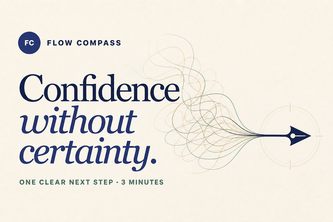
Flow Compass is an AI-powered decision-support companion designed for individuals facing complex personal or professional decisions. The product claims to help users move from mental pressure to one reality-aware next step in about three minutes, using a structured conversation process that includes topic selection, situation description, focused questioning, and a final plan.
What changed
The project evolved from an idea rooted in productivity fatigue and the limitations of traditional task management tools into a deployed private beta application. It was built as part of a hackathon submission and is currently live on Cloudflare Workers with Supabase integration.
Single most important open question
Does Flow Compass actually help users make better decisions or simply provide a structured way to avoid difficult choices? The author states this is a tool for clarity, not authority, but there is no evidence of user behavior data or outcome validation beyond informal feedback from a small group.
What The Product Actually Is
The description states that Flow Compass is an AI decision-reflection companion. It is described as:
- An application built with Next.js 16, React 19, and TypeScript.
- Using OpenAI Responses API with gpt-5.6-terra model.
- Deployed on Cloudflare Workers through OpenNext.
- Connected to Supabase for authentication and Postgres persistence.
- Utilizing Zod-backed Structured Outputs to validate responses.
- Designed to run a short conversation process involving:
- Topic selection (Work, business, life direction, relationships, etc.)
- Situation description
- Focused questions (limited to one or two)
- Final structured plan including action, boundary, what to set aside, and when to review
The system is said to examine four things: present response, outside/internal pressure, real-world constraints, and available capacity. It chooses among six internal decision routes:
- Move now
- Test something small
- Change the way
- Use a temporary bridge
- Pause for clarity
- Recommend deeper human support
It also includes optional Human Design profile information that influences question selection but does not predict outcomes or dictate actions.
Confidence High — based on detailed technical and process description, though no actual user data or performance metrics are provided.
Positioning & Claim Evolution
The author states that Flow Compass began as a response to the problem of productivity becoming part of the issue itself. It was inspired by the tension between ambition and overwhelm, where tools for organization fail to address deeper questions about energy allocation and decision-making.
Positioning claims:
- Not an oracle or another task manager.
- A calm companion that helps someone move from pressure to one honest next step.
- Designed to turn mental noise into actionable clarity without taking the decision away from the user.
- Intended to be a “next-step” tool, not a long-term solution or dependency.
The evolution of the claim appears to have moved from conceptual idea to functional prototype. The author notes that early versions were unclear about how to begin and required redesigning the onboarding experience to show the process before asking for input.
Confidence Medium — claims are self-reported and lack external validation or historical data showing how positioning has shifted over time.
Target Customer & ICP
The description states that Flow Compass targets people whose minds are busy with work, business, and life-direction decisions. These users are described as:
- Carrying too many responsibilities
- Facing ambitious goals and opportunities that all look valuable
- Struggling with the question: “With everything that matters, what should I give my energy to next?”
- Working adults dealing with work, business, or life-direction questions
There is no explicit segmentation beyond this general audience. The optional Human Design integration suggests a possible niche targeting users interested in personality frameworks, but it's not presented as core to the product.
Confidence Low — no evidence of customer personas, segmentation, or specific buyer profiles.
Business Model & Pricing Evidence
The description does not mention any business model or pricing structure. It indicates that:
- There is a private beta version available for signed-in users.
- Users can save plans, return to history, and add reflections.
- There is an option to correct interpretation once or request one revision.
- The public read-only demo shows the complete path without starting an AI call or saving any data.
No information is provided about monetization, subscription tiers, freemium models, or revenue streams.
Confidence Very low — no evidence of business model or pricing strategy.
Technical & Delivery Signals
The application is built using:
- Next.js 16
- React 19
- TypeScript
- OpenAI Responses API with gpt-5.6-terra
- Supabase for authentication and Postgres persistence
- Cloudflare Workers via OpenNext
- Zod-backed Structured Outputs
- A strict schema for conversation turns and final plans
Key technical features include:
- Model responses must match application schema.
- Additional checks for question count, agency, plain wording, and required plan fields.
- If a response fails, the server gives one constrained repair attempt.
- OpenAI requests use store: false — no API keys exposed to browser.
- Session tokens carry conversation counters and are server-verified.
- Payload limits, question budget, one interpretation correction, one plan revision, private-beta access, and rate limiting enforced.
The system uses versioned JSON rules instead of vector databases for knowledge base, making it easier to inspect, test, and change during MVP phase.
Confidence High — detailed technical architecture provided, though no evidence of scalability or production usage beyond MVP.
Traction & Maturity Signals
The description states that Flow Compass is currently in private beta and has been deployed end-to-end. It includes:
- A functional sign-in system
- Ability to start a fresh decision
- Topic selection and situation description
- Structured plan generation
- History saving and reflection addition
- Correction and revision capabilities
User testing involved informal feedback from about seven people, mostly working adults. Nearly everyone who reported back said the process helped them feel clearer, and roughly half told the author they had taken the suggested next step.
However, there is no evidence of:
- Revenue or monetization
- Customer acquisition or retention metrics
- Product usage statistics
- Formal A/B testing or performance tracking
Confidence Low — only anecdotal feedback from small sample size; no measurable traction or maturity indicators.
Competitive Context
The description does not provide any information about competitors or competitive positioning. It does not reference similar products, market gaps, or how Flow Compass differentiates from existing tools in the AI decision-support space.
Confidence Very low — no evidence of competitive analysis or awareness of existing solutions.
Open Questions & Risks
Several potential risks and open questions are implied by the description:
- Lack of User Behavior Validation: The author notes that user feedback was informal, with only seven testers involved. No formal metrics or outcome tracking exist.
- Overreliance on AI Interpretation Without Oversight: While the system validates outputs, it still relies heavily on AI interpretation for decision-making.
- Unclear Value Proposition: The product aims to provide clarity without authority, but this may not resonate with users who expect direct guidance.
- Limited Scalability: The current architecture uses versioned JSON rules rather than vector databases, which could limit scalability or adaptability.
- No Revenue Model: No indication of how the product will generate revenue or sustain itself beyond its current private beta phase.
- Potential for Misuse or Misinterpretation: The system is designed to avoid deterministic claims, but there's a risk that users might misinterpret the output or rely too heavily on it.
Confidence Medium — these are inferred risks based on the lack of evidence around traction, validation, and business sustainability.
Questions the description leaves open
- What specific user behaviors have you observed in your informal testing? How do those behaviors align with the stated goals?
- Can you explain how the six internal decision routes are selected and what criteria guide their application?
- How does the system handle edge cases or situations where the AI-generated plan conflicts with user intent or known constraints?
- What is the current roadmap for scaling beyond the private beta, including potential monetization strategies?
- Are there any plans to integrate external data sources or APIs that could enhance decision-making accuracy?
- How do you ensure consistent quality and safety across different types of inputs and user profiles?
- Has the team considered how to measure success beyond user-reported feelings of clarity?
Overall Assessment
Assessment Not ready for investment or partnership at this stage.
Reasoning
- The product is in early-stage private beta with no validated traction or revenue.
- There is no clear business model or pricing strategy.
- Limited evidence of user behavior validation beyond a small informal sample.
- No competitive analysis or market positioning data.
- The system appears to be built primarily for personal use rather than enterprise or mass adoption.
While the concept shows promise and the technical implementation is well-documented, there is insufficient evidence to support a commercial due-diligence read. The author's claims about impact and utility remain unproven without measurable outcomes or scalable infrastructure.
Confidence Low — this conclusion is based on lack of evidence rather than negative findings.
User Stories BotA demo video on every pull request
Get a demo video on every new feature
GitHub App that watches your pull requests and records a narrated, captioned demo.
Save time on demo prep and make informed decisions faster with a video walkthrough of every new feature.
Source
Submitted to the OpenAI 2026 hackathon on Devpost. Project home on Devpost. Back to the full gallery on Devpost.
This competitive analysis was produced by top-founders.com (opens in a new tab)
Generated by a language model from this project's public Devpost page — its tagline, the author's own write-up and any built-with tags listed there — as captured in August 2026. Short quotations are the author's words. It is an opinion on the idea as a business, not on the people behind it, and it reflects the description as published then. If the project has moved on, request a correction below. The analysis is not independent research and contains no verified traction, revenue or customer data.
An independent guide by KFG International LLC — not affiliated with, endorsed by, or connected to Devpost or OpenAI.