

Archive position — measured, not model output
3 likes on Devpost
128 of the 7,850 archived projects have more likes, and 93 share exactly 3 — so this project's #220 place in the like-ranked listing is a tie-break inside that group, not a ranking.
Projects (log scale)
Likes on Devpost. ▲ marks this project's group.
Show the figures
| Likes | Projects | Share of archive |
|---|---|---|
| 0 | 5,587 | 71.2% |
| 1 | 1,758 | 22.4% |
| 2 | 284 | 3.6% |
| 3–4 | 132 | 1.7% |
| 5–9 | 75 | 1.0% |
| 10+ | 14 | 0.2% |
 User Stories BotA demo video on every pull request
Get a demo video on every new feature
GitHub App that watches your pull requests and records a narrated, captioned demo.
Save time on demo prep and make informed decisions faster with a video walkthrough of every new feature.
Executive Summary
What the company appears to be
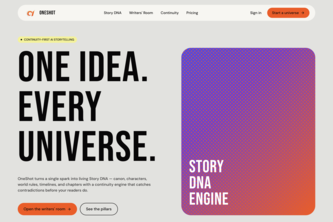
Zero - OneshotAi is an AI-powered storytelling platform that transforms a single creative idea into a structured, expandable fictional universe. The platform claims to generate "Story DNA" — including loglines, themes, characters, world-building elements, and timelines — from one seed input. It is built as a web application using Supabase for backend infrastructure and OpenAI tools for AI generation.
What changed
This project was submitted to the OpenAI 2026 hackathon by a team of four developers. The description indicates it was developed over a short timeframe (likely a hackathon) with no evidence of prior traction, revenue or customers.
Single most important open question
Is there any evidence that this product has moved beyond an experimental prototype to a functional, scalable platform with real user engagement or usage?
What The Product Actually Is
The description states that Zero - OneshotAi is a web-based storytelling tool that allows creators to enter a single idea and receive structured output in the form of "Story DNA". This includes:
- Logline
- Core themes
- Characters and their roles
- World-building elements
- Timeline events
- Initial story bible
The platform uses AI to generate these components from a seed input, storing them in a database for future expansion. It also supports authentication and row-level security to protect user-owned data.
Evidence
- The author states: “After signing in, each creator enters a protected dashboard where they can manage existing universes or select New universe.”
- The author describes how the AI engine generates structured Story DNA including logline, themes, characters, world-building elements, timeline events, and story bible.
- The platform uses Supabase for backend functions including authentication, database storage, and edge functions for AI workflows.
Inference The product appears to be a prototype or MVP built for a hackathon, not yet validated in production use.
Positioning & Claim Evolution
The project positions itself as an AI-powered tool that helps creators move from one idea to a complete fictional universe. It emphasizes:
- One-shot generation of structured content
- Persistence and reusability of generated data
- Consistency across evolving narratives
- A creative operating system for long-term story development
It also claims to be built with OpenAI tools, including logo creation.
Evidence
- The tagline: “One seed becomes a full story universe, characters, world rules, timeline, story bible that remembers itself and never contradicts itself as it grows.”
- The author states: “Instead of returning only raw text, the platform produces organized and reusable story data that can support future characters, scenes, plots, and connected stories.”
- The author mentions using OpenAI for both product development and visual identity.
Inference The positioning is aspirational — aiming to become a creative operating system. However, no evidence of actual adoption or market traction exists.
Target Customer & ICP
The target customer appears to be creative professionals, such as writers, game designers, novelists, or content creators who are interested in building detailed fictional worlds and narratives.
Evidence
- The author states: “Stories often begin with one exciting idea, but turning that idea into a complete fictional universe is difficult.”
- The platform aims to help creators manage complex narrative structures like characters, relationships, timelines, and themes.
Inference No specific ICP or segmentation data is provided. The description implies a broad audience of storytellers without identifying a core persona or use case.
Business Model & Pricing Evidence
There is no evidence in the description of any pricing model, monetization strategy, or business model.
Evidence
- No mention of subscriptions, freemium tiers, pay-per-use, or enterprise licensing.
- No indication of revenue streams or customer acquisition costs.
Inference The project is currently a hackathon submission with no commercial structure evident.
Technical & Delivery Signals
The platform was built using:
- Frontend: React, Tailwind CSS, Vite
- Backend: Supabase (authentication, database, edge functions)
- AI tools: OpenAI GPT models, Codex
- Infrastructure: Serverless architecture
It includes features like secure sign-in, row-level security, asynchronous generation workflows, and structured data output.
Evidence
- The author lists technologies used: “Built with (author-declared): ai-storytelling, authentication, codex, creative-tools, database, full-stack-development, generative-ai, gpt-5.6, lovable, openai, postgresql, react, row-level-security, serverless, story-generation, storybible, structured-outputs, supabase, supabase-auth, supabase-edge-functions, tailwind-css, typescript, vite, web-application, worldbuilding”
- The author describes how the AI workflow integrates with Supabase for secure data handling.
Inference The technical stack suggests a modern, scalable approach but lacks evidence of production deployment or performance metrics.
Traction & Maturity Signals
There is no evidence of traction, revenue, customers, or product adoption beyond the hackathon submission.
Evidence
- The project was submitted to a hackathon.
- No mention of active users, signups, or usage statistics.
- No evidence of monetization or business development activities.
Inference This is an experimental prototype with no demonstrated market traction or maturity.
Competitive Context
The description does not provide any information about competitors or the competitive landscape.
Evidence
- No mention of existing tools or platforms in the AI storytelling space.
- No comparison to other worldbuilding or creative writing tools.
Inference Without external context, it is unclear whether this product addresses a gap or overlaps with existing solutions.
Open Questions & Risks
Several key risks and open questions emerge from the self-reported description:
- No commercial viability: The platform has no evidence of revenue, pricing, or monetization.
- Prototype-only status: Built for a hackathon; no indication of production readiness or scalability.
- Unproven AI output quality: No data on accuracy, consistency, or utility of generated Story DNA.
- Limited user engagement: No evidence of real-world usage or feedback loops.
- Dependency on external tools: Heavy reliance on OpenAI and Codex may pose risks if those services change.
Inference The platform is untested in real-world conditions and lacks commercial validation.
Questions the description leaves open
- What is the current status of the product beyond the hackathon? Is it being used by anyone?
- How does the AI output quality vary across different inputs or domains?
- Are there any plans to monetize the platform, and what are they?
- What are the technical limitations or bottlenecks in scaling this system?
- Have you tested the platform with actual users, and if so, what were their reactions?
- How do you plan to ensure consistency and prevent contradictions as stories evolve?
- Are there any legal or ethical considerations around storing user-generated creative content?
Overall Assessment
Not evidenced.
Evidence
- No financials, traction, or customer data are available.
- The project is described as a hackathon submission with no indication of commercial progress.
Inference At this stage, there is insufficient evidence to assess investment or partnership potential. The product shows promise in concept but lacks validation in execution or market demand.
User Stories BotA demo video on every pull request
Get a demo video on every new feature
GitHub App that watches your pull requests and records a narrated, captioned demo.
Save time on demo prep and make informed decisions faster with a video walkthrough of every new feature.
Source
Submitted to the OpenAI 2026 hackathon on Devpost. Project home on Devpost. Back to the full gallery on Devpost.
This competitive analysis was produced by top-founders.com (opens in a new tab)
Generated by a language model from this project's public Devpost page — its tagline, the author's own write-up and any built-with tags listed there — as captured in August 2026. Short quotations are the author's words. It is an opinion on the idea as a business, not on the people behind it, and it reflects the description as published then. If the project has moved on, request a correction below. The analysis is not independent research and contains no verified traction, revenue or customer data.
An independent guide by KFG International LLC — not affiliated with, endorsed by, or connected to Devpost or OpenAI.