

Archive position — measured, not model output
1 like on Devpost
505 of the 7,850 archived projects have more likes, and 1,758 share exactly 1 — so this project's #2,175 place in the like-ranked listing is a tie-break inside that group, not a ranking.
Projects (log scale)
Likes on Devpost. ▲ marks this project's group.
Show the figures
| Likes | Projects | Share of archive |
|---|---|---|
| 0 | 5,587 | 71.2% |
| 1 | 1,758 | 22.4% |
| 2 | 284 | 3.6% |
| 3–4 | 132 | 1.7% |
| 5–9 | 75 | 1.0% |
| 10+ | 14 | 0.2% |
 User Stories BotA demo video on every pull request
Get a demo video on every new feature
GitHub App that watches your pull requests and records a narrated, captioned demo.
Save time on demo prep and make informed decisions faster with a video walkthrough of every new feature.
Executive Summary
Company: Vibe Signal
Self-reported basis: The description is entirely self-reported by the author, unverified, and submitted as part of a Devpost hackathon entry. No independent evidence of traction, revenue, customers or adoption exists.
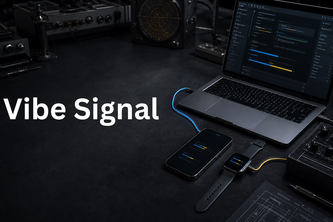
What it appears to be: A proof-of-concept tool that connects OpenAI's Codex agent to Apple devices (iPhone and Apple Watch) to enable remote monitoring and control of coding tasks via voice prompts and haptic feedback.
What changed: The project was built as a hackathon submission, with no indication of prior development or commercial deployment.
Single most important open question: Is there evidence of user need beyond the hackathon context, or any demonstration of adoption or market interest?
What The Product Actually Is
The description states that Vibe Signal is a system that connects Codex to iPhone and Apple Watch, displaying agent states (idle, working, waiting, completed, error) with visual and haptic feedback. It allows users to approve/deny requests, retry tasks, stop active processes, and send new prompts via voice from the Watch.
It uses:
- A TypeScript VS Code extension that hooks into Codex lifecycle events.
- A local WebSocket server for state synchronization and command handling.
- Native SwiftUI apps on iPhone and Apple Watch for UI and interaction.
- QR code pairing between devices.
- Local network communication (Wi-Fi).
- Voice transcription from Watch to iPhone, then to Codex.
The system is described as a "local-first architecture" with token authentication and background connectivity support.
Inference: The product appears to be an experimental integration of AI agent control with wearable tech for developers. It is not a commercial product but a prototype built in a short timeframe.
Positioning & Claim Evolution
The author states that Vibe Signal was inspired by physical AI coding controllers, aiming to make agent activity tangible and portable. The project positions itself as enabling a "complete coding loop from the wrist", allowing developers to interact with Codex without returning to their desk.
It claims to close the coding loop by:
- Sending voice prompts from Watch to Codex.
- Monitoring progress via live state updates.
- Enabling contextual actions (approve, retry, stop).
- Supporting local networking and background execution.
Inference: The positioning is aspirational — it frames itself as a solution for developers who want more mobility in AI-assisted coding. However, no evidence of market validation or prior user feedback exists beyond the hackathon context.
Target Customer & ICP
The description implies that Vibe Signal targets developers using Codex, particularly those who are:
- Working in environments where they may be away from their desks.
- Interested in hands-free control of AI agents.
- Comfortable with Apple ecosystem tools and local networking.
It is not clear if the target includes other types of users (e.g., non-developers, enterprise teams) or whether there's a defined ideal customer profile beyond "developers using Codex".
Inference: The ICP seems narrowly defined around developers using Codex in Apple environments. No evidence of segmentation or targeting beyond this.
Business Model & Pricing Evidence
There is no mention of pricing, monetization strategy, or business model in the description. The project is presented as a hackathon submission with no indication of any revenue streams or commercial viability.
Inference: No evidence of a business model or pricing structure exists. The product appears to be experimental and not intended for sale or commercial use at this stage.
Technical & Delivery Signals
The system is built using:
- TypeScript (VS Code extension)
- Node.js
- Swift, SwiftUI (iOS apps)
- WebSockets
- Apple WatchConnectivity
- AVFoundation (audio handling)
- Speech Recognition APIs
- QR codes for pairing
- URLSession and UserNotifications
It supports:
- Local network communication.
- Background execution on iOS.
- Haptic feedback.
- Voice transcription and playback.
- Token-based authentication.
The author notes challenges with lifecycle management across multiple Apple platforms, including background suspension, delayed transfers, and audio session handling.
Inference: The technical implementation shows a strong understanding of Apple platform constraints and integration. However, this is a prototype built in a short time, not a production-ready system.
Traction & Maturity Signals
The project was submitted to the OpenAI 2026 hackathon and has no evidence of prior traction or adoption. The team size is listed as one (Shibo Ding). There are no mentions of users, customers, revenue, or usage metrics.
Inference: No traction or maturity signals exist beyond the hackathon submission. It is a proof-of-concept with no indication of real-world deployment or user engagement.
Competitive Context
The description does not mention any competitors. However, it implies a space where developers interact with AI coding agents (e.g., Codex) and seek more portable control mechanisms. The concept overlaps with:
- Wearable computing for productivity.
- Remote task management in AI workflows.
- Developer tooling that extends beyond desktop interfaces.
No direct comparison or competitive analysis is provided.
Inference: No evidence of competitive landscape exists, but the idea aligns with broader trends in wearable productivity tools and remote agent control.
Open Questions & Risks
- Unproven market need: The project is a hackathon submission with no evidence of user demand.
- Limited scope: Only one developer built it; no team or organizational support.
- Prototype nature: Built for a short time, not designed for production use.
- Apple-specific: Tied to Apple ecosystem, limiting potential reach.
- No commercialization plan: No indication of how the idea might scale or monetize.
Inference: The project is experimental and lacks any signs of traction, scalability, or commercial viability. It is a proof-of-concept, not a product ready for market.
Questions the description leaves open
- What specific problem are you trying to solve beyond the hackathon context?
- Have you tested this with real users or in real-world development workflows?
- How do you plan to address security and privacy concerns around local network communication?
- Is there any interest from developers or enterprises in using such a tool?
- What would it take to move from prototype to production-ready product?
- Are you planning to support other AI agents beyond Codex?
- How do you intend to monetize this, if at all?
Overall Assessment
Not evidenced: There is no evidence of a viable business model, traction, or commercial interest in Vibe Signal beyond the hackathon submission.
Confidence level: Low — based on self-reported description only, with no external validation or data points.
Assessment: This is an experimental prototype with no demonstrated market need, revenue, or user adoption. It does not meet criteria for investment or partnership at this stage. It may be a useful idea to explore further, but it is not a product ready for commercialization or strategic interest.
User Stories BotA demo video on every pull request
Get a demo video on every new feature
GitHub App that watches your pull requests and records a narrated, captioned demo.
Save time on demo prep and make informed decisions faster with a video walkthrough of every new feature.
Source
Submitted to the OpenAI 2026 hackathon on Devpost. Project home on Devpost. Back to the full gallery on Devpost.
This competitive analysis was produced by top-founders.com (opens in a new tab)
Generated by a language model from this project's public Devpost page — its tagline, the author's own write-up and any built-with tags listed there — as captured in August 2026. Short quotations are the author's words. It is an opinion on the idea as a business, not on the people behind it, and it reflects the description as published then. If the project has moved on, request a correction below. The analysis is not independent research and contains no verified traction, revenue or customer data.
An independent guide by KFG International LLC — not affiliated with, endorsed by, or connected to Devpost or OpenAI.