

Archive position — measured, not model output
1 like on Devpost
505 of the 7,850 archived projects have more likes, and 1,758 share exactly 1 — so this project's #2,176 place in the like-ranked listing is a tie-break inside that group, not a ranking.
Projects (log scale)
Likes on Devpost. ▲ marks this project's group.
Show the figures
| Likes | Projects | Share of archive |
|---|---|---|
| 0 | 5,587 | 71.2% |
| 1 | 1,758 | 22.4% |
| 2 | 284 | 3.6% |
| 3–4 | 132 | 1.7% |
| 5–9 | 75 | 1.0% |
| 10+ | 14 | 0.2% |
 User Stories BotA demo video on every pull request
Get a demo video on every new feature
GitHub App that watches your pull requests and records a narrated, captioned demo.
Save time on demo prep and make informed decisions faster with a video walkthrough of every new feature.
Executive Summary
What the company appears to be
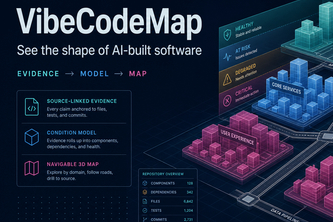
VibeCodeMap is an experimental, self-reported tool that visualizes software codebases as interactive 3D cities using AI and deterministic analysis. It aims to make complex systems visible by mapping architecture, dependencies, quality signals, and potential issues into a navigable environment.
What changed
The author states they built this for the OpenAI 2026 hackathon. The project is described as a research prototype, not a production-ready product. It includes an end-to-end workflow involving code inspection, analysis, AI-assisted semantic investigation, quality mapping, and visualization in a browser-based 3D map.
Single most important open question
Is there any evidence of traction, revenue, or adoption beyond the author’s own demonstration? The description makes no claims about customers, usage, or monetization — only that it is an experimental prototype.
Note: This analysis is based solely on the self-reported project description provided by the caller. No external verification, historical data, or third-party sources are available. All statements reflect what the author states and not necessarily what is true.
What The Product Actually Is
The description states that VibeCodeMap is an experimental evidence model and interactive 3D condition map for software repositories. It turns code into a navigable "software city" where:
- Products and systems become cities;
- Applications, services, workers, CLIs become areas;
- Features, layers, subsystems become districts;
- Components, interfaces, resources, actors become buildings;
- Calls, events, state access, external providers, static imports become visually distinct typed roads;
- Source-linked measurements appear as condition bands around buildings.
It uses a five-stage workflow:
- Inspect — inventories repository and excludes noise.
- Analyze — runs analyzers over reviewed scope (Go, Python, JS/TS).
- Codex + GPT-5.6 — guides semantic investigation.
- Quality mapping — maps deterministic measurements into source-linked DSL.
- Show — composes renderer-neutral JSON, generates standalone Three.js HTML map.
The tool is described as a research prototype, not a dependable code-audit product.
Inference: The product is built around AI-assisted visualization of software architecture and quality signals, using both deterministic analysis and LLMs to interpret code. It is not a traditional IDE or static analyzer but rather a visual exploration interface for developers.
Positioning & Claim Evolution
The author states:
- "AI can generate thousands of lines of software faster than a human can understand the resulting system."
- "VibeCodeMap turns code into an interactive 3D city, revealing architecture, dependencies, quality signals, side effects, and potential issues."
- "It is a research prototype, not a dependable code-audit product."
The positioning evolves from a problem identification (AI-generated systems are hard to understand) to a solution concept (visualize them as cities), and finally to a self-labeled prototype (not yet production-ready).
Claim: The author positions VibeCodeMap as a tool for understanding complex software systems through visual abstraction.
Inference: This is not a commercial product yet; it is an experimental idea with a strong developer-centric focus.
Target Customer & ICP
The description does not explicitly name target customers or define Ideal Customer Profiles (ICPs). However, the author implies:
- Developers working with large codebases.
- Teams seeking clarity in system architecture and dependencies.
- Users interested in visualizing software quality and potential issues.
It is implied that the tool targets software engineers, especially those dealing with complex systems where understanding structure and behavior is difficult.
Inference: The ICP likely includes developers, architects, or engineering leads who want to explore codebases visually and understand their inner workings.
Not evidenced: No explicit customer segments, personas, or use cases beyond developer exploration.
Business Model & Pricing Evidence
There is no evidence of a business model or pricing structure in the description. The author states:
- "VibeCodeMap is a research prototype, not a dependable code-audit product."
- "This is deliberately a development-time agent workflow rather than a hidden runtime API dependency."
Not evidenced: No mention of monetization, licensing, subscriptions, or any revenue model.
Technical & Delivery Signals
The project uses:
- Tools: Cloudflare Workers, Next.js, React, Three.js, Go, Python, JavaScript, TypeScript, Codex, GPT-5.6.
- Workflow stages: Inspection, analysis, AI-assisted semantic investigation, quality mapping, visualization.
- Output: Standalone HTML map rendered via Three.js, with embedded source-linked evidence.
The author notes:
- One CLI handles full pipeline from inspection to browser launch.
- Structural contracts remain editable and schema-validated.
- AI inference is marked with provenance, confidence, rationale, and source evidence.
- The tool maps itself as a demo (self-hosted).
Inference: The technical stack suggests a developer-focused, web-based prototype built for exploration and demonstration. It integrates AI with deterministic code analysis.
Traction & Maturity Signals
The description states:
- "VibeCodeMap is a research prototype."
- "The hosted demo dogfoods the complete idea: VibeCodeMap maps VibeCodeMap itself."
- Submitted to the OpenAI 2026 hackathon.
- No mention of users, customers, or adoption.
Not evidenced: No evidence of traction, revenue, customer base, or product maturity beyond a prototype.
Competitive Context
The description does not reference competitors or existing tools in this space. It is unclear whether similar visual code exploration tools exist.
Not evidenced: No competitive landscape or comparison to other products.
Open Questions & Risks
- Prototype-only status: The tool is described as a research prototype, not a product.
- No commercialization path: No evidence of monetization or customer traction.
- AI dependency: Heavy reliance on GPT-5.6 and Codex implies potential instability or scalability issues.
- Limited scope: Currently supports Go, Python, JS/TS; no mention of other languages or platforms.
- Self-mapping demo only: The only public example is a self-generated map — no real-world usage shown.
Inference: The project lacks commercial viability or traction. It may be more of an experimental idea than a product in development.
Questions the description leaves open
- What specific problems are you trying to solve for developers?
- How do you plan to transition from prototype to product?
- Have you identified any early adopters or use cases beyond the demo?
- What is your roadmap for supporting more languages and platforms?
- Are there any plans for monetization or commercial partnerships?
- How does VibeCodeMap handle large-scale codebases (e.g., >100k lines)?
- What are the limitations of AI-assisted interpretation vs. deterministic analysis?
Overall Assessment
Not evidenced: No information on valuation, funding rounds, or investment interest.
Assessment: This is a research prototype with no demonstrated traction, revenue, or commercialization strategy. It may be an interesting idea for future development but does not currently meet criteria for investment or partnership consideration based on the provided description.
User Stories BotA demo video on every pull request
Get a demo video on every new feature
GitHub App that watches your pull requests and records a narrated, captioned demo.
Save time on demo prep and make informed decisions faster with a video walkthrough of every new feature.
Source
Submitted to the OpenAI 2026 hackathon on Devpost. Project home on Devpost. Back to the full gallery on Devpost.
This competitive analysis was produced by top-founders.com (opens in a new tab)
Generated by a language model from this project's public Devpost page — its tagline, the author's own write-up and any built-with tags listed there — as captured in August 2026. Short quotations are the author's words. It is an opinion on the idea as a business, not on the people behind it, and it reflects the description as published then. If the project has moved on, request a correction below. The analysis is not independent research and contains no verified traction, revenue or customer data.
An independent guide by KFG International LLC — not affiliated with, endorsed by, or connected to Devpost or OpenAI.