

Archive position — measured, not model output
0 likes on Devpost
2,263 of the 7,850 archived projects have more likes, and 5,587 share exactly 0 — so this project's #4,139 place in the like-ranked listing is a tie-break inside that group, not a ranking.
Projects (log scale)
Likes on Devpost. ▲ marks this project's group.
Show the figures
| Likes | Projects | Share of archive |
|---|---|---|
| 0 | 5,587 | 71.2% |
| 1 | 1,758 | 22.4% |
| 2 | 284 | 3.6% |
| 3–4 | 132 | 1.7% |
| 5–9 | 75 | 1.0% |
| 10+ | 14 | 0.2% |
 User Stories BotA demo video on every pull request
Get a demo video on every new feature
GitHub App that watches your pull requests and records a narrated, captioned demo.
Save time on demo prep and make informed decisions faster with a video walkthrough of every new feature.
Executive Summary
What the company appears to be: Flight Delay Assistant is a self-reported iOS application designed to help travelers navigate flight delay remedies by providing structured, source-backed information on eligibility, value, deadlines, and next steps. It operates as a local-first app with no account requirement, using SQLite for data storage and SwiftUI for interface.
What changed: The project was submitted to the OpenAI 2026 hackathon, indicating it is an early-stage prototype or proof-of-concept built in a short timeframe. No evidence of prior development, funding, or commercial traction exists beyond this submission.
Single most important open question: Is there any evidence that the app has been used by travelers post-submission, or that it has begun to generate revenue or customer engagement beyond its hackathon context?
What The Product Actually Is
The description states:
- Flight Delay Assistant is a native iPhone app built with SwiftUI, Swift 6, SQLite, CryptoKit, LocalAuthentication, and UserNotifications.
- It uses a versioned U.S.-focused policy library containing 181 carrier records and 1,480 validated rules.
- The app executes a deterministic exact-remedy oracle that evaluates all 1,480 scenarios without generative AI inventing eligibility decisions.
- It provides travelers with complete sets of supported remedies, including explanations, value or calculation, evidence, deadline, official source, and next step.
Inference: The app is a local-first tool focused on U.S. flight delay remedies, designed to be used offline and without an account. It does not claim to file claims automatically or guarantee compensation.
Positioning & Claim Evolution
The description states:
- The app aims to turn "scattered rules into a clear, immediate plan" for travelers facing flight disruptions.
- It is positioned as a tool that explains every flight-delay remedy and makes it ready to request.
- It does not claim to be legal advice or to provide automatic live tracking or autonomous filing of claims.
Inference: The positioning is that of an informational assistant, not a legal or automated claims service. The evolution appears to be from a hackathon prototype to a potential product with a defined scope and data model.
Target Customer & ICP
The description states:
- The app targets travelers who face flight disruptions and are under time, cost, and information pressure.
- It is U.S.-focused, suggesting the primary customer base is American flyers.
Inference: The target customer is a U.S. traveler experiencing a flight delay, seeking structured guidance on remedies without needing an account or internet access.
Business Model & Pricing Evidence
The description states:
- No account is required to use the app.
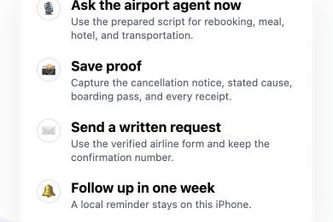
- Travelers can prepare scripts or written requests, open verified contact routes, save evidence, and schedule follow-ups.
- The app does not claim to provide automatic compensation or filing services.
Inference: There is no evidence of a pricing model or monetization strategy. The app appears to be free to use, with no stated business model beyond its hackathon submission.
Technical & Delivery Signals
The description states:
- Built with SwiftUI, Swift 6, SQLite, CryptoKit, LocalAuthentication, and UserNotifications.
- A deterministic engine evaluates 1,480 scenarios without generative AI involvement.
- The app is local-first and works offline.
- GPT-5.6 was used during development as a build-time engineering collaborator.
Inference: The technical stack suggests a native iOS product with strong emphasis on privacy and offline functionality. The use of deterministic logic implies a focus on accuracy over generative AI.
Traction & Maturity Signals
The description states:
- The project was submitted to the OpenAI 2026 hackathon.
- It is described as an MVP (minimum viable product).
- No evidence of revenue, customers, or adoption beyond its submission exists.
Inference: There are no signs of traction or commercial maturity. The app remains in a prototype or early-stage development phase.
Competitive Context
The description does not provide any information on competitors or market positioning beyond the stated goal of helping travelers navigate flight delay remedies.
Inference: No competitive analysis is possible from this description alone. There is no evidence of existing solutions or market presence.
Open Questions & Risks
- The app is U.S.-focused and does not claim worldwide coverage, limiting its potential market.
- It is a hackathon submission with no evidence of prior development or traction.
- No pricing model or monetization strategy is evident.
- The use of SQLite suggests limited scalability or data integration capabilities.
- The deterministic engine may be difficult to maintain or update without significant engineering effort.
Questions the description leaves open
- What is the source of the 1,480 validated rules and 181 carrier records? Are they publicly available or proprietary?
- Has the app been tested by real users beyond the hackathon?
- How does the team plan to scale the policy library beyond U.S. carriers?
- Is there any intention to monetize the app, and if so, how?
- What is the long-term maintenance strategy for keeping the 1,480 rules up to date?
Overall Assessment
The description states that Flight Delay Assistant is a hackathon submission with no evidence of revenue, customers, or commercial traction.
Inference: At this stage, there is insufficient evidence to support an investment or partnership decision. The project appears to be an early-stage prototype with no demonstrated market adoption or business model. Any further evaluation would require evidence of usage, monetization plans, or product-market fit beyond its hackathon context.
User Stories BotA demo video on every pull request
Get a demo video on every new feature
GitHub App that watches your pull requests and records a narrated, captioned demo.
Save time on demo prep and make informed decisions faster with a video walkthrough of every new feature.
Source
Submitted to the OpenAI 2026 hackathon on Devpost. Project home on Devpost. Back to the full gallery on Devpost.
This competitive analysis was produced by top-founders.com (opens in a new tab)
Generated by a language model from this project's public Devpost page — its tagline, the author's own write-up and any built-with tags listed there — as captured in August 2026. Short quotations are the author's words. It is an opinion on the idea as a business, not on the people behind it, and it reflects the description as published then. If the project has moved on, request a correction below. The analysis is not independent research and contains no verified traction, revenue or customer data.
An independent guide by KFG International LLC — not affiliated with, endorsed by, or connected to Devpost or OpenAI.