

Archive position — measured, not model output
0 likes on Devpost
2,263 of the 7,850 archived projects have more likes, and 5,587 share exactly 0 — so this project's #4,140 place in the like-ranked listing is a tie-break inside that group, not a ranking.
Projects (log scale)
Likes on Devpost. ▲ marks this project's group.
Show the figures
| Likes | Projects | Share of archive |
|---|---|---|
| 0 | 5,587 | 71.2% |
| 1 | 1,758 | 22.4% |
| 2 | 284 | 3.6% |
| 3–4 | 132 | 1.7% |
| 5–9 | 75 | 1.0% |
| 10+ | 14 | 0.2% |
 User Stories BotA demo video on every pull request
Get a demo video on every new feature
GitHub App that watches your pull requests and records a narrated, captioned demo.
Save time on demo prep and make informed decisions faster with a video walkthrough of every new feature.
Executive Summary
What the company appears to be
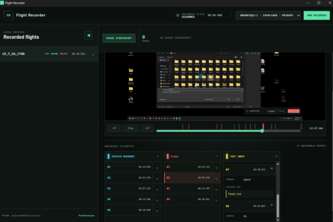
Flight Recorder is a self-reported plugin for Codex Desktop on Windows that records full-screen video during GPT "Computer Use" tasks. It logs events with timestamps and allows users to export screenshots back to GPT, aiming to improve observability in agentic workflows.
What changed
The project was built entirely by GPT 5.6 Sol within Codex Desktop, using technologies including Rust, Tauri, PowerShell, HTML, CSS, and JavaScript. It is presented as a solution to the lack of structured evidence during computer use by AI agents.
Single most important open question
Is there any evidence of external interest or usage beyond the author’s own claims? The description states no revenue, customers, or traction data are available.
What The Product Actually Is
The description states that Flight Recorder is a plugin for Codex Desktop on Windows, designed to capture full-screen video during GPT "Computer Use" tasks. It logs events such as pointer movement, mouse clicks, and text entry with timestamps. Users can review the resulting video with timeline markers and export screenshots back to GPT.
It connects directly to Codex Desktop through an MCP (Model Communication Protocol) with 9 included tools, enabling direct interface between the agent and plugin.
Evidence
- The author states: “This is a Codex Desktop plugin which is used to record Full Screen Video capture during Computer Use tasks…”
- The plugin uses timecode entry to log events like “pointer movement” and “mouse click.”
- It exports screenshots from the video at any point along the timeline.
- It integrates with Codex via MCP and 9 tools.
Inference The product is described as a developer tool aimed at improving transparency in AI agent behavior during GUI interactions.
Positioning & Claim Evolution
The author positions Flight Recorder not as a fix for slow or unreliable computer use, but as an observability layer that makes the limitations of current AI interaction visible and inspectable. The goal is to provide structured evidence so both users and agents can address what actually happened during a task.
Key claims from the description
- “Flight Recorder does not pretend to solve that underlying limitation [of computer use]. Its contribution is to make the limitation visible, inspectable, and useful.”
- “It combines video, real input timing, Codex lifecycle events, indexed frames, and a navigable timeline.”
- “A user can return to an exact moment, select the nearest real frame, and discuss it with Codex using shared evidence instead of memory or guesswork.”
Inference The positioning reflects a shift from trying to improve performance to improving accountability and traceability in AI workflows.
Target Customer & ICP
The description does not explicitly name target customers. However, based on the context:
- The plugin is built for Codex Desktop users, particularly those engaged in GPT "Computer Use" tasks.
- It targets individuals or teams working with AI agents performing GUI-based actions.
- The intended audience includes developers and researchers exploring agentic workflows.
Evidence
- The product is designed to work within Codex Desktop.
- It supports “any other time which Video evidence will be helpful.”
- The author mentions it could help improve prompts, interfaces, automation strategies, and agent behavior.
Inference The ICP likely includes early adopters of AI agents interacting with graphical interfaces — possibly developers, researchers, or advanced users experimenting with agentic workflows.
Business Model & Pricing Evidence
There is no evidence in the description regarding pricing, monetization strategy, or business model. The project is presented as a hackathon submission and appears to be built by one person (the author) without any indication of commercial intent beyond personal interest.
Evidence
- No mention of fees, subscriptions, or sales.
- The author says: “I asked GPT to share its own thoughts – they are listed below.” This suggests no external revenue stream is involved.
Inference If this evolves into a product, the business model remains unclear. It may be open-source, freemium, or part of a larger platform offering.
Technical & Delivery Signals
The project was built entirely by GPT 5.6 Sol within Codex Desktop using technologies such as:
- Rust
- Tauri
- PowerShell
- HTML/CSS/JavaScript
It integrates with Codex through an MCP (Model Communication Protocol) and includes 9 tools.
Evidence
- “This was exclusively created by GPT 5.6 Sol, within Codex Desktop, from start to finish.”
- Built using: css, html, javascript, powershell, rust, tauri
- Connects via MCP with 9 included tools
Inference The technical stack indicates a cross-platform development approach, though the author only has access to Windows. The use of GPT for building implies an experimental or proof-of-concept nature.
Traction & Maturity Signals
There is no evidence of traction, adoption, or user feedback beyond the author’s own statements. The project was submitted to a hackathon and does not include metrics such as:
- Number of users
- Revenue
- Customer base
- Market validation
Evidence
- No mention of downloads, usage stats, or customer data.
- The author states: “I’ve considered using a Virtual machine to continue development if public interest is there.”
- The project is described as a hackathon submission.
Inference The product has not yet reached a stage where traction can be measured. It remains in early-stage experimentation.
Competitive Context
There are no references to competitors or existing solutions in the description. The author does not compare Flight Recorder to other screen recording tools or AI interaction platforms.
Evidence
- No mention of competing products.
- No discussion of prior art or market positioning relative to others.
Inference The competitive landscape is unknown, but given its focus on integrating with Codex and enhancing agent observability, it may overlap with general-purpose screen recorders or debugging tools for AI agents.
Open Questions & Risks
Several risks and open questions emerge from the self-reported nature of the project:
- No external validation: The product was built entirely by GPT and lacks independent verification.
- Limited platform support: Only Windows is supported; no mention of macOS or Linux.
- Unclear commercial viability: No pricing, monetization, or business model described.
- Unproven demand: No evidence of public interest beyond the author’s own claims.
Evidence
- “I’ve considered using a Virtual machine to continue development if public interest is there.”
- “If there is a strong public interest I will consider making the plugin available for MacOS and possibly Linux as well.”
Inference The lack of traction, platform diversity, and commercial clarity raises concerns about scalability and long-term viability.
Questions the description leaves open
- What specific feedback or interest has been received from users beyond your own?
- Are there any plans to expand support beyond Windows?
- How do you intend to monetize this tool if at all?
- Has the plugin been tested in real-world scenarios with actual agents performing tasks?
- What are the technical limitations of integrating with Codex Desktop and how might they evolve?
Overall Assessment
This is a self-reported hackathon project with no evidence of traction, revenue, or customer validation. The author describes it as a tool for improving observability in AI agent workflows but provides no data on adoption, usage, or market response.
Confidence Level Low The description is entirely self-reported and unverified. There are no third-party sources, financials, or user metrics to support any commercial assessment.
Assessment Summary
- Not evidenced: No revenue, customers, or traction.
- Not evidenced: No pricing, business model, or monetization strategy.
- Not evidenced: No competitive analysis or market positioning.
- Inferred: The tool may be useful for developers working with AI agents in GUI environments.
- Risk: High due to lack of validation and limited scope.
Recommendation
This project is at a very early stage. Further diligence would require proof of concept, user feedback, and evidence of interest from the broader community or potential partners.
User Stories BotA demo video on every pull request
Get a demo video on every new feature
GitHub App that watches your pull requests and records a narrated, captioned demo.
Save time on demo prep and make informed decisions faster with a video walkthrough of every new feature.
Source
Submitted to the OpenAI 2026 hackathon on Devpost. Project home on Devpost. Back to the full gallery on Devpost.
This competitive analysis was produced by top-founders.com (opens in a new tab)
Generated by a language model from this project's public Devpost page — its tagline, the author's own write-up and any built-with tags listed there — as captured in August 2026. Short quotations are the author's words. It is an opinion on the idea as a business, not on the people behind it, and it reflects the description as published then. If the project has moved on, request a correction below. The analysis is not independent research and contains no verified traction, revenue or customer data.
An independent guide by KFG International LLC — not affiliated with, endorsed by, or connected to Devpost or OpenAI.