

Archive position — measured, not model output
0 likes on Devpost
2,263 of the 7,850 archived projects have more likes, and 5,587 share exactly 0 — so this project's #6,103 place in the like-ranked listing is a tie-break inside that group, not a ranking.
Projects (log scale)
Likes on Devpost. ▲ marks this project's group.
Show the figures
| Likes | Projects | Share of archive |
|---|---|---|
| 0 | 5,587 | 71.2% |
| 1 | 1,758 | 22.4% |
| 2 | 284 | 3.6% |
| 3–4 | 132 | 1.7% |
| 5–9 | 75 | 1.0% |
| 10+ | 14 | 0.2% |
 User Stories BotA demo video on every pull request
Get a demo video on every new feature
GitHub App that watches your pull requests and records a narrated, captioned demo.
Save time on demo prep and make informed decisions faster with a video walkthrough of every new feature.
Executive Summary
What the company appears to be
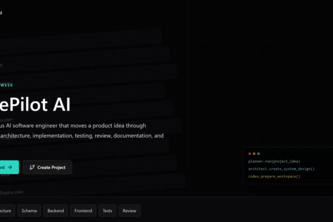
ProjectPilot AI is an autonomous software engineering platform that claims to orchestrate AI agents to execute full software development workflows from idea to deployment. The author states it uses GPT-5.6 for reasoning and OpenAI Codex for implementation, with a focus on transparency and traceability in AI decision-making.
What changed
The project is presented as an experimental submission to the OpenAI 2026 hackathon, indicating a nascent stage of development. It represents a self-reported exploration into how AI can be used to automate entire software engineering lifecycles rather than just code generation.
Single most important open question
Is there evidence that ProjectPilot AI has moved beyond concept or prototype into actual use by developers, or does it remain an unverified idea in the hackathon phase?
What The Product Actually Is
The description states that ProjectPilot AI is:
- An autonomous software engineering platform
- Powered by GPT-5.6 and OpenAI Codex
- Designed to transform natural language product ideas into production-ready software
- Capable of executing full development workflows including requirement analysis, architecture design, code generation, testing, documentation, and deployment
The author describes it as:
- Not an autocomplete tool but a system that owns the entire software engineering workflow
- A platform with a visual engineering pipeline that allows users to follow every stage of development
- Intended to make AI decision-making transparent and traceable
Evidence
- The project write-up explicitly defines its functionality.
- It lists specific technologies used (e.g., Next.js, React, FastAPI, Python).
- It describes how the system uses two distinct LLMs for different tasks.
Inference The product is described as a workflow automation tool for software engineering using AI agents, but no evidence of actual implementation or usage exists beyond the author's account.
Positioning & Claim Evolution
The author positions ProjectPilot AI as:
- A platform that moves beyond traditional AI coding assistants
- An autonomous system that owns the entire software engineering lifecycle
- A transparent and traceable alternative to black-box AI tools
Key claims include:
- It transforms product ideas into production-ready software in one workflow
- It provides a visual engineering pipeline for following development stages
- It combines reasoning (GPT-5.6) with implementation (Codex) to create a complete experience
Evidence
- The tagline and write-up both emphasize autonomy, full lifecycle execution, and transparency.
- The author explicitly contrasts it with existing tools (“not another autocomplete tool”).
Inference The positioning suggests a shift from code generation to end-to-end engineering orchestration. However, this is a self-reported intent, not verified traction or adoption.
Target Customer & ICP
The description states:
- The platform is designed for developers who want to turn product ideas into production-ready software
- It targets individuals and teams looking to automate complex workflows
- It aims to support both solo developers and collaborative environments
Evidence
- The author mentions “individuals and teams” as potential users.
- The focus on developer experience implies targeting technical users.
Inference The ICP appears to be software engineers or product teams seeking automation of full-stack development processes, but no specific customer segments or personas are defined.
Business Model & Pricing Evidence
There is no evidence provided about:
- Revenue streams
- Pricing models
- Monetization strategy
- Customer acquisition plans
Evidence
- No mention of monetization, pricing tiers, or sales mechanisms.
- The project is described as a hackathon submission with no indication of commercial intent.
Inference The business model remains unknown. It may be early-stage and unproven.
Technical & Delivery Signals
The author states:
- Built using Next.js, React, TypeScript, Tailwind CSS for frontend
- Backend built with FastAPI, Python
- Uses GPT-5.6 for reasoning and Codex for implementation
- Separated responsibilities between models to improve workflow orchestration
- Modular service architecture
- Real-time workflow visualization
Evidence
- Technology stack is listed in detail.
- The separation of model roles is described explicitly.
Inference The technical architecture shows a clear attempt at modular design and integration of AI models, but no evidence of live deployment or performance data.
Traction & Maturity Signals
There is no evidence of:
- Revenue
- Customers
- Users
- Product adoption
- Market traction
- Product maturity beyond prototype stage
Evidence
- The project was submitted to a hackathon.
- No mention of any live product, user base, or feedback loops.
Inference This is an early-stage idea with no demonstrated traction or market validation.
Competitive Context
The description does not reference:
- Competitors
- Market positioning relative to existing tools
- Differentiation from similar platforms
Evidence
- No mention of competitors or competitive landscape.
- The author only contrasts ProjectPilot AI with “traditional AI coding assistants.”
Inference No competitive analysis is available. It's unclear how this compares to other AI-assisted development tools.
Open Questions & Risks
Key risks and open questions based on the self-reported information:
- No evidence of real-world usage or customer feedback
- The project is described as a hackathon submission — implies experimental nature
- Claims about GPT-5.6 are unverified (as of current knowledge, GPT-5.6 does not exist)
- Lack of any revenue, headcount, or funding data
- No indication of scalability or production readiness
Evidence
- The project is explicitly labeled as a hackathon submission.
- No mention of any real-world testing or deployment.
Inference This is a speculative idea with no demonstrated viability or commercial potential at this stage.
Questions the description leaves open
- What specific problems are you solving, and how do you know they exist?
- How does your platform handle edge cases or ambiguous requirements?
- Are there any real users or pilot customers currently testing the system?
- What is your plan for scaling beyond a single developer’s workflow?
- Can you demonstrate actual outputs from the system (e.g., generated code, PRDs)?
- What are the limitations of current AI models in terms of accuracy and reliability?
- How do you intend to monetize this platform if it becomes viable?
Overall Assessment
Not evidenced.
There is no evidence that ProjectPilot AI has progressed beyond a hackathon prototype. No revenue, customers, traction or commercial viability are indicated in the description.
The author's claims about autonomous AI agents executing full software engineering workflows are ambitious but unproven. The project lacks any signal of product-market fit, scalability, or monetization strategy.
Given that this is a self-reported, unverified account of an experimental hackathon submission, there is insufficient basis to recommend investment or partnership at this time.
Confidence Level Low
Reasoning
The entire description is self-reported and lacks any verifiable data on product usage, revenue, customers, or market validation.
User Stories BotA demo video on every pull request
Get a demo video on every new feature
GitHub App that watches your pull requests and records a narrated, captioned demo.
Save time on demo prep and make informed decisions faster with a video walkthrough of every new feature.
Source
Submitted to the OpenAI 2026 hackathon on Devpost. Project home on Devpost. Back to the full gallery on Devpost.
This competitive analysis was produced by top-founders.com (opens in a new tab)
Generated by a language model from this project's public Devpost page — its tagline, the author's own write-up and any built-with tags listed there — as captured in August 2026. Short quotations are the author's words. It is an opinion on the idea as a business, not on the people behind it, and it reflects the description as published then. If the project has moved on, request a correction below. The analysis is not independent research and contains no verified traction, revenue or customer data.
An independent guide by KFG International LLC — not affiliated with, endorsed by, or connected to Devpost or OpenAI.