

Archive position — measured, not model output
0 likes on Devpost
2,263 of the 7,850 archived projects have more likes, and 5,587 share exactly 0 — so this project's #6,101 place in the like-ranked listing is a tie-break inside that group, not a ranking.
Projects (log scale)
Likes on Devpost. ▲ marks this project's group.
Show the figures
| Likes | Projects | Share of archive |
|---|---|---|
| 0 | 5,587 | 71.2% |
| 1 | 1,758 | 22.4% |
| 2 | 284 | 3.6% |
| 3–4 | 132 | 1.7% |
| 5–9 | 75 | 1.0% |
| 10+ | 14 | 0.2% |
 User Stories BotA demo video on every pull request
Get a demo video on every new feature
GitHub App that watches your pull requests and records a narrated, captioned demo.
Save time on demo prep and make informed decisions faster with a video walkthrough of every new feature.
Executive Summary
What the company appears to be
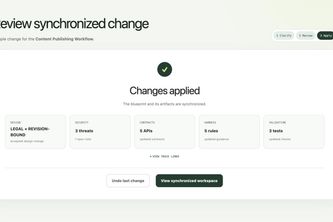
ProjectDNA is an AI-powered software architect tool described by its author as a "decision-aware specification compiler for software projects." It aims to maintain a synchronized engineering blueprint that evolves with product requirements, preserving traceability across design, contracts, harness (agent rules), and validation layers.
What changed
The project description reflects a self-reported prototype built during a hackathon. It is not evidenced to have moved beyond the initial development stage or achieved any commercial traction.
Single most important open question
Is there evidence of real-world usage, customer feedback, or product-market fit beyond this single-person prototype?
Note
This analysis is based solely on the self-reported project description provided by the author. No external verification, revenue data, customer names, or traction metrics are available.
What The Product Actually Is
The description states that ProjectDNA is a "decision-aware specification compiler for software projects." It begins with a product idea and identifies elements such as purpose, users, scope, requirements, constraints, scale assumptions, critical invariants, and architecture decisions.
It then stores accepted design intent in a typed canonical model called ProjectIR. From this model, it derives four synchronized artifact layers:
- Design: requirements, invariants, priorities, engineering decisions
- Contracts: OpenAPI definitions, ERDs, sequence flows
- Harness: AI-agent instructions and implementation constraints
- Validation: acceptance scenarios and traceability checks
Changes to a requirement trigger a proposed patch that shows direct and indirect impacts. Only explicit human action can make these proposals accepted.
Claim
The author claims ProjectDNA generates synchronized artifacts from one canonical model.
Evidence Yes, in the write-up under "What it does"
Inference Not evident — this is a stated feature of the system
Positioning & Claim Evolution
The author describes ProjectDNA as an alternative to isolated AI-generated documents. Instead of generating disconnected outputs, it maintains one connected engineering blueprint that evolves with project changes.
It positions itself as:
- A tool for maintaining consistency between requirements and implementation
- An approach to managing evolving software architecture through a structured model
- A system that prevents drift between documentation and actual code
Claim
The author claims ProjectDNA moves beyond one-off document generation toward engineering artifacts that remain connected as the system evolves.
Evidence Yes, in the write-up under "Inspiration" and "What it does"
Inference Not evident — this is a stated vision, not demonstrated functionality
Target Customer & ICP
The description does not name specific customers or personas. However, it implies use cases for:
- Product managers or architects working on complex software projects
- Teams needing to maintain alignment between design and implementation
- Developers or engineers who want to reduce drift in their systems
Claim
The author suggests ProjectDNA targets teams managing evolving software architecture.
Evidence Yes, in the write-up under "Inspiration"
Inference Not evident — no explicit ICP or target user profile is defined
Business Model & Pricing Evidence
There is no evidence of a business model or pricing structure. The project is described as a prototype built during a hackathon.
Claim
No evidence of any commercial model or pricing.
Evidence Not evidenced
Inference Not evident — this is not mentioned anywhere in the description
Technical & Delivery Signals
The application is built using:
- React and TypeScript
- Next.js-compatible vinext runtime
- Cloudflare Workers for deployment
- OpenAI API with GPT-5.6 Structured Outputs
- Zod schema for ProjectIR validation
- Codex for development assistance
It uses deterministic code to validate proposals, render artifacts, apply accepted changes atomically, and support undo functionality.
Claim
The author claims the system is built on modern web stack and integrates with AI APIs.
Evidence Yes, in "How we built it"
Inference Not evident — this is a stated architecture, not verified
Traction & Maturity Signals
The project is described as a prototype created during a hackathon. There is no evidence of:
- Revenue
- Customers
- Product-market fit
- Adoption metrics
- Iteration history or product evolution beyond the initial version
Claim
The author states it's a prototype from a hackathon.
Evidence Yes, in "What's next for ProjectDNA" and "Challenges we ran into"
Inference Not evident — no traction data is provided
Competitive Context
The description does not mention competitors or similar tools. It focuses on the unique aspect of maintaining synchronized engineering blueprints rather than generating isolated outputs.
Claim
No competitive landscape is described.
Evidence Not evidenced
Inference Not evident — no mention of existing solutions or market positioning
Open Questions & Risks
- Single-person team: The entire project was built by one individual, which raises questions about scalability and long-term maintenance.
- Prototype-only status: No evidence of real-world usage or feedback.
- Unverified AI integration: While it uses GPT-5.6, there is no demonstration of how this integrates into a production-ready system.
- No commercial viability: No pricing, monetization strategy, or business model is described.
Claim
The project lacks team support, traction, and commercial viability indicators.
Evidence Yes, in the description
Inference Not evident — these are logical conclusions from the lack of evidence
Questions the description leaves open
- What specific problems do you see in current software architecture tools that ProjectDNA solves?
- How does ProjectDNA handle ambiguity or conflicting requirements in a real-world setting?
- Have you tested this with any actual teams or projects beyond the prototype?
- What is your plan for scaling beyond a single developer?
- Are there any known limitations of the current AI integration (e.g., hallucinations, latency)?
- How do you envision integrating with existing development workflows like GitHub or CI/CD pipelines?
Note
These questions are based on gaps in the description and aim to uncover deeper insights into feasibility, traction, and scalability.
Overall Assessment
Not evidenced
There is no evidence of:
- Revenue
- Customers
- Product-market fit
- Team strength beyond one person
- Commercial viability or roadmap beyond prototype stage
The project is described as a hackathon prototype with no indication of traction, adoption, or monetization strategy.
Claim
The project has not demonstrated commercial readiness.
Evidence Not evidenced
Inference Yes — based on absence of any evidence of traction or business model
User Stories BotA demo video on every pull request
Get a demo video on every new feature
GitHub App that watches your pull requests and records a narrated, captioned demo.
Save time on demo prep and make informed decisions faster with a video walkthrough of every new feature.
Source
Submitted to the OpenAI 2026 hackathon on Devpost. Project home on Devpost. Back to the full gallery on Devpost.
This competitive analysis was produced by top-founders.com (opens in a new tab)
Generated by a language model from this project's public Devpost page — its tagline, the author's own write-up and any built-with tags listed there — as captured in August 2026. Short quotations are the author's words. It is an opinion on the idea as a business, not on the people behind it, and it reflects the description as published then. If the project has moved on, request a correction below. The analysis is not independent research and contains no verified traction, revenue or customer data.
An independent guide by KFG International LLC — not affiliated with, endorsed by, or connected to Devpost or OpenAI.