

Archive position — measured, not model output
0 likes on Devpost
2,263 of the 7,850 archived projects have more likes, and 5,587 share exactly 0 — so this project's #7,525 place in the like-ranked listing is a tie-break inside that group, not a ranking.
Projects (log scale)
Likes on Devpost. ▲ marks this project's group.
Show the figures
| Likes | Projects | Share of archive |
|---|---|---|
| 0 | 5,587 | 71.2% |
| 1 | 1,758 | 22.4% |
| 2 | 284 | 3.6% |
| 3–4 | 132 | 1.7% |
| 5–9 | 75 | 1.0% |
| 10+ | 14 | 0.2% |
 User Stories BotA demo video on every pull request
Get a demo video on every new feature
GitHub App that watches your pull requests and records a narrated, captioned demo.
Save time on demo prep and make informed decisions faster with a video walkthrough of every new feature.
Executive Summary
What the company appears to be
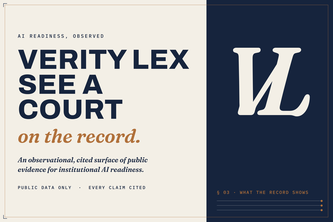
Verity Lex is a self-reported SaaS product that reads public court records in California superior courts and scores them against legally grounded standards using AI-assisted discovery and deterministic rule engines. It is described as an analyst’s intelligence tool, not a one-click assessment engine.
What changed
The project evolved from a self-serve SaaS model to an analyst-focused tool after encountering challenges with model variability and the need for adaptive document discovery. The author reframed it as a stateless observer that builds baselines over time rather than delivering static scores.
Single most important open question — the commercial due-diligence read
Is there evidence of traction, revenue, or customer adoption beyond the author's own development efforts? The description states no such data exists.
What The Product Actually Is
The description states that Verity Lex is a tool that:
- Reads public records from California superior courts.
- Uses an AI agent (GPT-5.6) to discover relevant documents.
- Extracts evidence into structured JSON using Tavily for retrieval.
- Scores the findings against a registry of nine legally grounded standards.
- Operates with a deterministic rule engine that does not use the model’s output in scoring.
- Provides cited, auditable results and marks gaps as “not located” rather than absent.
- Allows users to download audit bundles and recompute scores manually.
It is described as an analyst's intelligence tool, not a one-click public assessment. The author notes that it was built in about two days with AI assistance and human review.
Evidence
- Described as reading court records and scoring them against legal standards.
- Uses GPT-5.6 for discovery and Tavily for retrieval.
- Employs a deterministic rule engine for scoring.
- Provides cited evidence and auditability.
- Built in a short timeframe with AI and human oversight.
Inference The tool is designed to support readiness intelligence for government operators, not end-users or general consumers.
Positioning & Claim Evolution
The description states that Verity Lex flips the traditional model of selling software to government institutions. Instead of vendors hunting for problems, it starts with understanding the institution first — specifically, what the court is legally held to and whether its public record shows compliance.
It positions itself as a tool that:
- Reads public records without assuming institutional knowledge.
- Scores against published legal standards.
- Provides auditability and cited evidence.
- Is built to avoid shelfware by grounding findings in real documents.
The author notes that early versions were self-serve SaaS, but evolved into an analyst tool after discovering model variability issues. The product is now framed as a stateless observer that builds baselines over time.
Evidence
- Claims to start at the foundation: understanding legal standards before selling solutions.
- Positions itself against “shelfware” and eroded trust in public sector software.
- Evolved from self-serve SaaS to analyst tool due to model behavior.
Inference The positioning reflects a shift toward a more mature, reviewable intelligence product rather than a quick solution.
Target Customer & ICP
The description states that Verity Lex is intended for:
- Government operators or analysts who need readiness intelligence.
- Courts (specifically California superior courts).
- Entities that want to understand institutional compliance before selling solutions.
It is not described as targeting end-users, consumers, or general SaaS buyers. The author emphasizes the tool's role in helping operators understand institutions before engaging with them.
Evidence
- Designed for government operators and analysts.
- Focuses on California superior courts.
- Aims to support readiness intelligence for institutional buyers.
Inference The ICP appears to be government entities or consultants working with public institutions, not general software buyers.
Business Model & Pricing Evidence
Not evidenced. The description does not mention pricing, subscription models, or monetization strategies.
Evidence
- No mention of pricing.
- No indication of a commercial model beyond the product’s development and demo.
Technical & Delivery Signals
The description states that:
- The tool is built using Next.js, TypeScript, GPT-5.6 (Terra tier), Tavily, and Vercel.
- Uses a neurosymbolic architecture: AI for discovery and reasoning, deterministic engine for scoring.
- Implements CI/CD with Codex, GitHub, and pull request reviews.
- The model is scoped via gated prompts.
- JSON schema extraction is used to structure evidence.
- The rule engine does not import the model’s output, enforcing a strict boundary between reading and scoring.
Evidence
- Built with Next.js, TypeScript, GPT-5.6, Tavily.
- Uses CI/CD and pull request reviews.
- Implements deterministic scoring.
- AI agent used for discovery; rule engine for scoring.
Inference The architecture is designed to be reliable and auditable, with clear separation between AI and scoring logic.
Traction & Maturity Signals
Not evidenced. The description does not provide any data on:
- Revenue
- Customers
- Usage metrics
- Adoption
- Product maturity beyond the demo
Evidence
- No traction or adoption data.
- Described as a deployed product built in two days.
- Live demo exists, but no user base is mentioned.
Competitive Context
Not evidenced. The description does not mention:
- Competitors
- Market size
- Industry trends
- Direct or indirect substitutes
Evidence
- No competitive landscape described.
- No mention of existing tools for court record analysis or legal readiness intelligence.
Open Questions & Risks
- No traction or revenue evidence: The product is described as built by one person and deployed in two days, with no data on adoption or monetization.
- Unverified claims: All descriptions are self-reported and unverified.
- Model variability challenge: The author notes that early versions had inconsistent scores due to model behavior — a potential risk for reliability.
- Limited scope: Currently focused only on California superior courts, with no indication of expansion plans.
- No pricing or business model: No commercial strategy is described.
Evidence
- No revenue or customer data.
- Model variability noted as a challenge.
- Limited geographic and institutional scope.
- No mention of monetization.
Questions the description leaves open
- What is the actual legal standing of the nine standards used in scoring?
- How does the tool handle jurisdictional differences beyond California?
- Are there any plans for monetization or customer acquisition?
- Has the tool been tested with real analysts or government users?
- What are the technical limitations of the current GPT-5.6 implementation?
- How is data stored, and what are the privacy implications?
- Is there a plan to expand beyond California courts?
Overall Assessment
Not evidenced. The description does not provide any information on:
- Valuation
- Funding rounds
- Investor interest
- Partnership potential
Evidence
- No financial or investment data.
- No indication of partnership opportunities.
Inference This is a self-reported project with no evidence of commercial traction, revenue, or institutional adoption. It is not ready for investment or partnership consideration based on the provided information.
User Stories BotA demo video on every pull request
Get a demo video on every new feature
GitHub App that watches your pull requests and records a narrated, captioned demo.
Save time on demo prep and make informed decisions faster with a video walkthrough of every new feature.
Source
Submitted to the OpenAI 2026 hackathon on Devpost. Project home on Devpost. Back to the full gallery on Devpost.
This competitive analysis was produced by top-founders.com (opens in a new tab)
Generated by a language model from this project's public Devpost page — its tagline, the author's own write-up and any built-with tags listed there — as captured in August 2026. Short quotations are the author's words. It is an opinion on the idea as a business, not on the people behind it, and it reflects the description as published then. If the project has moved on, request a correction below. The analysis is not independent research and contains no verified traction, revenue or customer data.
An independent guide by KFG International LLC — not affiliated with, endorsed by, or connected to Devpost or OpenAI.