

Archive position — measured, not model output
1 like on Devpost
505 of the 7,850 archived projects have more likes, and 1,758 share exactly 1 — so this project's #1,638 place in the like-ranked listing is a tie-break inside that group, not a ranking.
Projects (log scale)
Likes on Devpost. ▲ marks this project's group.
Show the figures
| Likes | Projects | Share of archive |
|---|---|---|
| 0 | 5,587 | 71.2% |
| 1 | 1,758 | 22.4% |
| 2 | 284 | 3.6% |
| 3–4 | 132 | 1.7% |
| 5–9 | 75 | 1.0% |
| 10+ | 14 | 0.2% |
 User Stories BotA demo video on every pull request
Get a demo video on every new feature
GitHub App that watches your pull requests and records a narrated, captioned demo.
Save time on demo prep and make informed decisions faster with a video walkthrough of every new feature.
Executive Summary
What the company appears to be
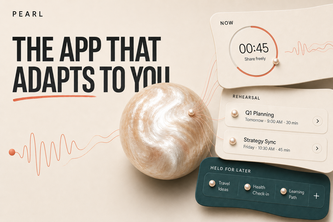
Pearl is a self-reported personal planning tool built as a native SwiftUI app. It allows users to speak for up to 60 seconds about their day, and then generates a dynamic, personalized interface tailored to that input. The system claims to build tools such as timers, checklists, decision aids, and notes based on the user's spoken reflection, calendar data, and Apple Health information.
What changed
The author states that Pearl began with a problem: existing planning tools ask too much of overwhelmed people by requiring them to fill out fixed planners. The solution was to start with one minute of natural speech and build only what is needed for the day — no fixed interface, just dynamic tools based on context.
Single most important open question
Is there evidence that Pearl has been used beyond its author’s own development or testing? The description contains no information about users, adoption, revenue, or traction. It is unclear whether the product has moved beyond a prototype or demonstration stage.
What The Product Actually Is
The description states that Pearl is a native SwiftUI app designed to turn a user's spoken reflection into a dynamic interface for the day. It uses:
- Apple Speech for transcription
- EventKit for calendar events
- HealthKit for data such as sleep and workouts
It generates a daily interface composed of:
- One "Now" item (the immediate task)
- Up to two "Next" tools (next steps)
- An optional "Held" area (deferred concerns)
- Real calendar events placed on a live day view
- Controls chosen based on the user’s needs (e.g., timers, checklists, decision aids)
The app uses an AuriUI format to describe generated interfaces. AuriUI is described as a line-based language that maps to SwiftUI views. The system parses this format and renders it using prebuilt SwiftUI components.
It also includes:
- Local policy checks to filter out unsafe or invalid content
- State management via stable IDs for controls
- A mechanism to preserve state during rebuilds (e.g., completed timers, deferred actions)
- Use of Codex with GPT-5.6 Sol for development assistance
Inference The product is a prototype or proof-of-concept built in a hackathon setting, not a commercial offering.
Positioning & Claim Evolution
The author states that Pearl was inspired by the idea that planning tools often ask overwhelmed people to do more planning, and instead of forcing users into fixed systems, it begins with one minute of speech and builds only what is needed for the day.
It positions itself as:
- A tool that creates a small, usable interface rather than another chat response
- An app that generates tools tailored to the user’s current needs
- A system that learns from user behavior (e.g., patterns of deferring or making steps smaller)
The claim evolution shows a shift from a problem-solution narrative to a user-centric, generative UI approach, where the interface adapts dynamically based on input and context.
Inference The positioning is focused on reducing cognitive load and increasing usability through dynamic, context-aware interfaces. It does not claim market traction or product maturity.
Target Customer & ICP
The description states that Pearl is intended for people who:
- Are overwhelmed
- Struggle to start or choose
- Need help with planning but do not want to fill out fixed planners
It targets users who:
- Want a small, usable interface
- Prefer tools tailored to their current needs
- May benefit from decision aids, timers, and rehearsal cards
The ICP is inferred as:
- Individuals seeking personal productivity or planning support
- People who prefer spoken input over typing or structured forms
Not evidenced No explicit customer segments, personas, or user data are provided.
Business Model & Pricing Evidence
The description does not state anything about a business model or pricing. It is unclear whether Pearl is:
- A freemium product
- A paid app
- A B2B tool
- A consumer product with in-app purchases
Not evidenced No pricing, monetization strategy, or revenue model is described.
Technical & Delivery Signals
The author reports that Pearl was built using:
- SwiftUI (native iOS)
- AuriUI (interface description language)
- Codex + GPT-5.6 Sol for development
- Apple Speech, EventKit, HealthKit
Key technical features include:
- Streaming parser that reads one line at a time
- Local policy checks to filter content
- Stable IDs for state management
- Use of prebuilt SwiftUI views instead of generated code
- Fallback mechanisms for incomplete or failed outputs
Inference The app is built with a focus on local processing, user safety, and dynamic UI generation, but it is not described as scalable or production-ready.
Traction & Maturity Signals
The description states that Pearl was submitted to the OpenAI 2026 hackathon. It is presented as a prototype or demo, not a commercial product.
There is no evidence of:
- Users
- Adoption
- Revenue
- Customer feedback
- Product usage beyond development
Not evidenced No traction, growth metrics, or user data are provided.
Competitive Context
The description does not mention any competitors. It does not state how Pearl compares to existing planning tools, productivity apps, or generative UI systems.
Not evidenced No competitive analysis, market positioning, or comparison to other tools is included.
Open Questions & Risks
- Prototype only: The product is described as a hackathon submission with no evidence of real-world usage.
- No commercial viability: There is no indication of monetization, pricing, or business model.
- Unproven user adoption: No data on how many people use it or how effective it is.
- Limited scope: It is built for iOS only and uses Apple-specific APIs (HealthKit, EventKit).
- No third-party validation: The description is entirely self-reported with no external verification.
Inference Without traction or commercialization, Pearl is not a viable investment or partnership opportunity at this stage.
Questions the description leaves open
- What is the intended user base beyond the author’s own use?
- Has the app been tested with real users? If so, what were the results?
- Are there plans to expand beyond iOS or integrate with other platforms?
- How does Pearl handle privacy and data security for sensitive inputs like health or calendar data?
- What is the long-term vision for monetization or product development?
- Has the author considered scalability or performance issues in a production environment?
Overall Assessment
Not evidenced There is no evidence of revenue, customers, or traction to support an investment or partnership decision.
The description indicates that Pearl is a self-reported hackathon prototype, not a commercial product. It lacks any indication of:
- Market adoption
- Product maturity
- Business model
- Revenue or customer data
Inference At this stage, Pearl is not a viable candidate for investment or partnership unless further development and traction are demonstrated.
User Stories BotA demo video on every pull request
Get a demo video on every new feature
GitHub App that watches your pull requests and records a narrated, captioned demo.
Save time on demo prep and make informed decisions faster with a video walkthrough of every new feature.
Source
Submitted to the OpenAI 2026 hackathon on Devpost. Project home on Devpost. Back to the full gallery on Devpost.
This competitive analysis was produced by top-founders.com (opens in a new tab)
Generated by a language model from this project's public Devpost page — its tagline, the author's own write-up and any built-with tags listed there — as captured in August 2026. Short quotations are the author's words. It is an opinion on the idea as a business, not on the people behind it, and it reflects the description as published then. If the project has moved on, request a correction below. The analysis is not independent research and contains no verified traction, revenue or customer data.
An independent guide by KFG International LLC — not affiliated with, endorsed by, or connected to Devpost or OpenAI.