

Archive position — measured, not model output
1 like on Devpost
505 of the 7,850 archived projects have more likes, and 1,758 share exactly 1 — so this project's #1,640 place in the like-ranked listing is a tie-break inside that group, not a ranking.
Projects (log scale)
Likes on Devpost. ▲ marks this project's group.
Show the figures
| Likes | Projects | Share of archive |
|---|---|---|
| 0 | 5,587 | 71.2% |
| 1 | 1,758 | 22.4% |
| 2 | 284 | 3.6% |
| 3–4 | 132 | 1.7% |
| 5–9 | 75 | 1.0% |
| 10+ | 14 | 0.2% |
 User Stories BotA demo video on every pull request
Get a demo video on every new feature
GitHub App that watches your pull requests and records a narrated, captioned demo.
Save time on demo prep and make informed decisions faster with a video walkthrough of every new feature.
Executive Summary
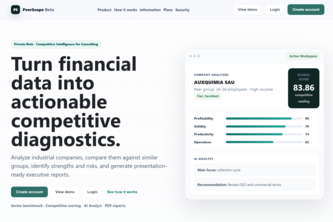
PeerScope is a self-reported financial analysis platform for consulting teams, built as part of an OpenAI 2026 hackathon project. The author describes it as an evidence-grounded system that allows consultants to calculate canonical company scores, compare them with peers, and generate structured executive reports using AI. It uses deterministic scoring pipelines and controlled AI workflows to ensure traceability and validation of outputs.
The description states PeerScope is designed for small and mid-sized consultancies lacking internal data teams or software budgets. It includes a single developer (Javier Gonzalvez Sempere) and was built with Python, FastAPI, PostgreSQL, Supabase, and GPT-5.6.
Key commercial due-diligence questions include: Is there any evidence of traction beyond the demo? What is the actual market demand for this type of tool among consulting teams? How does PeerScope differentiate from existing financial data platforms or internal tools used by consultancies?
The most important open question is whether the described functionality has been validated with real users in a production environment, and if so, what adoption metrics exist.
What The Product Actually Is
The description states that PeerScope is an "evidence-grounded financial analysis and reporting platform for consulting teams." It allows consultants to:
- Select a company and calculate a canonical financial score.
- Compare it with relevant sector peers.
- Identify strengths, weaknesses, and areas requiring further investigation.
- Ask an AI Analyst questions about the company.
- Generate a structured executive report.
- Edit the report conversationally while reviewing every proposed change.
- Preserve a traceable version history instead of overwriting previous work.
The system is described as using deterministic scoring pipelines for KPI definitions, weights, peer groups, percentiles, and final scores. GPT-5.6 is used in two controlled workflows:
- AI Analyst — receives only a compact, company-scoped evidence packet; factual claims must reference approved evidence IDs.
- Conversational report editing — returns structured, section-scoped patch operations instead of rewriting entire reports.
The system validates AI responses and protects canonical financial figures, labeling user-provided context as unverified and displaying word-level diffs before any edit is applied.
Positioning & Claim Evolution
The description states PeerScope was built to address the challenge faced by small and mid-sized consultancies that rely on fragmented data, manual spreadsheets, and outdated workflows. It aims to transform raw company data into reproducible competitive intelligence while keeping consultants in control.
The author frames it as more than another financial dashboard — a platform designed to support rather than replace professional judgment. The positioning emphasizes:
- Evidence-grounded analysis
- Traceable reporting
- Support for smaller consultancies without internal data teams or software budgets
- Reproducible competitive intelligence
There is no evidence of prior versions, iterations, or claimed market traction beyond the Build Week demo.
Target Customer & ICP
The description states PeerScope is designed for consulting teams, particularly small and mid-sized consultancies that lack internal data teams or software budgets. These firms are described as relying heavily on intuition and repetitive work when selecting potential clients and identifying improvement opportunities.
The author notes these consultancies often do not have the resources available to larger firms to support financial analysis workflows.
No specific customer personas, firm sizes, or industry segments beyond "chemical sector" are detailed in the description.
Business Model & Pricing Evidence
Not evidenced. The description does not contain any information about pricing models, revenue streams, monetization strategies, or business model assumptions.
Technical & Delivery Signals
The system is built with:
- Python, FastAPI, PostgreSQL, Supabase, Pydantic
- JavaScript, HTML/CSS
- pytest, Playwright, Render
- OpenAI Responses API
- Codex (used throughout development cycle)
Key technical features include:
- Deterministic financial scoring pipeline
- Structured AI workflows with controlled evidence references
- Validation of AI claims and figures
- Safe abstention and rejection of unsupported output
- Structured conversational report editing
- Word-level diffs for edits
- Immutable report versions and restore capability
- Authentication and tenant isolation
- Production deployment on Render
The author reports 316 passing automated tests and a controlled real AI evaluation where zero unauthorized evidence IDs or invented figures were accepted.
Traction & Maturity Signals
Not evidenced. The description states that PeerScope moved from an early prototype to a controlled end-to-end demonstration release during Build Week, but provides no data on actual user adoption, customer feedback, revenue, or usage metrics beyond the demo environment.
Competitive Context
Not evidenced. The description does not mention any existing competitive landscape, similar products, or market positioning relative to other financial data platforms or internal tools used by consultancies.
Open Questions & Risks
- Single-person development team (Javier Gonzalvez Sempere)
- No evidence of traction beyond demo environment
- Self-reported claims without independent verification
- Limited sector coverage (only chemical sector pack mentioned)
- No pricing, monetization or business model details
- Unclear how the platform would scale to multiple sectors or users
- Dependency on GPT-5.6 and OpenAI APIs for core functionality
Questions the description leaves open
- What specific feedback have you received from consulting teams during the demo phase?
- How do you plan to expand beyond the chemical sector?
- What are your assumptions about pricing and monetization?
- Have you identified any potential customers or partners who might be interested in this solution?
- How would you handle scaling the platform for multiple concurrent users?
- What is your timeline for moving from demo to production-ready version?
- How do you plan to ensure data privacy and security compliance?
Overall Assessment
Not evidenced. The description provides no information about funding rounds, valuation, or investment interest. It does not state whether the project is seeking investment or partnership opportunities.
The author describes PeerScope as a hackathon submission with a controlled demo release, but there is no evidence of commercial traction, customer validation, or market demand beyond the self-reported account. The platform appears to be in an early development stage with limited evidence of real-world application or adoption.
User Stories BotA demo video on every pull request
Get a demo video on every new feature
GitHub App that watches your pull requests and records a narrated, captioned demo.
Save time on demo prep and make informed decisions faster with a video walkthrough of every new feature.
Source
Submitted to the OpenAI 2026 hackathon on Devpost. Project home on Devpost. Back to the full gallery on Devpost.
This competitive analysis was produced by top-founders.com (opens in a new tab)
Generated by a language model from this project's public Devpost page — its tagline, the author's own write-up and any built-with tags listed there — as captured in August 2026. Short quotations are the author's words. It is an opinion on the idea as a business, not on the people behind it, and it reflects the description as published then. If the project has moved on, request a correction below. The analysis is not independent research and contains no verified traction, revenue or customer data.
An independent guide by KFG International LLC — not affiliated with, endorsed by, or connected to Devpost or OpenAI.