

Archive position — measured, not model output
1 like on Devpost
505 of the 7,850 archived projects have more likes, and 1,758 share exactly 1 — so this project's #1,642 place in the like-ranked listing is a tie-break inside that group, not a ranking.
Projects (log scale)
Likes on Devpost. ▲ marks this project's group.
Show the figures
| Likes | Projects | Share of archive |
|---|---|---|
| 0 | 5,587 | 71.2% |
| 1 | 1,758 | 22.4% |
| 2 | 284 | 3.6% |
| 3–4 | 132 | 1.7% |
| 5–9 | 75 | 1.0% |
| 10+ | 14 | 0.2% |
 User Stories BotA demo video on every pull request
Get a demo video on every new feature
GitHub App that watches your pull requests and records a narrated, captioned demo.
Save time on demo prep and make informed decisions faster with a video walkthrough of every new feature.
Executive Summary
Per Biscuit is a web-based tool developed by one person (Peter Johnson) that allows users to compare official food-label serving sizes with real-world consumption amounts. It recalculates nutrition data in real time and aggregates anonymous user-submitted portions to build community averages. The project was built as part of the OpenAI 2026 hackathon, using a stack including Supabase, Cloudflare, and Codex.
The description states that Per Biscuit aims to make existing nutrition information more useful by showing the gap between recommended and actual consumption, without offering dietary advice or judgment. It includes features like live product search, adjustable portions, instant recalculation, and anonymous community submissions.
What Changed: The project evolved from a simple observation about biscuit serving sizes into a functional public tool with editorial content and plans for broader impact on food industry practices.
Single Most Important Open Question: Is there sufficient user engagement or community data to validate the utility of aggregated portion trends? The description does not provide evidence of traction, revenue, or customer adoption beyond the solo developer's own account.
What The Product Actually Is
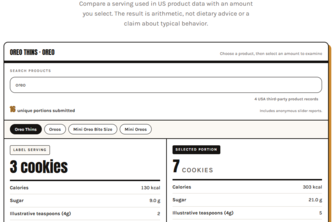
The description states that Per Biscuit is a responsive web application designed to compare manufacturer-recommended serving sizes with what people actually eat. It allows users to search for food or drink products and adjust their portion size, which triggers real-time recalculations of calories, sugar, salt, and other nutritional values.
It combines:
- Structured product information (from labels)
- Anonymous user-submitted portions
- Side-by-side display of official vs. actual consumption
The tool is described as not recommending diets or judging behavior, but rather making nutrition data more accessible and contextual.
Inference: The product appears to function as a consumer-facing interface for comparing food label accuracy with real-world eating habits, using anonymized community data to enhance understanding.
Positioning & Claim Evolution
The description states that Per Biscuit started from an individual observation about biscuit serving sizes — specifically, the absurdity of “Per Biscuit” as a serving size. This led to a broader question: how much do recommended serving sizes differ from actual consumption?
Its positioning is framed around:
- Making nutrition information more useful
- Highlighting discrepancies between labels and real-world intake
- Providing an educational tool rather than a prescriptive one
The project has evolved beyond a simple calculator into:
- A platform with original articles
- Analysis of unrealistic serving sizes
- Plans to share anonymized findings with researchers and the food industry
Inference: The positioning has shifted from a niche curiosity (biscuit portioning) to a potential tool for public health awareness and data collection, though no evidence supports this evolution in practice.
Target Customer & ICP
The description does not clearly define a target customer or ideal customer profile (ICP). It implies that the product is intended for consumers who read nutrition labels, but does not specify:
- Demographics
- Behavioral patterns
- Use cases beyond casual interest
- Whether it targets specific health-conscious groups or general users
The author notes that the tool is meant to be non-judgmental and educational, suggesting a broad, non-discriminatory audience.
Inference: The ICP likely includes individuals interested in nutrition, health awareness, or food labeling accuracy — but no evidence supports segmentation or targeting strategies.
Business Model & Pricing Evidence
The description does not provide any information about:
- Revenue streams
- Pricing models
- Monetization plans
- Paid features or subscriptions
It emphasizes that the tool is not recommending diets and focuses on education and transparency, implying no direct commercial intent at this stage.
Inference: There is no evidence of a business model or pricing structure; the project appears to be an open-source or prototype effort with no stated monetization strategy.
Technical & Delivery Signals
The description states that Per Biscuit was built using:
- Frontend: HTML, CSS, JavaScript
- Backend/Data: Supabase (for product and community data), PostgreSQL
- Hosting/Security: Cloudflare
- Development Tooling: Codex (used throughout development)
It also mentions:
- Responsive web design
- Real-time nutrition recalculation
- Anonymous submission endpoints
- Mobile layout improvements via Codex
Inference: The technical stack suggests a lightweight, self-contained web application built by one developer. Use of Codex implies rapid prototyping and automation in development.
Traction & Maturity Signals
The description does not include any evidence of:
- User base or engagement metrics
- Revenue or monetization
- Customer acquisition or retention data
- Product usage statistics
- Product maturity beyond initial prototype
It notes that the project has developed beyond a single calculator and includes editorial content, but no traction indicators are provided.
Inference: No measurable traction or product maturity is evidenced. The tool appears to be in early development or prototype phase.
Competitive Context
The description does not mention:
- Competitors
- Market landscape
- Similar tools or platforms
- Industry positioning
It does state that the goal is to make realistic portion information a normal part of understanding food, suggesting a potential niche in consumer health or nutrition education.
Inference: No competitive analysis or market context is provided. The project appears to be unique in its approach, but there is no evidence of existing alternatives or market saturation.
Open Questions & Risks
- Solo Developer Dependency: The entire project was built by one person (Peter Johnson), raising concerns about scalability and long-term maintenance.
- Data Quality Challenges: Inconsistent food data formats and units are noted as major challenges, which could limit usability and accuracy.
- Low Engagement Risk: No evidence of user engagement or community growth; the tool may struggle to attract enough submissions for meaningful averages.
- No Monetization Strategy: The project lacks any indication of how it might generate revenue or sustain itself beyond its hackathon origin.
- Unverified Claims: All claims are self-reported and unverified, with no third-party validation or external data.
Inference: The project is highly speculative in its potential for impact or commercial viability due to lack of traction, funding, or clear path to monetization.
Questions the description leaves open
- What specific user behaviors have you observed since launching?
- How do you plan to ensure the quality and authenticity of community-submitted data?
- Have you identified any potential partnerships with health organizations, food manufacturers, or public health bodies?
- What is your strategy for scaling beyond a single developer?
- Are there any legal or privacy considerations around collecting and sharing anonymized portion data?
- How do you intend to measure success or impact of the tool?
Overall Assessment
Not evidenced: There is no evidence of revenue, customers, traction, or financial performance to support an investment or partnership decision.
The description indicates that Per Biscuit is a conceptual prototype, developed by one person as part of a hackathon. It has not demonstrated:
- Product-market fit
- User engagement
- Scalability
- Commercial viability
Inference: Based on the self-reported account, this project is in an exploratory phase with no clear path to commercialization or measurable impact. Any investment or partnership would be highly speculative and dependent on future development and traction — none of which are evidenced here.
User Stories BotA demo video on every pull request
Get a demo video on every new feature
GitHub App that watches your pull requests and records a narrated, captioned demo.
Save time on demo prep and make informed decisions faster with a video walkthrough of every new feature.
Source
Submitted to the OpenAI 2026 hackathon on Devpost. Project home on Devpost. Back to the full gallery on Devpost.
This competitive analysis was produced by top-founders.com (opens in a new tab)
Generated by a language model from this project's public Devpost page — its tagline, the author's own write-up and any built-with tags listed there — as captured in August 2026. Short quotations are the author's words. It is an opinion on the idea as a business, not on the people behind it, and it reflects the description as published then. If the project has moved on, request a correction below. The analysis is not independent research and contains no verified traction, revenue or customer data.
An independent guide by KFG International LLC — not affiliated with, endorsed by, or connected to Devpost or OpenAI.