

Archive position — measured, not model output
0 likes on Devpost
2,263 of the 7,850 archived projects have more likes, and 5,587 share exactly 0 — so this project's #3,601 place in the like-ranked listing is a tie-break inside that group, not a ranking.
Projects (log scale)
Likes on Devpost. ▲ marks this project's group.
Show the figures
| Likes | Projects | Share of archive |
|---|---|---|
| 0 | 5,587 | 71.2% |
| 1 | 1,758 | 22.4% |
| 2 | 284 | 3.6% |
| 3–4 | 132 | 1.7% |
| 5–9 | 75 | 1.0% |
| 10+ | 14 | 0.2% |
 User Stories BotA demo video on every pull request
Get a demo video on every new feature
GitHub App that watches your pull requests and records a narrated, captioned demo.
Save time on demo prep and make informed decisions faster with a video walkthrough of every new feature.
Executive Summary
What the company appears to be
The description states that Current is a system designed to turn trusted sources into personalized learning paths, with an emphasis on testing understanding rather than recall, adapting to learner needs, and enabling educators to intervene when necessary. It uses AI to generate structured learning experiences from documentation, papers, and files.
What changed
The author reports a significant shift in product direction: from a generic AI dashboard to a system focused on "progress should mean demonstrating an idea, not scrolling past it." This reorientation appears central to the project's current form.
Single most important open question (commercial due-diligence read)
Is there evidence of real-world adoption or usage by learners or educators that would suggest viability beyond a prototype? The description contains no data on users, revenue, or customer engagement.
What The Product Actually Is
The description states that Current:
- Turns documentation, papers, links, and uploaded files into structured learning paths.
- Follows a cycle: Sources → Read → Recall → Apply → Reflect → Review.
- Evaluates understanding rather than exact wording.
- Records concept-level misconceptions.
- Adapts the next activity based on learner performance.
- Schedules future retrieval practice.
- Includes a research agent that monitors sources and proposes curriculum updates for approval.
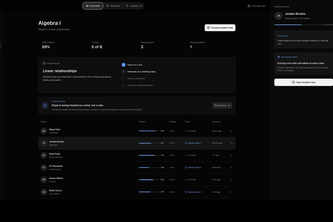
- Extends to educators via “Current Classroom,” allowing them to see shared misconceptions, assign targeted reviews, and receive evidence of student understanding.
Inferred from the description:
- The system uses AI models (GPT-5.6) in different roles: Sol for planning paths and evaluating source changes; Terra for authoring lessons; Luna for recall and application feedback.
- It is built with Next.js, React, TypeScript, and OpenAI APIs.
- A local-first runtime stores learner progress and supports offline behavior.
Not evidenced:
- No details on how the system handles content ingestion or processing beyond “sources.”
- No information about how the AI models are trained or fine-tuned.
- No mention of integration with existing LMS platforms or tools.
Positioning & Claim Evolution
The author states that Current was inspired by a gap in traditional education and AI interfaces:
- Traditional courses become outdated quickly.
- Chat interfaces remove productive friction, which is essential for learning.
- Current sits between these extremes: source-grounded, adaptive, and evidence-based.
Key claims made:
- Progress should mean demonstrating an idea, not scrolling past it.
- The system evaluates understanding rather than exact wording.
- Misconceptions are recorded at the concept level.
- Curriculum updates happen through human approval, not silent rewriting.
Inferred evolution:
- Initial version was a generic AI dashboard; this was scrapped in favor of a more focused approach.
- The focus shifted from general AI utility to structured learning with feedback loops and educator involvement.
Not evidenced:
- No evidence of prior positioning or claims before this version.
- No indication of how the product differentiates itself from other AI learning tools or platforms.
Target Customer & ICP
The description mentions two main user groups:
- Learners: Individuals pursuing personal or lifelong learning, especially in fast-moving fields.
- Educators: Teachers who can use Current Classroom to monitor student progress, assign targeted interventions, and act on evidence of understanding.
Inferred:
- The system targets learners interested in self-directed study with structured feedback.
- Educators are positioned as key users for classroom implementation.
Not evidenced:
- No specific customer personas or segments defined.
- No information about how the product reaches these users.
- No mention of institutional adoption or pilot programs.
Business Model & Pricing Evidence
The description does not state anything about:
- Revenue model
- Pricing structure
- Monetization strategy
- Subscription tiers or usage-based billing
Inferred:
- The system may be sold to institutions or individuals, with potential for educator-facing features.
- Classroom functionality suggests a B2B or education-focused model.
Not evidenced:
- No pricing data, customer acquisition costs, or monetization plans.
- No indication of whether the product is free, freemium, or paid.
Technical & Delivery Signals
The description states that Current is built with:
- Next.js 16, React 19, TypeScript
- React Flow for UI/UX
- OpenAI APIs (GPT-5.6, Codex)
- Deployed via OpenAI Sites
- Local-first runtime for storing progress and supporting offline behavior
Inferred:
- The system uses task-specific routing of AI models.
- Structured outputs are enforced to maintain compatibility with the product runtime.
- Deterministic fallbacks ensure reproducibility during demo or low-connectivity scenarios.
Not evidenced:
- No details on infrastructure scalability, data privacy, or security measures.
- No information about API access, developer tools, or extensibility.
- No mention of how the system handles large-scale content ingestion or processing.
Traction & Maturity Signals
The description states:
- The complete workflow functions end to end.
- Thirty passing product and API tests.
- A working demo with full user flows.
- The system supports learner profiles, cloud sync, teacher-authored constraints, and optional focus tools in its roadmap.
Inferred:
- The project is a functional prototype but not yet deployed at scale.
- It has undergone iterative development and testing.
Not evidenced:
- No information on actual users or usage metrics.
- No evidence of customer feedback loops or product-market fit.
- No mention of beta users, pilot programs, or institutional partnerships.
Competitive Context
The description does not provide any information about:
- Competitors in the AI learning space
- Market positioning relative to existing tools like Coursera, Khan Academy, Duolingo, or Anki
- Differentiation from other AI-powered education platforms
Inferred:
- Current operates in a competitive space that includes AI-driven learning systems and adaptive curricula.
- It may compete with tools that offer chat-based learning or spaced repetition.
Not evidenced:
- No competitor analysis or market share data.
- No indication of how Current compares technically or functionally to existing solutions.
Open Questions & Risks
Key risks identified from the description:
- Lack of traction: No evidence of real-world usage, customers, or revenue.
- Unproven scalability: The system is described as a prototype with limited testing beyond internal validation.
- Dependency on AI models: Heavy reliance on GPT-5.6 and OpenAI APIs may create vendor lock-in or instability.
- Unclear monetization path: No business model or pricing strategy is evident.
- Educator adoption risk: The system requires teacher engagement, which may be difficult to achieve without proven value.
Open questions:
- The project is described as a single-person effort (team size: 1).
- No mention of partnerships, institutional pilots, or user feedback loops.
- The focus on “evidence-based learning” and “teacher intervention” suggests a niche market with uncertain demand.
Questions the description leaves open
- What specific educational outcomes have you observed in learners using Current?
- How do you plan to scale beyond the current prototype and single developer?
- Have you conducted any user testing or pilot programs with educators or students?
- What is your strategy for monetization, and how are you approaching customer acquisition?
- How does Current handle content that is not available in structured formats (e.g., videos, unstructured text)?
- What are the technical limitations of relying on GPT-5.6 and OpenAI APIs for core functionality?
- How do you plan to differentiate from existing AI learning platforms or spaced repetition tools?
Overall Assessment
The description states that Current is a functional prototype with end-to-end workflows, but there is no evidence of traction, revenue, or customer engagement. The system is described as a single-developer effort with no institutional backing or pilot programs.
Assessment:
This project is in an early stage of development and lacks commercial due-diligence signals such as user data, revenue, or market validation. It represents a compelling idea with strong technical execution but requires further evidence of viability before any investment or partnership consideration.
The author claims the system works end-to-end, but this does not constitute proof of adoption or scalability. The lack of real-world usage, monetization strategy, and competitive positioning makes it difficult to assess its potential for growth or impact.
Confidence level: Low — based on self-reported evidence only, with no external validation or traction data.
User Stories BotA demo video on every pull request
Get a demo video on every new feature
GitHub App that watches your pull requests and records a narrated, captioned demo.
Save time on demo prep and make informed decisions faster with a video walkthrough of every new feature.
Source
Submitted to the OpenAI 2026 hackathon on Devpost. Project home on Devpost. Back to the full gallery on Devpost.
This competitive analysis was produced by top-founders.com (opens in a new tab)
Generated by a language model from this project's public Devpost page — its tagline, the author's own write-up and any built-with tags listed there — as captured in August 2026. Short quotations are the author's words. It is an opinion on the idea as a business, not on the people behind it, and it reflects the description as published then. If the project has moved on, request a correction below. The analysis is not independent research and contains no verified traction, revenue or customer data.
An independent guide by KFG International LLC — not affiliated with, endorsed by, or connected to Devpost or OpenAI.