

Archive position — measured, not model output
0 likes on Devpost
2,263 of the 7,850 archived projects have more likes, and 5,587 share exactly 0 — so this project's #7,527 place in the like-ranked listing is a tie-break inside that group, not a ranking.
Projects (log scale)
Likes on Devpost. ▲ marks this project's group.
Show the figures
| Likes | Projects | Share of archive |
|---|---|---|
| 0 | 5,587 | 71.2% |
| 1 | 1,758 | 22.4% |
| 2 | 284 | 3.6% |
| 3–4 | 132 | 1.7% |
| 5–9 | 75 | 1.0% |
| 10+ | 14 | 0.2% |
 User Stories BotA demo video on every pull request
Get a demo video on every new feature
GitHub App that watches your pull requests and records a narrated, captioned demo.
Save time on demo prep and make informed decisions faster with a video walkthrough of every new feature.
Executive Summary
What the company appears to be
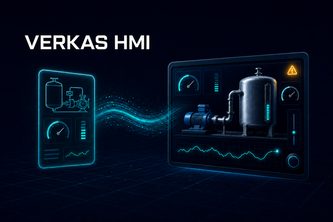
Verkas HMI is a self-reported tool that uses AI (specifically GPT-5.6) to convert industrial machine specifications into reviewable HMI (Human Machine Interface) prototypes, aiming to reduce the time engineers spend on manual HMI creation from days to minutes.
What changed
The project evolved from a manual, MCP-enabled HMI editor into a spec-driven workflow that incorporates AI for specification analysis and HMI proposal generation. The author reports integrating GPT-5.6 into both the app’s development and its internal AI-powered workflow.
Single most important open question
Is there evidence of any real-world usage or feedback from industrial engineers, or has this remained a proof-of-concept with no traction?
What The Product Actually Is
The description states that Verkas HMI is an application that allows users to import or type in machine specifications and then generates HMI prototypes through AI. It includes a review flow for refining the spec and proposing screens and functionality, followed by a visual editor for further development.
- Product function: Converts industrial specs into reviewable HMI prototypes using AI.
- Core features: Spec intake (text or Word), AI-driven proposal generation (via GPT-5.6), structured review process, visual editor for refinement.
- Not evidenced Whether the tool is currently used by engineers, how many users exist, or if it has been deployed in real industrial systems.
Positioning & Claim Evolution
The author positions Verkas HMI as a solution to inefficiencies in industrial UI development — specifically, reducing time spent on manual HMI creation. The product is described as an attempt to improve the workflow by integrating AI into the early stages of HMI design.
- Claim: Reduces HMI creation time from days to minutes.
- Evolution: Started as a manual editor; evolved into a spec-driven workflow with AI-assisted proposal generation.
- Not evidenced Whether this claim has been validated in practice, or if there is any user feedback on the tool’s effectiveness.
Target Customer & ICP
The target customer appears to be industrial engineers working on HMI development for PLC (Programmable Logic Controller) systems. The product is built around the idea of improving workflows in industrial control software environments.
- Target customer: Industrial engineers building HMI interfaces for industrial systems.
- ICP inferred: Engineers who work with machine specs and PLC programming, likely in manufacturing or automation settings.
- Not evidenced Customer names, number of users, or actual engagement data.
Business Model & Pricing Evidence
The description does not mention any pricing model, revenue streams, or monetization strategy. It is unclear whether the tool will be sold as a SaaS product, a one-time license, or if it’s still in development.
- Not evidenced Business model, pricing, or monetization approach.
- Inference: If this becomes a commercial product, it may target industrial software teams or engineering departments.
Technical & Delivery Signals
The project is built using a stack including React, TypeScript, Node.js, Electron, and OpenAI APIs. It uses GPT-5.6 for AI-driven spec interpretation and HMI generation.
- Tech stack: React, TypeScript, Node.js, Electron, OpenAI API, GPT-5.6.
- Delivery approach: A local editor with AI integration; structured workflow from spec to prototype.
- Not evidenced Deployment strategy, scalability, or performance metrics.
Traction & Maturity Signals
The project is described as a hackathon submission (Devpost entry for OpenAI 2026 hackathon). The author reports progress made during Build Week but does not provide evidence of any real-world usage or adoption.
- Not evidenced Revenue, customers, or product adoption.
- Inference: This appears to be a prototype or proof-of-concept, not a mature product in use.
Competitive Context
The description does not mention direct competitors. However, it implies that there are existing tools for generating control code but few for HMI generation — suggesting a potential gap in the market.
- Not evidenced Competitor landscape, market positioning, or competitive differentiation.
- Inference: The tool may address a niche in industrial UI development where AI is underused.
Open Questions & Risks
- Risk of overstatement: The author claims significant time savings but provides no data to back this up.
- Lack of traction: No evidence of real-world usage or customer feedback.
- Unclear commercial viability: No pricing, monetization, or business model described.
- Dependency on AI tools: Heavy reliance on GPT-5.6 and other proprietary tools may pose risks if access changes.
Questions the description leaves open
- What specific industrial machine specs are you able to process today?
- How does the AI-generated HMI proposal compare to manual design in terms of usability or functionality?
- Have you tested this with actual engineers or industrial teams?
- What is your plan for scaling beyond a hackathon prototype?
- Are there any legal or compliance issues related to using GPT-5.6 in industrial settings?
Overall Assessment
Not evidenced No data on traction, revenue, or user feedback supports an investment or partnership decision at this stage.
- Confidence level: Low.
- Assessment: This is a self-reported prototype with no evidence of commercial viability or real-world usage. It may be a promising idea in need of further development and validation before any serious due diligence can proceed.
User Stories BotA demo video on every pull request
Get a demo video on every new feature
GitHub App that watches your pull requests and records a narrated, captioned demo.
Save time on demo prep and make informed decisions faster with a video walkthrough of every new feature.
Source
Submitted to the OpenAI 2026 hackathon on Devpost. Project home on Devpost. Back to the full gallery on Devpost.
This competitive analysis was produced by top-founders.com (opens in a new tab)
Generated by a language model from this project's public Devpost page — its tagline, the author's own write-up and any built-with tags listed there — as captured in August 2026. Short quotations are the author's words. It is an opinion on the idea as a business, not on the people behind it, and it reflects the description as published then. If the project has moved on, request a correction below. The analysis is not independent research and contains no verified traction, revenue or customer data.
An independent guide by KFG International LLC — not affiliated with, endorsed by, or connected to Devpost or OpenAI.