

Archive position — measured, not model output
0 likes on Devpost
2,263 of the 7,850 archived projects have more likes, and 5,587 share exactly 0 — so this project's #7,529 place in the like-ranked listing is a tie-break inside that group, not a ranking.
Projects (log scale)
Likes on Devpost. ▲ marks this project's group.
Show the figures
| Likes | Projects | Share of archive |
|---|---|---|
| 0 | 5,587 | 71.2% |
| 1 | 1,758 | 22.4% |
| 2 | 284 | 3.6% |
| 3–4 | 132 | 1.7% |
| 5–9 | 75 | 1.0% |
| 10+ | 14 | 0.2% |
 User Stories BotA demo video on every pull request
Get a demo video on every new feature
GitHub App that watches your pull requests and records a narrated, captioned demo.
Save time on demo prep and make informed decisions faster with a video walkthrough of every new feature.
Executive Summary
What the company appears to be
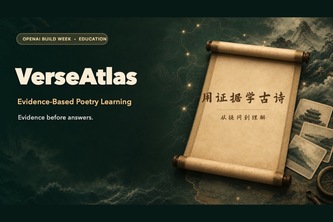
VerseAtlas is an AI-powered educational tool designed for middle-school Chinese poetry instruction. It presents students with a guided inquiry process that emphasizes evidence-based interpretation using historical context, maps, and teacher-reviewed materials. The system uses GPT-5.6 in a constrained way — not to generate answers, but to ask follow-up questions that prompt reasoning.
What changed
The project was submitted as part of the OpenAI 2026 hackathon. It represents an experimental approach to integrating AI into pedagogy by focusing on scaffolding student thinking rather than delivering ready-made interpretations.
Single most important open question
Is there evidence of traction, adoption or feedback from educators or students beyond this single hackathon submission?
What The Product Actually Is
The description states that VerseAtlas is a guided inquiry workspace for middle-school Chinese poetry, where students begin with a full poem and select a reading focus (e.g., word, phrase, image). They investigate this through maps, timelines, textbook notes, and teacher-reviewed evidence cards. The tool supports building an “evidence basket” and revising interpretations of the poem.
It uses GPT-5.6 in a constrained mode — returning only one short follow-up question grounded in selected materials, not writing full interpretations. It also includes features like historical maps (via Leaflet.js), curriculum-aligned annotations, and inquiry questions tied to each poem.
The system is built with Next.js, React, TypeScript, and integrates with OpenAI's API and Codex for development. The current version covers ten curriculum poems, including detailed materials and pathways for two of them: To the Frontier as an Envoy and Spring View.
Inference The product appears to be a prototype or proof-of-concept built during a hackathon, not yet deployed in classrooms or commercialized.
Positioning & Claim Evolution
The author claims that VerseAtlas is an evidence-first AI tutor for Chinese poetry, aiming to shift teaching away from memorization toward interpretive reasoning. It positions itself as an alternative to AI tools that provide polished interpretations too early — instead, it makes the next step of reasoning harder to skip.
It also states that the tool helps students move from initial impressions to evidence-based interpretation without replacing their own voice.
Inference This reflects a pedagogical philosophy focused on scaffolding critical thinking rather than delivering content. However, no external validation or prior use cases are provided.
Target Customer & ICP
The description states that VerseAtlas targets middle-school students learning Chinese poetry, specifically within a curriculum context. It is designed to support classroom instruction and align with educational standards.
It also mentions that the system supports both competition (judged) and classroom deployments, suggesting it may be intended for use in formal education settings, possibly including teacher-led environments.
Inference The primary user base seems to be middle-school students and teachers, though no data on actual users or customer segments is available beyond this claim.
Business Model & Pricing Evidence
There is no evidence of a business model or pricing structure in the provided description. The project is described as a hackathon submission with no indication of monetization plans, licensing models, or target revenue streams.
Inference The tool is likely not yet commercialized; it may be used internally for educational purposes or as a demonstration of AI integration in pedagogy.
Technical & Delivery Signals
VerseAtlas is built using Next.js, React, TypeScript, and integrates with OpenAI’s API (gpt-5.6-sol) and Codex. It uses Leaflet.js for map visualization and stores materials server-side to prevent unrestricted access to raw source text.
The system sends lesson and evidence IDs rather than full texts, keeping the interaction grounded in curated content. It implements a one-question response format, limiting GPT-5.6’s output to encourage reasoning over direct answers.
Inference This suggests a deliberate design choice to avoid AI shortcuts and maintain pedagogical integrity — but no real-world deployment or performance metrics are shared.
Traction & Maturity Signals
The description indicates that the project was submitted to the OpenAI 2026 hackathon, and includes a ten-poem atlas with curriculum-aligned materials. It also mentions teacher-reviewed evidence cards, inquiry questions, and historical context for each poem.
However, there is no evidence of traction, such as:
- Number of users
- Classroom adoption
- Feedback from educators or students
- Revenue or funding
Inference This is a prototype or demo-level product with no demonstrated market presence or user engagement beyond the hackathon.
Competitive Context
The description does not mention competitors. However, it implies that existing AI tools for education may offer overly simplified interpretations or lack scaffolding for reasoning. The approach taken by VerseAtlas — using constrained AI to prompt deeper thinking — appears to differentiate it from generic AI tutoring systems.
Inference While the product is positioned as innovative in its use of AI for pedagogy, no competitive landscape or benchmarking data is provided.
Open Questions & Risks
- No traction or adoption: The tool exists only as a hackathon submission with no evidence of real-world usage.
- Unproven educational impact: There is no data on whether the approach improves learning outcomes.
- Limited scalability: The current version covers only ten poems and lacks teacher authoring tools or classroom pilots.
- Unclear path to monetization: No business model, pricing, or revenue plan is evident.
- Dependence on single founder/team: The team size is listed as one member ("fox lady"), which raises concerns about execution capacity.
Inference The project remains experimental and untested in real-world educational settings. It lacks the maturity or validation needed for commercial viability.
Questions the description leaves open
- What specific feedback have you received from educators or students who tested this tool?
- How do you plan to scale beyond the current ten poems and add more content?
- Are there any plans to integrate with existing educational platforms or LMS systems?
- What are your thoughts on accessibility improvements, bilingual support, and inclusive design?
- Do you have a roadmap for teacher authoring tools or classroom deployment features?
- How do you intend to validate the effectiveness of the pedagogical approach?
Overall Assessment
Not evidenced: There is no evidence of revenue, customers, traction, or financials beyond the hackathon submission.
The project is described as a proof-of-concept, built by one person, with no indication of commercialization or market readiness. While it presents an interesting idea in AI-assisted education, there is no demonstrated product-market fit, user engagement, or business model.
Confidence level: Low — based entirely on self-reported claims and a single hackathon submission.
User Stories BotA demo video on every pull request
Get a demo video on every new feature
GitHub App that watches your pull requests and records a narrated, captioned demo.
Save time on demo prep and make informed decisions faster with a video walkthrough of every new feature.
Source
Submitted to the OpenAI 2026 hackathon on Devpost. Project home on Devpost. Back to the full gallery on Devpost.
This competitive analysis was produced by top-founders.com (opens in a new tab)
Generated by a language model from this project's public Devpost page — its tagline, the author's own write-up and any built-with tags listed there — as captured in August 2026. Short quotations are the author's words. It is an opinion on the idea as a business, not on the people behind it, and it reflects the description as published then. If the project has moved on, request a correction below. The analysis is not independent research and contains no verified traction, revenue or customer data.
An independent guide by KFG International LLC — not affiliated with, endorsed by, or connected to Devpost or OpenAI.