

Archive position — measured, not model output
0 likes on Devpost
2,263 of the 7,850 archived projects have more likes, and 5,587 share exactly 0 — so this project's #7,465 place in the like-ranked listing is a tie-break inside that group, not a ranking.
Projects (log scale)
Likes on Devpost. ▲ marks this project's group.
Show the figures
| Likes | Projects | Share of archive |
|---|---|---|
| 0 | 5,587 | 71.2% |
| 1 | 1,758 | 22.4% |
| 2 | 284 | 3.6% |
| 3–4 | 132 | 1.7% |
| 5–9 | 75 | 1.0% |
| 10+ | 14 | 0.2% |
 User Stories BotA demo video on every pull request
Get a demo video on every new feature
GitHub App that watches your pull requests and records a narrated, captioned demo.
Save time on demo prep and make informed decisions faster with a video walkthrough of every new feature.
Executive Summary
The description states that UPI_Fraud_Detection is an AI-powered fraud detection system for UPI transactions, built as a full-stack web application using machine learning models and deployed on cloud infrastructure. The author claims it analyzes transaction patterns in real time to identify suspicious activities. It was submitted to the OpenAI 2026 hackathon.
This project appears to be a prototype or proof-of-concept built by one individual (Rajanya Saha) over a short timeframe, likely during a hackathon. There is no evidence of revenue, customers, traction, or commercial deployment beyond the self-reported description. The system uses standard ML techniques including SMOTE for class imbalance and multiple models like XGBoost and LightGBM.
The single most important open question is: What is the actual commercial viability of this solution, and how does it compare to existing fraud detection systems in the UPI ecosystem?
What The Product Actually Is
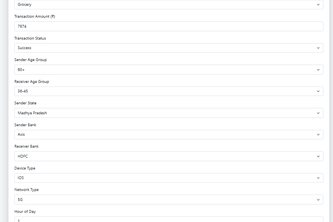
The description states that UPI_Fraud_Detection is an AI-powered fraud detection system for UPI transactions. It is described as a full-stack web application that:
- Analyzes transaction data in real time
- Uses machine learning models to predict if a transaction is fraudulent or legitimate
- Accepts transaction details through a web interface
- Evaluates features such as:
- Transaction amount
- Merchant category
- Transaction type
- Sender and receiver banks
- Device type
- Network type
- Time of transaction
The system integrates ML models with a Flask backend and a frontend built with HTML, CSS, and JavaScript. It was built using Python-based tools including scikit-learn, XGBoost, LightGBM, SMOTE, and deployed on GitHub and Render Cloud Platform.
Positioning & Claim Evolution
The description states that the system is positioned as an AI-powered fraud detection tool for UPI transactions. The author claims it helps prevent digital payment fraud by analyzing transaction patterns in real time.
The claim evolution shows:
- Initial inspiration: Addressing the growing problem of digital fraud with UPI payments
- Core positioning: Real-time fraud detection using machine learning
- Technical approach: Rule-based systems are insufficient; ML models are needed
- Value proposition: Identifies risky transactions before financial damage occurs
This is a self-reported claim about intent and positioning, not proof of traction or effectiveness.
Target Customer & ICP
The description states that the system targets users in India who use UPI for digital payments. It is designed to help prevent fraud in UPI transactions, which are described as widely used.
However, there is no evidence provided about:
- Specific customer segments (e.g., banks, payment service providers, merchants)
- Customer personas or buyer profiles
- Whether the system targets end-users or financial institutions
The ICP appears to be financial institutions or payment platforms using UPI, but this is inferred from context rather than stated directly.
Business Model & Pricing Evidence
Not evidenced. The description does not contain any information about:
- Revenue streams
- Pricing models
- Monetization strategy
- Customer acquisition costs
- Unit economics
The project appears to be a prototype with no commercial business model described.
Technical & Delivery Signals
The description states that the system was built using:
- Frontend: HTML, CSS, JavaScript
- Backend: Flask (Python)
- ML Libraries: scikit-learn, XGBoost, LightGBM, SMOTE
- Data Processing: One-Hot Encoding, StandardScaler
- Deployment: GitHub, Render Cloud Platform
Key technical details:
- Dataset size: 25,000+ UPI transactions
- Class imbalance handled with SMOTE
- Models tested: Logistic Regression, Random Forest, XGBoost, LightGBM
- Real-time prediction capability through web interface
- Challenges included deployment compatibility and class imbalance
Traction & Maturity Signals
Not evidenced. The description does not contain any information about:
- Revenue or monetization
- Customer base or adoption
- Product usage metrics
- Market traction
- Commercial deployment
- Iteration history or product maturity
The project was submitted to a hackathon, suggesting it is early-stage and likely not commercially deployed.
Competitive Context
Not evidenced. The description does not contain any information about:
- Competitors in the UPI fraud detection space
- Existing solutions or market players
- Market size or competitive positioning
- Differentiation from existing systems
The author mentions that current systems rely on rule-based methods, but does not compare to actual competitors.
Open Questions & Risks
Inferences based on self-reported information:
- Single-person development: The system was built by one person (Rajanya Saha), which raises questions about scalability and long-term maintenance.
- Hackathon prototype: Built for a hackathon, suggesting it may not be production-ready or fully tested.
- Limited dataset: Only 25,000+ transactions with only ~480 fraud cases, which may not be sufficient for robust ML model training.
- Class imbalance handling: While SMOTE was used, this is a known challenge in fraud detection that requires careful validation.
- Deployment complexity: The description mentions challenges with deploying preprocessing steps and encoders, indicating potential integration issues.
- No commercial evidence: No revenue, customers, or traction data provided.
Questions the description leaves open
- What is the actual dataset size and quality? How representative is it of real-world UPI fraud patterns?
- Has the system been tested in a live environment or with real transaction data?
- What are the performance metrics (precision, recall, F1-score) for fraud detection?
- How does this solution compare to existing fraud detection systems in the UPI ecosystem?
- What is the plan for scaling beyond a hackathon prototype?
- Are there any partnerships or commercial relationships with banks or payment providers?
- How will the system handle data privacy and compliance requirements (e.g., GDPR, Indian data protection laws)?
- What are the technical challenges in production deployment that were not addressed in the prototype?
Overall Assessment
Not evidenced. The description does not contain any information about:
- Valuation or funding status
- Investment interest or partnership opportunities
- Commercial viability or market potential
- Financial projections or business metrics
The project appears to be a hackathon submission with no evidence of commercial traction, revenue, or customer adoption. It represents an early-stage idea rather than a developed product or business opportunity.
User Stories BotA demo video on every pull request
Get a demo video on every new feature
GitHub App that watches your pull requests and records a narrated, captioned demo.
Save time on demo prep and make informed decisions faster with a video walkthrough of every new feature.
Source
Submitted to the OpenAI 2026 hackathon on Devpost. Project home on Devpost. Back to the full gallery on Devpost.
This competitive analysis was produced by top-founders.com (opens in a new tab)
Generated by a language model from this project's public Devpost page — its tagline, the author's own write-up and any built-with tags listed there — as captured in August 2026. Short quotations are the author's words. It is an opinion on the idea as a business, not on the people behind it, and it reflects the description as published then. If the project has moved on, request a correction below. The analysis is not independent research and contains no verified traction, revenue or customer data.
An independent guide by KFG International LLC — not affiliated with, endorsed by, or connected to Devpost or OpenAI.