

Archive position — measured, not model output
0 likes on Devpost
2,263 of the 7,850 archived projects have more likes, and 5,587 share exactly 0 — so this project's #7,466 place in the like-ranked listing is a tie-break inside that group, not a ranking.
Projects (log scale)
Likes on Devpost. ▲ marks this project's group.
Show the figures
| Likes | Projects | Share of archive |
|---|---|---|
| 0 | 5,587 | 71.2% |
| 1 | 1,758 | 22.4% |
| 2 | 284 | 3.6% |
| 3–4 | 132 | 1.7% |
| 5–9 | 75 | 1.0% |
| 10+ | 14 | 0.2% |
 User Stories BotA demo video on every pull request
Get a demo video on every new feature
GitHub App that watches your pull requests and records a narrated, captioned demo.
Save time on demo prep and make informed decisions faster with a video walkthrough of every new feature.
Executive Summary
What the company appears to be
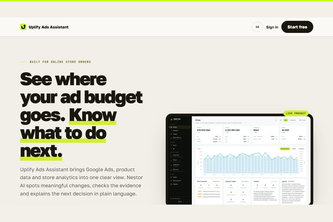
Nestor AI (formerly Uplify Ads Assistant) is a self-reported decision-support tool for online store owners that aggregates data from five Google services — Google Ads, Merchant Center, Google Analytics 4, Search Console, and PageSpeed — and attempts to explain business impact in plain language. It presents evidence-backed actions for review and approval by the user, with an emphasis on human control over automated changes.
What changed
During a hackathon (Build Week), the author added a new "Nestor" decision layer that enables conversation-based analysis of data signals and prepares draft actions for manual review. This included integrating tools for action planning, source citation, plan limits, cost quotas, and a verification bridge between audit findings and actionable proposals.
Single most important open question
Is there sufficient evidence of traction or commercial viability to justify further investment or partnership consideration? The description is entirely self-reported and lacks any data on revenue, customers, usage, or adoption beyond the author’s own account.
What The Product Actually Is
The description states that Nestor AI:
- Connects five Google data sources: Google Ads, Merchant Center, Google Analytics 4, Search Console, and PageSpeed.
- Provides a single workspace for these systems.
- Offers an assistant-like interface that reads metrics, campaigns, products, search visibility, site evidence, audit findings, recent actions, and outcomes.
- Explains commercial consequences in plain language.
- Prepares draft actions for review and approval by the user.
- Does not make live changes without human consent.
- Labels comparisons as directional signals rather than causal proof.
Inference The product appears to be a data aggregation and decision-support tool aimed at performance marketing or e-commerce store owners who use Google platforms. It is built around a conversational AI layer that synthesizes disparate signals into actionable insights, but with strong guardrails preventing automatic execution.
Positioning & Claim Evolution
The author claims:
- The product was inspired by the problem of fragmented data across multiple Google systems.
- It aims to solve the challenge of answering questions like “Why did sales fall this week?” by unifying and interpreting data.
- Unlike generic chatbots, Nestor is designed to be challenged — showing sources, naming comparison periods, admitting incomplete data, and never changing live accounts without approval.
Inference Positioning has evolved from a basic data collection tool into a decision-support assistant that emphasizes transparency, human control, and evidence-based action. The evolution during Build Week focused on adding conversational reasoning and an action layer with review mechanisms.
Target Customer & ICP
The description states:
- The target customer is online store owners.
- These users spend money on Google Ads.
- They are likely performance marketers or agency clients who need to interpret data and make decisions quickly.
Inference The ideal customer profile (ICP) appears to be small-to-medium-sized e-commerce businesses using Google advertising platforms. However, no explicit segmentation or targeting criteria beyond this general category are provided.
Business Model & Pricing Evidence
Not evidenced.
Explanation
There is no mention of pricing models, monetization strategies, or business model details in the description. The author does not state whether the tool will be sold as a SaaS product, offered free to early adopters, or supported through another mechanism.
Technical & Delivery Signals
The description states:
- Built using FastAPI, SQLAlchemy, PostgreSQL, Redis, Celery.
- Integrates with Google Ads API, Merchant API, Google Analytics Data API, Search Console API, and PageSpeed Insights API.
- Uses Claude Sonnet as the model gateway for reasoning.
- Codex + GPT-5.6 was used during development to implement features and test safety invariants.
- Includes tenant-scoped tool execution, source citations, conversation history, plan limits, cost quotas, and verification bridges.
- Supports undo functionality for supported actions.
- Model responses must pass Pydantic schema validation before being accepted.
Inference The technical stack suggests a modern backend architecture with strong separation of concerns. The use of Codex during development indicates rapid prototyping and testing using LLMs. The system enforces strict boundaries between data access, model interaction, and action execution to ensure safety and multi-tenancy.
Traction & Maturity Signals
Not evidenced.
Explanation
There is no evidence of revenue, customer base, usage metrics, or adoption rates. The project is described as a hackathon submission with limited prior development. No mention of pilot programs, beta users, or live deployments beyond the author's own testing.
Competitive Context
Not evidenced.
Explanation
The description does not reference competitors or existing solutions in the space. It does not compare Nestor AI to other tools that aggregate Google data or provide decision support for online stores.
Open Questions & Risks
- No commercial traction or revenue evidence: The product is described as a hackathon project with no known customers or monetization.
- Unverified claims about user behavior and impact: Statements about faster problem identification, better challenge of decisions, and fewer low-confidence changes are self-reported.
- Limited scalability assumptions: The system is built for single-user environments (tenant-scoped), but there’s no indication of how it might scale to larger organizations or more complex workflows.
- Dependency on LLMs with limited control over output quality: While schema validation exists, the risk of misleading or unsafe outputs remains unless further safeguards are implemented.
- Unclear path to monetization: No pricing model, subscription structure, or go-to-market strategy is described.
Questions the description leaves open
- What specific problems do store owners face today that this tool solves?
- How many stores have you tested with, and what were the results?
- Are there any early adopters or pilot customers currently using the system?
- What is your plan for monetization and pricing?
- How do you intend to scale beyond a single developer’s capacity?
- What are the key limitations of the current version that prevent broader deployment?
- Can you provide examples of how Nestor AI has helped users make better decisions in practice?
- What safeguards exist against misinterpretation or misuse of model outputs?
Overall Assessment
Not evidenced.
Explanation
There is insufficient evidence to assess the commercial viability, traction, or scalability of Nestor AI. The project is described as a hackathon effort with no known revenue, customers, or measurable impact. Any potential investment or partnership value would depend on future development and demonstration of real-world utility, which is not yet evident in the provided description.
User Stories BotA demo video on every pull request
Get a demo video on every new feature
GitHub App that watches your pull requests and records a narrated, captioned demo.
Save time on demo prep and make informed decisions faster with a video walkthrough of every new feature.
Source
Submitted to the OpenAI 2026 hackathon on Devpost. Project home on Devpost. Back to the full gallery on Devpost.
This competitive analysis was produced by top-founders.com (opens in a new tab)
Generated by a language model from this project's public Devpost page — its tagline, the author's own write-up and any built-with tags listed there — as captured in August 2026. Short quotations are the author's words. It is an opinion on the idea as a business, not on the people behind it, and it reflects the description as published then. If the project has moved on, request a correction below. The analysis is not independent research and contains no verified traction, revenue or customer data.
An independent guide by KFG International LLC — not affiliated with, endorsed by, or connected to Devpost or OpenAI.