

Archive position — measured, not model output
0 likes on Devpost
2,263 of the 7,850 archived projects have more likes, and 5,587 share exactly 0 — so this project's #7,468 place in the like-ranked listing is a tie-break inside that group, not a ranking.
Projects (log scale)
Likes on Devpost. ▲ marks this project's group.
Show the figures
| Likes | Projects | Share of archive |
|---|---|---|
| 0 | 5,587 | 71.2% |
| 1 | 1,758 | 22.4% |
| 2 | 284 | 3.6% |
| 3–4 | 132 | 1.7% |
| 5–9 | 75 | 1.0% |
| 10+ | 14 | 0.2% |
 User Stories BotA demo video on every pull request
Get a demo video on every new feature
GitHub App that watches your pull requests and records a narrated, captioned demo.
Save time on demo prep and make informed decisions faster with a video walkthrough of every new feature.
Executive Summary
What the company appears to be
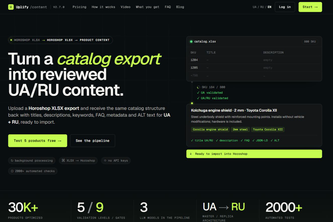
Uplify Content — Fact-Grounded Catalog Pipeline is a self-reported service that processes Horoshop XLSX exports into reviewed, import-ready product content for Ukrainian and Russian locales. It uses generative AI (with GPT-5.6 and Codex) to extract facts from public product pages, validate them against locale-specific rules, and produce structured output in XLSX format compatible with Horoshop’s workflow.
What changed
The project was extended during the OpenAI Build Week hackathon using Codex and GPT-5.6 between July 13–21, 2026. The author states that this version includes a production-equivalent test suite (~1,400 tests), a bilingual batch run, and enhancements to handling of SSRF, HTML safety, and billing logic.
Single most important open question
Is there any evidence of actual use beyond the developer’s own testing or internal trials? The description does not provide data on customers, revenue, or adoption. It is unclear whether Uplify Content has moved past a prototype or proof-of-concept stage.
What The Product Actually Is
The description states that Uplify Content accepts a standard Horoshop XLSX export with product URLs and returns the same catalog structure with reviewed content for Ukrainian and Russian locales. This includes:
- SEO and H1 titles;
- Structured HTML descriptions and TL;DR;
- Metadata and five keyword phrases per locale;
- Benefits, FAQ and JSON-LD;
- Image ALT text;
- Visible OK, WARN and ERROR outcomes;
- An XLSX that can be imported through the normal Horoshop workflow.
It does not require merchant admin passwords or API keys. It reads public product pages, preserves SKU identity, and processes each row asynchronously.
The system uses FastAPI, PostgreSQL, Redis, Celery workers, pandas, openpyxl, Beautiful Soup, lxml, and other tools to parse source data and validate outputs.
Inference The service is built as a pipeline that integrates AI generation with validation gates, retry logic, and explicit failure handling. It appears designed for batch processing of product catalogs in Ukrainian and Russian for Ukrainian e-commerce platforms like Horoshop.
Positioning & Claim Evolution
The author claims Uplify Content turns a Horoshop XLSX export into reviewed, import-ready UA/RU content — emphasizing that it avoids common pitfalls of generative AI such as mixing languages, inventing claims, or producing files that don’t import cleanly.
It positions itself not as a generic AI content generator but as a specialized tool for Ukrainian e-commerce merchants using Horoshop. It emphasizes:
- Fact-based workflows;
- Locale-specific validation;
- Preservation of SKU identity;
- Fail-closed behavior for critical rows;
- Transparency in warnings and errors.
Inference The positioning evolved from a hackathon prototype to a production-ready service with real-world use cases, though no external confirmation exists about its deployment or adoption beyond the developer's own testing.
Target Customer & ICP
The description states that Ukrainian online stores often manage hundreds or thousands of products through Horoshop. Supplier data is inconsistent and rewriting SKUs manually is slow.
The target customer appears to be:
- Ukrainian e-commerce merchants;
- Those using Horoshop as their catalog management platform;
- Users who need to generate multilingual product content at scale.
Inference The ICP seems focused on small-to-medium-sized businesses in Ukraine that rely on Horoshop for catalog maintenance and want to reduce manual effort while ensuring quality and compliance with local rules.
Business Model & Pricing Evidence
The description does not provide any information about pricing, billing models, or monetization strategies. It mentions trial and billing logic that charges successful delivery rather than queued requests, but no further details are given.
Inference There is no clear evidence of a business model beyond the idea that users pay for completed deliveries — whether via usage-based pricing, subscriptions, or per-row fees remains unknown.
Technical & Delivery Signals
The system is built using:
- FastAPI (backend);
- PostgreSQL and Redis (databases);
- Celery workers (asynchronous processing);
- pandas and openpyxl (XLSX handling);
- Beautiful Soup and lxml (HTML parsing);
- GPT-5.6 and Codex (AI generation and review);
- Docker (containerization);
- Pydantic, pytest, SQLAlchemy (validation/testing).
It includes:
- Source-fact contract extraction;
- Locale-specific validators for Ukrainian and Russian;
- Retry and fallback stages;
- SSRF protection;
- Formula-injection and unsafe HTML safeguards;
- SKU preservation across round trips.
Inference The architecture suggests a mature, production-grade pipeline with strong emphasis on safety, validation, and deterministic behavior. However, no evidence of live deployment or performance metrics is provided.
Traction & Maturity Signals
The author claims:
- A real production service used on more than 30,000 catalog rows.
- A source-fact contract with five coverage strategies and retry behavior.
- A UA-master/RU-replica architecture with brand- and INCI-aware locale checks.
- Fail-closed handling for critical rows and visible review warnings.
- Trial and billing logic that charges successful delivery rather than a queued request.
- A complete English judge path with a parser-verified five-product sample and a finished reference result.
However, there is no evidence of:
- Customer base or user feedback;
- Revenue or monetization data;
- Public usage statistics or adoption rates;
- Independent validation or audit reports.
Inference While the project has undergone significant development and includes test coverage (~1,400 tests), it lacks external traction signals. The maturity level is inferred from its structure and features but not confirmed by real-world use.
Competitive Context
The description does not mention competitors directly. However, based on the domain — multilingual product content generation for e-commerce platforms — it likely competes with:
- Generic AI content generators;
- E-commerce catalog management tools;
- Localized content automation services.
It differentiates itself by focusing specifically on Horoshop and offering a fact-grounded, validated pipeline that integrates with existing workflows.
Inference The competitive landscape is unclear without additional data. Uplify Content may be positioned as niche but specialized, targeting Ukrainian merchants who need localized product content at scale.
Open Questions & Risks
- No external validation or customer feedback: The description lacks evidence of real-world usage or performance beyond internal testing.
- Unverified claims about production use: Statements like “used on more than 30,000 catalog rows” are self-reported and uncorroborated.
- Unclear monetization strategy: No pricing model or revenue data provided.
- High technical complexity without public metrics: The system includes many safeguards but no performance data (e.g., P50/P95 times).
- Single-person team: With only one member listed, scalability and long-term maintenance are concerns.
Inference The project shows strong engineering effort and clear intent to solve a specific problem. However, due to lack of external validation or traction, it remains speculative as a commercial product.
Questions the description leaves open
- What is the actual scale of usage beyond your own testing? How many merchants are currently using Uplify Content?
- Can you provide evidence of how the system handles edge cases in real-world data?
- Is there any feedback from users or customers regarding quality, usability, or performance?
- What is the current billing model and how do you plan to scale monetization?
- How do you ensure consistency between AI-generated content and brand guidelines?
- Are there plans to expand support beyond Horoshop or into other e-commerce platforms?
- What are the key technical bottlenecks or challenges still being faced in production?
Overall Assessment
Confidence Level: Low
The description presents a technically sophisticated solution tailored to a specific market (Ukrainian e-commerce with Horoshop). It includes detailed architecture, validation mechanisms, and test coverage. However, all evidence is self-reported and unverified.
There is no indication of traction, revenue, or customer adoption beyond the developer’s own claims. The project appears to be in an early stage of development or deployment, possibly post-hackathon prototype.
Assessment Not ready for investment or partnership without further validation of real-world usage, performance data, and business model clarity. The engineering is strong, but commercial viability remains unproven.
User Stories BotA demo video on every pull request
Get a demo video on every new feature
GitHub App that watches your pull requests and records a narrated, captioned demo.
Save time on demo prep and make informed decisions faster with a video walkthrough of every new feature.
Source
Submitted to the OpenAI 2026 hackathon on Devpost. Project home on Devpost. Back to the full gallery on Devpost.
This competitive analysis was produced by top-founders.com (opens in a new tab)
Generated by a language model from this project's public Devpost page — its tagline, the author's own write-up and any built-with tags listed there — as captured in August 2026. Short quotations are the author's words. It is an opinion on the idea as a business, not on the people behind it, and it reflects the description as published then. If the project has moved on, request a correction below. The analysis is not independent research and contains no verified traction, revenue or customer data.
An independent guide by KFG International LLC — not affiliated with, endorsed by, or connected to Devpost or OpenAI.