

Archive position — measured, not model output
0 likes on Devpost
2,263 of the 7,850 archived projects have more likes, and 5,587 share exactly 0 — so this project's #7,470 place in the like-ranked listing is a tie-break inside that group, not a ranking.
Projects (log scale)
Likes on Devpost. ▲ marks this project's group.
Show the figures
| Likes | Projects | Share of archive |
|---|---|---|
| 0 | 5,587 | 71.2% |
| 1 | 1,758 | 22.4% |
| 2 | 284 | 3.6% |
| 3–4 | 132 | 1.7% |
| 5–9 | 75 | 1.0% |
| 10+ | 14 | 0.2% |
 User Stories BotA demo video on every pull request
Get a demo video on every new feature
GitHub App that watches your pull requests and records a narrated, captioned demo.
Save time on demo prep and make informed decisions faster with a video walkthrough of every new feature.
Executive Summary
What the company appears to be
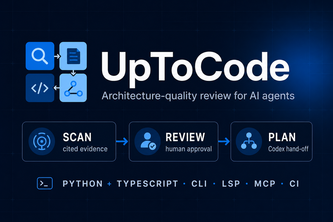
UpToCode is a self-reported architecture-quality scanner for AI agent applications in Python and TypeScript. It claims to detect architectural flaws such as missing execution bounds, budgets, approval gates, and other controls that are not caught by traditional linting. The tool operates primarily offline and statically, with optional integration into CI/CD pipelines, VS Code, and GitHub Actions.
What changed
The project was submitted to the OpenAI 2026 hackathon on Devpost. It is described as a single-developer effort built using Python and TypeScript, with support for multiple frameworks including LangGraph, CrewAI, PydanticAI, LlamaIndex, Anthropic, and OpenAI Agents SDK.
Single most important open question
Is there evidence of real-world usage or adoption beyond the author's own development environment?
What The Product Actually Is
The description states that UpToCode is an evidence-backed architecture-quality scanner for Python and TypeScript AI agent applications. It recognizes specific frameworks such as:
- OpenAI Agents SDK
- Anthropic
- CrewAI
- PydanticAI
- LlamaIndex
- LangGraph
- MCP servers
- Conservative custom agent loops
It can:
- Detect missing execution bounds, budgets, approval gates, validation, resilience, evals, observability, and other controls.
- Emit reports in multiple formats: terminal, JSON, standalone HTML, GitHub annotations, job summaries, SARIF 2.1.0.
- Show analyzed-file coverage, source evidence, stable fingerprints, and primary-source citations.
- Redact recognized secrets and narrow PII before reports or optional model judgment.
- Bind human approvals and rejections to an exact report fingerprint.
- Generate an approved-only FIXPLAN.md for Codex without changing source.
- Expose ten typed local MCP tools for various workflows.
- Provide a credential-protected hosted MCP surface for submitted-content testing.
- Integrate with pre-commit, GitHub Actions, SARIF code scanning, and a VS Code LSP extension.
The tool is described as static, offline, and non-mutating by default. An optional GPT-5.6 judgment tier exists but requires double opt-in (--judgment --send-code), sends only bounded redacted evidence, uses OpenAI Responses Structured Outputs with store=false, and cannot erase deterministic findings.
Evidence The author's own write-up describes the functionality in detail.
Inference This is a tool designed to improve safety and compliance in AI agent development by identifying architectural issues early in the development lifecycle.
Positioning & Claim Evolution
The description states that UpToCode was built to catch architecture defects, not just syntactic errors or linting issues. It emphasizes:
- Early detection of flaws like unbounded loops, no run budget, ungated destructive tools, or lack of eval coverage.
- Human approval steps between analysis and source changes.
- Evidence-backed findings instead of invented quality scores.
- Integration with existing developer workflows (CI/CD, VS Code, GitHub Actions).
It also mentions that the tool is built to “close the loop” by generating a report-bound, approved-only plan designed for a safe Codex hand-off.
Evidence The author's own write-up and tagline support this positioning.
Inference The product positions itself as a safety net in AI agent development, aiming to prevent runtime failures or security risks through early architectural review.
Target Customer & ICP
The description does not explicitly name target customers. However, it implies that the tool is aimed at developers working with AI agents in Python and TypeScript environments. It supports frameworks like LangGraph, CrewAI, PydanticAI, LlamaIndex, Anthropic, and OpenAI Agents SDK.
It integrates with:
- Pre-commit hooks
- GitHub Actions
- VS Code LSP extension
- SARIF code scanning
This suggests a developer-focused audience who are building or maintaining AI agent systems and want to ensure architectural integrity.
Evidence The write-up mentions framework support, integration points, and developer tooling.
Inference The ICP likely includes developers or engineering teams working on AI agent applications in Python/TypeScript, particularly those using modern LLM orchestration tools.
Business Model & Pricing Evidence
There is no evidence of pricing, business model, monetization strategy, or revenue streams in the description. The tool is described as being built for a hackathon and includes optional paid tiers (e.g., GPT-5.6 judgment tier), but no details are provided about how these might be offered or priced.
Evidence Not evidenced.
Technical & Delivery Signals
The project is built with:
- Python 3.11+
- AST analysis
- Tree-sitter TypeScript parsing
- Pydantic contracts
- Typer
- pygls
- Official MCP SDK
- OpenAI Responses Structured Outputs
It includes:
- A TypeScript VS Code extension
- A Next.js product site
- A composite GitHub Action
- A credential-protected Cloud Run MCP deployment
The tool supports:
- CLI, reports, CI, LSP, and MCP surfaces
- Local and hosted MCP boundaries
- Release gates with zero production findings
- Full offline suite and acceptance runner
- Real CLI and MCP lifecycles without live model calls
Evidence The author's own write-up provides technical details.
Inference This is a technically sophisticated tool built for developers, with strong emphasis on offline functionality and auditability.
Traction & Maturity Signals
There is no evidence of traction or adoption beyond the author’s own development. No customers, users, or usage metrics are mentioned. The project is described as a hackathon submission and lacks any indication of real-world deployment or market validation.
Evidence Not evidenced.
Competitive Context
The description does not mention competitors directly. However, it implies that UpToCode addresses gaps in current AI agent safety tools by focusing on architecture-level issues, rather than code-level linting or static analysis.
It operates in a space where:
- LLM agents are increasingly used
- Safety and compliance are critical concerns
- Tools exist for linting and CI/CD, but few focus specifically on architectural flaws
Evidence Not evidenced.
Inference UpToCode competes with tools that provide general static analysis or CI/CD integrations, but it differentiates itself by focusing on architecture-level safety in AI agents.
Open Questions & Risks
- No traction or adoption: The tool is described as a hackathon project with no evidence of real-world usage.
- Single developer team: Only one member listed (DDYRich72 Nokes).
- Unproven business model: No pricing, monetization, or revenue data provided.
- Limited scope: Focuses only on Python and TypeScript, and specific frameworks.
- Optional paid tier: The GPT-5.6 judgment tier is double opt-in and requires sending code — raises privacy and security concerns if not handled carefully.
- Self-reported maturity: No independent validation or audit data.
Evidence Not evidenced.
Questions the description leaves open
- What real-world use cases have you seen for this tool beyond your own development?
- How do you plan to scale beyond a single developer team?
- Are there any early adopters or pilot users of the tool?
- What is the expected path to monetization, and how will pricing be structured?
- How does the tool handle edge cases or unsupported constructs in dynamic languages like Python?
- What are the plans for expanding support beyond Python and TypeScript?
- Can you provide more details on how the human approval binding works in practice?
- How do you ensure that the optional GPT-5.6 tier doesn’t introduce bias or false positives?
Overall Assessment
There is no evidence of revenue, customers, traction, or a clear business model. The project appears to be a hackathon submission with no indication of commercial viability or market readiness.
The tool shows technical sophistication and addresses an important gap in AI agent safety, but without real-world usage or a path to monetization, it is not yet ready for investment or partnership consideration.
Evidence Not evidenced.
Inference This is a promising idea with strong potential if further developed and validated in production environments. As-is, it remains a proof-of-concept.
User Stories BotA demo video on every pull request
Get a demo video on every new feature
GitHub App that watches your pull requests and records a narrated, captioned demo.
Save time on demo prep and make informed decisions faster with a video walkthrough of every new feature.
Source
Submitted to the OpenAI 2026 hackathon on Devpost. Project home on Devpost. Back to the full gallery on Devpost.
This competitive analysis was produced by top-founders.com (opens in a new tab)
Generated by a language model from this project's public Devpost page — its tagline, the author's own write-up and any built-with tags listed there — as captured in August 2026. Short quotations are the author's words. It is an opinion on the idea as a business, not on the people behind it, and it reflects the description as published then. If the project has moved on, request a correction below. The analysis is not independent research and contains no verified traction, revenue or customer data.
An independent guide by KFG International LLC — not affiliated with, endorsed by, or connected to Devpost or OpenAI.