

Archive position — measured, not model output
0 likes on Devpost
2,263 of the 7,850 archived projects have more likes, and 5,587 share exactly 0 — so this project's #7,467 place in the like-ranked listing is a tie-break inside that group, not a ranking.
Projects (log scale)
Likes on Devpost. ▲ marks this project's group.
Show the figures
| Likes | Projects | Share of archive |
|---|---|---|
| 0 | 5,587 | 71.2% |
| 1 | 1,758 | 22.4% |
| 2 | 284 | 3.6% |
| 3–4 | 132 | 1.7% |
| 5–9 | 75 | 1.0% |
| 10+ | 14 | 0.2% |
 User Stories BotA demo video on every pull request
Get a demo video on every new feature
GitHub App that watches your pull requests and records a narrated, captioned demo.
Save time on demo prep and make informed decisions faster with a video walkthrough of every new feature.
Executive Summary
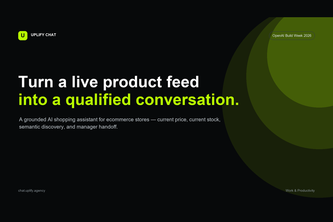
What the company appears to be: UPLIFY Chat is a self-reported product that builds an AI-powered shopping assistant for ecommerce stores. It connects to a public Google Merchant or YML XML feed and turns it into an embedded AI chatbot. The assistant validates and refreshes product data, normalizes facts, and enables shoppers to ask for products in natural language while ensuring responses are grounded in real-time inventory.
What changed: The project was built over three days (July 19–21, 2026) during a hackathon. It went from concept to shipping a working prototype with full technical implementation including feed ingestion, semantic search, conversation persistence, and merchant dashboard.
Single most important open question: Is there any evidence of traction, revenue, or customer adoption beyond the author’s own development effort?
What The Product Actually Is
The description states that UPLIFY Chat is an AI-powered ecommerce assistant that connects to a public Google Merchant or YML XML feed and turns it into an embedded chatbot. It builds tenant-scoped full-text and vector indexes, exposes a storefront widget, and allows shoppers to ask for products by use case, budget, material, brand, or description.
It includes:
- Feed validation and normalization
- Product retrieval using PostgreSQL + pgvector
- Conversational constraints and manager handoff
- Merchant workspace with analytics and billing state
The system uses FastAPI as backend service, Next.js for frontend, Preact for widget, and integrates tools like Claude Haiku 4.5 for tool calling, Voyage for embeddings, and Docker for deployment.
Inference: The product appears to be a verticalized SaaS solution aimed at small-to-medium-sized online retailers looking to improve customer engagement through AI chatbots that are grounded in real-time product data.
Positioning & Claim Evolution
The author claims UPLIFY Chat is designed to avoid common pitfalls of generic AI assistants — such as recommending unavailable products or quoting outdated prices. It emphasizes grounding responses in live feed data rather than static documents or copied website text.
Key positioning elements:
- Starts from merchant’s operational data
- Enables natural language discovery of products
- Ensures verified product cards are returned
- Offers a manager handoff without taking payment in chat
Inference: The positioning suggests a shift toward trust-bound AI assistants for ecommerce, where accuracy and integration with existing systems matter more than novelty.
Target Customer & ICP
The description states that UPLIFY Chat targets online stores that already maintain accurate price and stock data for Google Merchant, marketplaces, and advertising. These are likely small-to-medium-sized businesses using platforms like Shopify or similar.
It also implies a need for better lead generation tools that integrate with existing workflows — particularly those where managers complete orders after initial chat interactions.
Inference: The ICP seems to be merchants who already have structured product feeds and want to enhance their digital storefronts with conversational AI, without disrupting current order flows.
Business Model & Pricing Evidence
There is no explicit mention of pricing or business model in the description. However, it notes that:
- Product payment is deliberately not taken in the chat
- The merchant confirms the order and payment method
- Merchant workspace includes billing state and plan limits
Inference: This suggests a SaaS-style subscription model with tiered plans based on usage (e.g., number of conversations, leads, or store tenants), though no concrete pricing details are provided.
Technical & Delivery Signals
The project was built in 3 days during a hackathon using:
- Codex + GPT-5.6 for implementation and adversarial testing
- FastAPI backend with PostgreSQL/pgvector storage
- Next.js frontend, Preact widget component
- Docker-based production deployment
- Semantic search via Voyage embeddings and Claude Haiku 4.5
Key technical signals:
- Multi-tenancy support
- Bounded search tool calling
- Conversation history persistence
- Rate limiting and origin validation
- Feed synchronization from XML/YML sources
Inference: The delivery shows a high degree of technical maturity for a prototype, especially in areas like vector search, tool calling, and secure API design.
Traction & Maturity Signals
The description states that the product was created and shipped between July 19 and July 21, 2026. It includes an initial commit (d37c52d) and a detailed history of vertical slices implemented during Build Week.
However, there is no evidence of:
- Revenue
- Customers
- Usage metrics
- Product adoption beyond the author’s own development
Inference: The project has reached prototype maturity but lacks any signs of traction or commercial viability.
Competitive Context
The description does not reference competitors directly. However, it implies a space where AI-powered ecommerce assistants exist — such as those built by companies like Shopify, Zendesk, or custom integrations with chatbot platforms.
It positions itself as distinct because:
- Grounded in real-time product feeds
- Avoids hallucinations through strict validation
- Integrates with existing workflows via manager handoff
Inference: UPLIFY Chat likely competes with generic AI assistants used for customer service, but differentiates by grounding responses and integrating into existing order management systems.
Open Questions & Risks
- No revenue or customer data: The entire description is self-reported and unverified. No evidence of traction or monetization.
- Single-person team: Only one developer was involved in building the product.
- Prototype-only status: Built during a hackathon; no indication of long-term development or scaling plans.
- Unproven market fit: No mention of early adopters, pilot programs, or feedback loops.
- Limited integration scope: Currently supports only Google Merchant and YML feeds — not other platforms like Shopify or WooCommerce.
Questions the description leaves open
- What specific types of merchants are you targeting? Are there any existing customers?
- How do you plan to scale beyond the current single-developer build?
- Have you conducted any user testing or feedback collection with real stores?
- What is your go-to-market strategy for reaching potential customers?
- How will you handle data privacy and compliance (e.g., GDPR, CCPA)?
- Are there plans to support additional ecommerce platforms beyond Google Merchant/YML?
- What are the key performance indicators (KPIs) you’re tracking internally?
Overall Assessment
Not evidenced: There is no evidence of revenue, customers, or traction beyond the author’s own development effort.
The product shows strong technical execution and a clear understanding of the problem space — particularly around grounding AI responses in real-time data. However, without any commercial validation or market feedback, it remains a prototype with uncertain commercial potential.
Confidence level: Low. The description is self-reported and unverified; no third-party corroboration exists.
Assessment: Early-stage idea with strong engineering foundation but no demonstrated traction or business model. Not ready for investment or partnership unless further validated through pilots or early users.
User Stories BotA demo video on every pull request
Get a demo video on every new feature
GitHub App that watches your pull requests and records a narrated, captioned demo.
Save time on demo prep and make informed decisions faster with a video walkthrough of every new feature.
Source
Submitted to the OpenAI 2026 hackathon on Devpost. Project home on Devpost. Back to the full gallery on Devpost.
This competitive analysis was produced by top-founders.com (opens in a new tab)
Generated by a language model from this project's public Devpost page — its tagline, the author's own write-up and any built-with tags listed there — as captured in August 2026. Short quotations are the author's words. It is an opinion on the idea as a business, not on the people behind it, and it reflects the description as published then. If the project has moved on, request a correction below. The analysis is not independent research and contains no verified traction, revenue or customer data.
An independent guide by KFG International LLC — not affiliated with, endorsed by, or connected to Devpost or OpenAI.