

Archive position — measured, not model output
0 likes on Devpost
2,263 of the 7,850 archived projects have more likes, and 5,587 share exactly 0 — so this project's #3,543 place in the like-ranked listing is a tie-break inside that group, not a ranking.
Projects (log scale)
Likes on Devpost. ▲ marks this project's group.
Show the figures
| Likes | Projects | Share of archive |
|---|---|---|
| 0 | 5,587 | 71.2% |
| 1 | 1,758 | 22.4% |
| 2 | 284 | 3.6% |
| 3–4 | 132 | 1.7% |
| 5–9 | 75 | 1.0% |
| 10+ | 14 | 0.2% |
 User Stories BotA demo video on every pull request
Get a demo video on every new feature
GitHub App that watches your pull requests and records a narrated, captioned demo.
Save time on demo prep and make informed decisions faster with a video walkthrough of every new feature.
Executive Summary
What the company appears to be
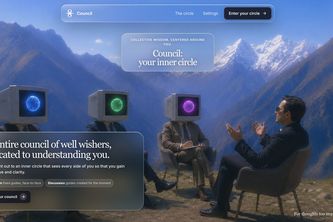
Council: your Inner Circle is a self-reported AI-powered emotional support platform that presents itself as a multi-agent system offering three distinct AI guides — therapist, guide, and friend — in both voice and text modes. It aims to provide personalized, non-judgmental listening and perspective-taking for users experiencing anxiety, loneliness, or mental overwhelm.
What changed
The project description indicates an evolution from a general idea of needing “a support system we wished existed” into a concrete product built with AI agents, voice interaction, and memory systems. It is positioned as a tool to help users navigate emotional complexity through structured multi-agent dialogue rather than traditional chatbots.
Single most important open question
Is there evidence of any traction, revenue, or user adoption beyond the author’s own account? The description contains no data on usage, customers, monetization, or market validation — only claims and technical architecture.
Note: This analysis is based entirely on the self-reported, unverified project description provided by the caller. No external corroboration exists for any of the stated features, functionality, or business outcomes.
What The Product Actually Is
The description states that Council is a multi-agent AI system designed to offer users a private inner circle composed of three specialized AI agents:
- A therapist, who helps understand emotions, thoughts, and behavioral patterns.
- A guide, who brings structure, perspective, and practical direction.
- A friend, who listens with warmth, empathy, and familiarity.
It offers two main modes:
- Voice Mode: A face-to-face, video-call-style experience where users can speak naturally with the three guides.
- Council Discussion: A dynamic group of specialized agents that analyze a user’s problem from multiple angles (e.g., mental health, relationships, career decisions).
The system uses an orchestration layer to determine which agents are relevant, how they should respond, and how their outputs are synthesized into one coherent answer.
It also includes:
- Real-time voice interaction capabilities
- Memory and context retention
- A calming interface built with modern web technologies
Claim: The product is described as a multi-agent AI system that allows users to engage in emotionally nuanced conversations using voice or text.
Evidence: Yes, from the project write-up.
Positioning & Claim Evolution
The author describes Council as an emotional support tool intended for people who feel isolated or overwhelmed. It positions itself as:
- Not just another chatbot
- A replacement for traditional therapy that is inaccessible or expensive
- An alternative to friends who may not have time or emotional bandwidth
- A safe, judgment-free space for personal reflection
The positioning evolved from a broad need ("nobody you can truly talk to") to a specific solution involving AI agents with distinct roles and personalities.
Claim: Council aims to be an emotionally intelligent support system that listens deeply, remembers what matters, and helps users gain clarity.
Evidence: Yes, in the inspiration and what it does sections.
Target Customer & ICP
The description implies a target audience of individuals experiencing:
- Anxiety
- Loneliness
- Uncertainty
- Overthinking
- Mental overwhelm
These users are described as those who may not have access to professional therapy or emotional support from friends due to time constraints, lack of understanding, or emotional bandwidth.
It is implied that the platform serves people seeking a private, non-judgmental space for self-reflection and emotional processing — especially during difficult periods.
Claim: The target customer is emotionally vulnerable individuals who want personalized, empathetic listening without judgment.
Evidence: Yes, in the inspiration section.
Business Model & Pricing Evidence
There is no mention of pricing, monetization strategy, or business model in the project description. The author does not state whether Council will be free, subscription-based, ad-supported, or otherwise funded.
Claim: No evidence of business model or pricing.
Evidence: Not evidenced.
Technical & Delivery Signals
The system is built using:
- Next.js, React, TypeScript, Tailwind CSS
- OpenAI models (including GPT-5.6), Codex, ElevenLabs API
- Real-time voice technologies including WebRTC, speech recognition, and text-to-speech
- Multi-agent architecture with orchestration logic
It includes features such as:
- Voice activity detection
- Streaming AI responses
- Audio interruption handling
- Echo cancellation
- Turn-taking between user and agents
- Memory management for context retention
Claim: The platform uses a multi-agent system, real-time voice interaction, and advanced memory/context systems.
Evidence: Yes, in the how we built it section.
Traction & Maturity Signals
There is no evidence of traction, revenue, or user adoption. The project was submitted to the OpenAI 2026 hackathon, but there is no indication of any launch, beta users, or product usage metrics.
Claim: No evidence of traction or maturity.
Evidence: Not evidenced.
Competitive Context
The author does not reference existing competitors. However, based on the description, potential categories include:
- Mental health apps (e.g., Headspace, Calm)
- AI chatbots for emotional support
- Therapy platforms (e.g., BetterHelp, Talkspace)
- Voice-based conversational AI tools
It is unclear whether Council directly competes with any of these or if it occupies a unique niche.
Claim: No evidence of competitive landscape.
Evidence: Not evidenced.
Open Questions & Risks
Several risks and open questions are present based on the self-reported description:
- The system is described as a prototype or hackathon submission — no commercial deployment or user base.
- There is no mention of safety protocols beyond “emotional responsibility,” which may not be sufficient for vulnerable users.
- The use of AI agents raises concerns about hallucination, misinterpretation, and lack of accountability.
- Voice interaction introduces technical complexity that could fail in real-world conditions.
- No evidence of regulatory compliance or ethical oversight.
Claim: Risks include lack of traction, unproven safety mechanisms, and high technical risk.
Evidence: Inferred from the absence of any commercial or user data, and the nature of the product.
Questions the description leaves open
- What is your plan for ensuring the safety and ethical use of AI in emotionally vulnerable contexts?
- How do you intend to differentiate Council from existing mental health tools or chatbots?
- Have you conducted any user testing or gathered feedback on the multi-agent experience?
- What are your plans for scaling beyond a single-person team?
- Are there any legal or compliance considerations around privacy, data handling, or AI liability?
- How do you intend to monetize this product, and what is your go-to-market strategy?
Inference: These questions aim to probe the lack of evidence in key areas such as traction, safety, differentiation, and business model.
Overall Assessment
This is a self-reported project submitted for a hackathon. There is no evidence of revenue, customers, or product traction. The description outlines an ambitious technical architecture but lacks any demonstration of real-world impact or commercial viability.
Claim: No investment or partnership value at this stage.
Evidence: Not evidenced.
User Stories BotA demo video on every pull request
Get a demo video on every new feature
GitHub App that watches your pull requests and records a narrated, captioned demo.
Save time on demo prep and make informed decisions faster with a video walkthrough of every new feature.
Source
Submitted to the OpenAI 2026 hackathon on Devpost. Project home on Devpost. Back to the full gallery on Devpost.
This competitive analysis was produced by top-founders.com (opens in a new tab)
Generated by a language model from this project's public Devpost page — its tagline, the author's own write-up and any built-with tags listed there — as captured in August 2026. Short quotations are the author's words. It is an opinion on the idea as a business, not on the people behind it, and it reflects the description as published then. If the project has moved on, request a correction below. The analysis is not independent research and contains no verified traction, revenue or customer data.
An independent guide by KFG International LLC — not affiliated with, endorsed by, or connected to Devpost or OpenAI.