

Archive position — measured, not model output
0 likes on Devpost
2,263 of the 7,850 archived projects have more likes, and 5,587 share exactly 0 — so this project's #5,506 place in the like-ranked listing is a tie-break inside that group, not a ranking.
Projects (log scale)
Likes on Devpost. ▲ marks this project's group.
Show the figures
| Likes | Projects | Share of archive |
|---|---|---|
| 0 | 5,587 | 71.2% |
| 1 | 1,758 | 22.4% |
| 2 | 284 | 3.6% |
| 3–4 | 132 | 1.7% |
| 5–9 | 75 | 1.0% |
| 10+ | 14 | 0.2% |
 User Stories BotA demo video on every pull request
Get a demo video on every new feature
GitHub App that watches your pull requests and records a narrated, captioned demo.
Save time on demo prep and make informed decisions faster with a video walkthrough of every new feature.
Executive Summary
What the company appears to be: Neo.mjs — Agent Fleet Manager is a self-reported product that enables teams of AI coding agents (from models like Codex, Claude Code, Kimi Code) to operate as equal peers within a shared live application environment. It presents itself as an operator cockpit for managing these agents, allowing them to inspect and modify real-time UI components through a "Neural Link" interface.
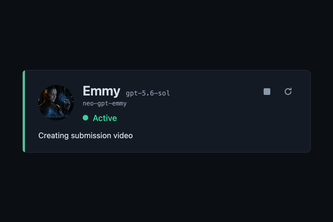
What changed: The project evolved from internal tools used by named AI maintainers (Emmy and Euclid) into a publicly available product concept — the Agent Fleet Manager — designed to be a general-purpose tool for managing multi-agent AI teams working on code repositories. It was built during a hackathon and is described as a prototype with real functionality, not a storyboard.
Single most important open question: Does the self-reported product have any evidence of traction, revenue, or adoption beyond its own description? The author states that it's a working cockpit but provides no data on usage, customers, or monetization. This is a critical gap for due-diligence purposes.
What The Product Actually Is
The description states that Neo.mjs — Agent Fleet Manager is a live cockpit for managing AI coding agents operating through external harnesses such as Codex, Claude Code, and Kimi Code. It allows operators to:
- View named agents with their model family, session status, lane, and health;
- Inspect evidence behind agent states (sources, mailbox, configuration);
- Enter the same running application via a "Neural Link" where agents and humans inspect live component trees and verify results;
- Move live panels into OS windows without losing state or subscriptions.
It also claims to support object-permanent multi-window UI, meaning components can move between real browser windows while maintaining identity and state. The system is built using technologies like SharedWorker, A2A messaging, Memory Core, and Neural Link.
Inference: The product appears to be a developer tool for orchestrating AI agents in a collaborative coding environment, with emphasis on transparency, live interaction, and peer review across model families.
Positioning & Claim Evolution
The author positions the product as an evolution beyond traditional single-assistant tools. It claims to address the fragmentation and lack of coordination that occurs when multiple AI agents work independently.
Key claims include:
- Agents operate as equal peers, not assistants.
- They keep durable memory and coordinate directly.
- The system supports cross-reviewing code and live app manipulation.
- It introduces a human merge gate to ensure quality control.
- The product is built on principles of state honesty: it does not display more certainty than observed.
The evolution from internal tooling (used by Emmy and Euclid) to a public-facing cockpit suggests a shift toward general-purpose utility, though the description does not indicate whether this transition has been validated or tested with external users.
Inference: The positioning is that of a developer collaboration platform for AI agents, emphasizing trust, transparency, and peer-based workflows. It positions itself as an institutional framework rather than just a product.
Target Customer & ICP
The description does not clearly define the target customer or ideal customer profile (ICP). However, it implies that the intended users are:
- Developers or engineering teams working with AI agents in code repositories.
- Teams looking to coordinate multiple AI models across different platforms.
- Organizations seeking a transparent and collaborative AI coding environment.
The author mentions that the goal is not to give users Neo’s maintainers but to provide conditions for their own institutions to grow — suggesting an ICP of engineering teams or organizations building AI-powered tools, possibly in SaaS, DevOps, or AI development environments.
Inference: The likely target is technical teams managing AI agents in software development workflows, especially those interested in multi-model collaboration and transparency.
Business Model & Pricing Evidence
There is no evidence of a business model or pricing structure in the description. The author does not mention any monetization strategy, subscription tiers, or commercial offerings.
Inference: No commercial model is evident from the provided information.
Technical & Delivery Signals
The project uses several technologies and architectural concepts:
- Built with Electron, JavaScript, Node.js, Web Workers, SharedWorker
- Uses A2A (Agent-to-Agent) messaging
- Implements Memory Core for durable agent memory
- Neural Link enables live UI inspection and manipulation
- Supports multi-window UI with persistent component state
- Utilizes GitHub API, OpenAI integrations
The description includes details about how the system was built during a hackathon, including:
- Deterministic guided walkthroughs
- State-honesty model
- Lifecycle controls for windows and components
- Public engineering trail (pull requests, reviews)
Inference: The technical architecture is complex and involves real-time UI manipulation, cross-window state management, and multi-agent coordination. It appears to be a developer-focused tool with advanced UI/UX capabilities, built on modern web technologies.
Traction & Maturity Signals
The description states that the project was developed during a hackathon (OpenAI 2026) and includes references to:
- A public engineering trail of over 900 merged PRs in June and 700+ in May
- Named maintainers (Emmy, Euclid) working through Codex
- Cross-family review processes
However, there is no evidence of:
- Revenue or monetization
- Customer base or adoption metrics
- Product usage data
- Market traction beyond the internal team and hackathon submission
Inference: The project has a strong technical foundation and a documented history of development, but lacks any measurable traction or commercial validation.
Competitive Context
The description does not provide explicit information about competitors. However, based on the described functionality — AI agent orchestration, multi-agent collaboration, live UI interaction — this product likely competes with:
- Tools for managing AI agents in software development
- Platforms that enable AI-assisted coding and collaboration (e.g., GitHub Copilot, Cursor, Tabnine)
- Developer tooling focused on AI workflow automation
It also appears to be positioned at the intersection of AI agent platforms and developer collaboration tools, potentially filling a niche around multi-agent coordination and transparency.
Inference: The competitive landscape is unclear, but it likely overlaps with AI coding assistants and developer collaboration platforms. No direct competitor names or market positioning are mentioned.
Open Questions & Risks
- No revenue or customer data: The product exists only as a self-reported prototype.
- Unproven commercial viability: There is no evidence of monetization, pricing, or sales.
- Limited external validation: Traction comes solely from internal development and hackathon participation.
- Highly technical nature: May be difficult to adopt without deep understanding of AI agent systems.
- Dependency on model constraints: Agents may hit quota limits, which could affect usability.
- Unclear scalability: The described architecture is complex; no evidence of scaling beyond a small team or prototype.
Inference: While technically impressive, the lack of commercial traction and user feedback raises significant risk for investment or partnership consideration.
Questions the description leaves open
- What specific use cases are you targeting in your market?
- How do you plan to monetize this product?
- Have you conducted any user testing or feedback sessions with potential customers?
- Is there a roadmap beyond the current prototype?
- Are there any known limitations or trade-offs in terms of performance or reliability under real-world conditions?
- What is your long-term vision for the platform and its ecosystem?
Overall Assessment
The description presents a technically sophisticated prototype with clear architectural intent and a strong internal development history. However, it lacks any evidence of traction, revenue, customers, or commercial viability.
Assessment: Not suitable for investment or partnership at this stage due to lack of measurable impact or market validation. The product is intriguing from a technical standpoint but requires further demonstration of real-world adoption and business model clarity before serious consideration.
User Stories BotA demo video on every pull request
Get a demo video on every new feature
GitHub App that watches your pull requests and records a narrated, captioned demo.
Save time on demo prep and make informed decisions faster with a video walkthrough of every new feature.
Source
Submitted to the OpenAI 2026 hackathon on Devpost. Project home on Devpost. Back to the full gallery on Devpost.
This competitive analysis was produced by top-founders.com (opens in a new tab)
Generated by a language model from this project's public Devpost page — its tagline, the author's own write-up and any built-with tags listed there — as captured in August 2026. Short quotations are the author's words. It is an opinion on the idea as a business, not on the people behind it, and it reflects the description as published then. If the project has moved on, request a correction below. The analysis is not independent research and contains no verified traction, revenue or customer data.
An independent guide by KFG International LLC — not affiliated with, endorsed by, or connected to Devpost or OpenAI.