

Archive position — measured, not model output
0 likes on Devpost
2,263 of the 7,850 archived projects have more likes, and 5,587 share exactly 0 — so this project's #5,508 place in the like-ranked listing is a tie-break inside that group, not a ranking.
Projects (log scale)
Likes on Devpost. ▲ marks this project's group.
Show the figures
| Likes | Projects | Share of archive |
|---|---|---|
| 0 | 5,587 | 71.2% |
| 1 | 1,758 | 22.4% |
| 2 | 284 | 3.6% |
| 3–4 | 132 | 1.7% |
| 5–9 | 75 | 1.0% |
| 10+ | 14 | 0.2% |
 User Stories BotA demo video on every pull request
Get a demo video on every new feature
GitHub App that watches your pull requests and records a narrated, captioned demo.
Save time on demo prep and make informed decisions faster with a video walkthrough of every new feature.
Executive Summary
Company: Nept
Self-reported basis: The analysis is based entirely on the project description provided by the caller — including name, tagline, author’s own write-up, and technology stack. No external verification or historical data is available.
Commercial due-diligence read: Nept appears to be a developer-first deployment platform that automates application deployment from Git repositories, supporting both frontend and backend applications with preview environments and production-grade features like TLS and DDoS protection. The author states it aims to simplify infrastructure for developers, similar to Vercel or Netlify. However, no evidence of revenue, customers, traction or product-market fit is present. The single most important open question is whether Nept has achieved sufficient developer adoption or technical maturity to justify further investment or partnership.
What The Product Actually Is
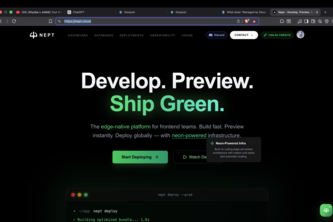
The description states that Nept is an edge-native deployment platform that allows developers to connect a Git repository and automatically build, preview, and deploy applications. It supports modern frontend frameworks as well as backend languages such as Node.js, Python, Go, Rust, Java, PHP, Ruby, C#, and more.
- The system has four main stages: source integration, application detection and build, deployment orchestration, and secure traffic routing.
- Developers can use either a Git repository or the Nept CLI to initiate deployment.
- It assigns URLs to deployed workloads and routes requests to them.
- Preview environments are created for every branch.
- Production deployments include automatic TLS, DDoS protection, and scaling.
Inference: Based on the description, Nept is positioned as an automated CI/CD and deployment tool that abstracts infrastructure complexity from developers. It is not evidenced whether it has been used beyond a prototype or hackathon context.
Positioning & Claim Evolution
The author states that Nept was inspired by platforms like Vercel and Netlify, aiming to offer a similar developer-first experience while creating its own platform.
- The core positioning is: “developers should be able to move from code to production without being slowed down by infrastructure”.
- It claims to support both frontend and backend applications.
- The platform aims to provide:
- Automatic deployments from Git
- Branch preview environments
- Production essentials such as global delivery, TLS, DDoS mitigation, and automatic scaling
Inference: Nept positions itself in the serverless or deployment-as-a-service space. It is not evidenced whether this positioning has evolved over time or if it has been validated by users.
Target Customer & ICP
The description states that Nept targets developers, particularly those who want to deploy applications quickly and without infrastructure overhead.
- It supports modern frontend frameworks and backend languages.
- The platform is designed for developers who value simplicity, automation, and configuration-light workflows.
- It is described as a developer-first platform.
Inference: The ICP (Ideal Customer Profile) appears to be individual developers or small teams building web applications using common stacks. No evidence of enterprise customers or specific use cases beyond this is provided.
Business Model & Pricing Evidence
There is no mention in the description of pricing, monetization strategy, or business model.
- The author does not state how Nept intends to make money.
- There is no indication of paid tiers, freemium offerings, or subscription models.
- No evidence of revenue streams or customer acquisition costs is present.
Inference: The business model remains unknown. It is unclear whether Nept intends to be free, pay-as-you-go, or enterprise-focused.
Technical & Delivery Signals
The author describes the technical architecture and delivery process:
- Built with technologies including Amazon Firecrackers, ClickHouse, Docker, Kubernetes, Next.js, Node.js, PostgreSQL.
- The system supports many frameworks while keeping a consistent developer experience.
- It uses Codex to automate DNS configuration through Domain Connect.
- Uses scheduling features of Codex to monitor emails and prepare replies for integration with Cloudflare and Domain Connect.
Inference: The platform appears to be built on modern infrastructure components, but no evidence of production usage or scalability is provided. The use of Codex suggests early-stage automation efforts rather than a mature system.
Traction & Maturity Signals
There is no evidence of traction, customers, revenue, or product-market fit in the description.
- The project was submitted to the OpenAI 2026 hackathon, indicating it is likely a prototype or early-stage idea.
- No mention of users, adoption rates, or usage metrics.
- No evidence of product maturity beyond initial development.
Inference: Nept has not demonstrated any measurable traction or market validation. It is described as a hackathon project with no known production use.
Competitive Context
The description explicitly states that Nept is inspired by platforms like Vercel and Netlify, positioning itself in the same category of deployment tools for developers.
- It aims to offer similar functionality but with its own unique features.
- The author mentions support for many backend languages, which may differentiate it from some competitors.
Inference: In a competitive landscape dominated by Vercel, Netlify, and others, Nept would need to prove distinct value or niche appeal. No evidence of competitive positioning or differentiation is provided.
Open Questions & Risks
- No traction or revenue: The project is described as a hackathon submission with no evidence of adoption.
- Single founder team: Only one member (MR. K) is listed, raising questions about execution capability and scalability.
- Unproven market fit: No evidence of user feedback, product-market fit, or customer validation.
- Limited technical depth: The use of Codex for automation suggests early-stage development rather than a robust system.
- No pricing or monetization strategy: Unclear how the platform will generate revenue.
Inference: The lack of traction, limited team size, and absence of business model or user data are significant open questions for any commercial due-diligence evaluation.
Questions the description leaves open
- What is the current status of Nept? Is it a working prototype or a live product?
- How many developers are currently using Nept, and what feedback have you received?
- What is your monetization strategy? Are you planning to charge for usage or offer freemium tiers?
- How do you plan to scale beyond the current team size?
- What differentiates Nept from existing platforms like Vercel or Netlify?
- Have you validated your product with real users or beta testers?
- What are your plans for expanding support for additional frameworks or languages?
Overall Assessment
Not evidenced: There is no evidence to support a commercial investment or partnership decision.
- The project is described as a hackathon submission.
- No revenue, customers, traction, or validated product-market fit are present.
- The team size is small (one person).
- No business model or pricing strategy is evident.
Confidence level: Very low. This is a self-reported idea with no external validation or commercial evidence to support further due-diligence engagement.
User Stories BotA demo video on every pull request
Get a demo video on every new feature
GitHub App that watches your pull requests and records a narrated, captioned demo.
Save time on demo prep and make informed decisions faster with a video walkthrough of every new feature.
Source
Submitted to the OpenAI 2026 hackathon on Devpost. Project home on Devpost. Back to the full gallery on Devpost.
This competitive analysis was produced by top-founders.com (opens in a new tab)
Generated by a language model from this project's public Devpost page — its tagline, the author's own write-up and any built-with tags listed there — as captured in August 2026. Short quotations are the author's words. It is an opinion on the idea as a business, not on the people behind it, and it reflects the description as published then. If the project has moved on, request a correction below. The analysis is not independent research and contains no verified traction, revenue or customer data.
An independent guide by KFG International LLC — not affiliated with, endorsed by, or connected to Devpost or OpenAI.