

Archive position — measured, not model output
1 like on Devpost
505 of the 7,850 archived projects have more likes, and 1,758 share exactly 1 — so this project's #2,142 place in the like-ranked listing is a tie-break inside that group, not a ranking.
Projects (log scale)
Likes on Devpost. ▲ marks this project's group.
Show the figures
| Likes | Projects | Share of archive |
|---|---|---|
| 0 | 5,587 | 71.2% |
| 1 | 1,758 | 22.4% |
| 2 | 284 | 3.6% |
| 3–4 | 132 | 1.7% |
| 5–9 | 75 | 1.0% |
| 10+ | 14 | 0.2% |
 User Stories BotA demo video on every pull request
Get a demo video on every new feature
GitHub App that watches your pull requests and records a narrated, captioned demo.
Save time on demo prep and make informed decisions faster with a video walkthrough of every new feature.
Executive Summary
What the company appears to be
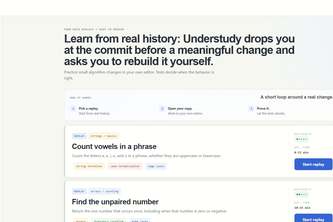
Understudy is a self-reported local AI coding coach that uses Git history to generate guided practice exercises for developers. The tool aims to help learners understand real software changes by having them rebuild those changes themselves, using tests as evidence and AI coaching for support.
What changed
The author states this is a project built for the OpenAI 2026 hackathon. It is described as a local Next.js application with no external dependencies beyond Git and OpenAI APIs. The tool supports linking local repositories or using a built-in task manager, and it generates practice tasks from commit history.
Single most important open question
Is there any evidence of real usage, adoption, or traction beyond the author’s own development? The description is entirely self-reported with no data on users, revenue, or product-market fit.
What The Product Actually Is
The description states that Understudy is a local Next.js application built with React, TypeScript, Node.js, Git worktrees, npm, Vitest, Zod, and the OpenAI API. It is designed to run locally on a developer’s machine without requiring an account or cloud workspace.
It supports:
- Linking compatible local Git repositories
- Identifying replayable commits (especially those adding tests)
- Drafting learner-friendly tasks from commit history
- Creating isolated working copies of codebases
- Running project tests and edge-case checks
- Providing AI coaching via GPT-5.6 for planning, hints, and reflection
- Generating a final Mastery Report with attempts, test results, timeline, and Git diff
The tool is described as not generating patches, but instead helping learners rebuild changes themselves using tests as evidence.
Evidence
- The author states: “Understudy is a local Next.js application built with React, TypeScript, Node.js, Git worktrees, npm, Vitest, Zod, and the OpenAI API.”
- It supports linking repositories or using a built-in task manager.
- It uses AI only for coaching, not code generation.
Inference The product is a developer education tool, not a commercial SaaS offering. It is self-contained and runs locally.
Positioning & Claim Evolution
The author positions Understudy as an educational tool that uses real Git history to teach developers how to reason through software changes, rather than just generating code.
Key claims:
- AI is used for coaching, not code generation.
- The goal is to help learners become more capable of solving problems independently.
- It uses existing behavior and tests as evidence, not artificial prompts.
- It mimics real development workflows: understanding codebases, preserving behavior, handling edge cases, and explaining decisions.
Evidence
- “AI coding tools are very good at generating patches. But getting a patch is not the same as understanding why the change works.”
- “The goal is not for AI to write the solution. The goal is for the learner to become more capable of solving the problem independently.”
- “The tests decide whether the solution works. AI only provides guidance.”
Inference This positioning reflects a shift from traditional coding exercises (often artificial) to real-world, evidence-based learning, using Git history as a source of practice.
Target Customer & ICP
The author describes the target user as developers who want to improve their understanding of real software changes and reasoning. The tool is intended for learners who are already familiar with development environments like VS Code or Cursor.
It is not described as targeting:
- Beginners without Git experience
- Non-developers
- Teams or organizations
The ICP appears to be self-directed developers seeking to improve their problem-solving skills through practice, especially in the context of real-world codebases.
Evidence
- “Understudy applies the same idea to software: developers study real code changes so they can understand and reproduce them themselves.”
- “Learners need to know which project they are working on, what behavior they are trying to change, where their editable copy is located.”
Inference The tool is likely aimed at intermediate-to-advanced developers, not novices or students.
Business Model & Pricing Evidence
There is no evidence of a business model or pricing structure in the description. The product is described as a local application with no mention of monetization, subscriptions, or paid features.
Evidence
- No mention of revenue, pricing, or monetization.
- The tool runs locally and does not require an account or cloud workspace.
Inference The project appears to be non-commercial, possibly a hackathon submission or personal project, with no evidence of a commercial business model.
Technical & Delivery Signals
Understudy is built as a local Next.js application using:
- React
- TypeScript
- Node.js
- Git worktrees
- Vitest for testing
- Zod for validation
- OpenAI API (GPT-5.6)
It supports:
- Isolated working copies of repositories
- Test verification and edge-case checks
- AI coaching via GPT-5.6
- Local execution without cloud dependencies
Evidence
- “Understudy is a local Next.js application built with React, TypeScript, Node.js, Git worktrees, npm, Vitest, Zod, and the OpenAI API.”
- “It runs locally, so the learner’s project and worktree remain on their own machine.”
Inference The tool is technically robust, with a clear architecture for local execution and Git integration. It uses modern tools and practices.
Traction & Maturity Signals
There is no evidence of traction or maturity beyond the author’s own development. No customer data, usage metrics, or adoption indicators are provided.
Evidence
- The project was submitted to a hackathon.
- No mention of users, customers, or product-market fit.
- No revenue, ARR, or headcount data.
Inference The tool is in an early stage, likely a prototype or proof-of-concept. There is no evidence of real-world usage or commercial traction.
Competitive Context
The description does not mention any direct competitors. However, the concept aligns with:
- Developer education platforms (e.g., Exercism, LeetCode)
- AI coding tools that offer coaching or explanations
- Tools that use Git history for learning (e.g., GitHub Copilot, CodeSandbox)
Evidence
- No mention of competitors.
- The tool is described as using Git history in a novel way to generate practice tasks.
Inference It may be positioned as a niche educational tool, distinct from general coding platforms or AI assistants. Its uniqueness lies in the use of real codebases and Git history for learning.
Open Questions & Risks
- No commercial traction or evidence of adoption: The project is described only as a hackathon submission.
- Limited scope: It is a local tool with no cloud features, which may limit scalability or usability.
- AI coaching boundaries: While the author states AI is used for support, not replacement, there’s no evidence of how this boundary is enforced or measured.
- No validation of learning outcomes: There is no mention of whether learners actually improve or if the tool is effective.
Evidence
- No data on users, adoption, or impact.
- The tool is described as a local application with no cloud features.
Inference The project may be high-risk for commercialization, especially without evidence of user engagement or learning outcomes.
Questions the description leaves open
- What is the actual user experience like? How do developers interact with the tool in practice?
- Have you tested the tool with real users, and if so, what feedback did you get?
- How do you plan to scale beyond a local application?
- Is there any evidence of learning outcomes or improvements from using the tool?
- What are your plans for monetization or commercial viability?
- How does the tool handle edge cases in Git history that may not be replayable?
- Do you have any data on how many developers have used it, or how long they spend on tasks?
Overall Assessment
Not evidenced.
The description is entirely self-reported and unverified. There is no evidence of:
- Revenue
- Customers
- Traction
- Product-market fit
- Commercial viability
This appears to be a personal or hackathon project, not a commercial venture.
Inference If this is a prototype or early-stage idea, it may have potential for further development. However, there is no basis for investment or partnership at this time due to the lack of evidence of real usage or impact.
User Stories BotA demo video on every pull request
Get a demo video on every new feature
GitHub App that watches your pull requests and records a narrated, captioned demo.
Save time on demo prep and make informed decisions faster with a video walkthrough of every new feature.
Source
Submitted to the OpenAI 2026 hackathon on Devpost. Project home on Devpost. Back to the full gallery on Devpost.
This competitive analysis was produced by top-founders.com (opens in a new tab)
Generated by a language model from this project's public Devpost page — its tagline, the author's own write-up and any built-with tags listed there — as captured in August 2026. Short quotations are the author's words. It is an opinion on the idea as a business, not on the people behind it, and it reflects the description as published then. If the project has moved on, request a correction below. The analysis is not independent research and contains no verified traction, revenue or customer data.
An independent guide by KFG International LLC — not affiliated with, endorsed by, or connected to Devpost or OpenAI.