

Archive position — measured, not model output
1 like on Devpost
505 of the 7,850 archived projects have more likes, and 1,758 share exactly 1 — so this project's #2,144 place in the like-ranked listing is a tie-break inside that group, not a ranking.
Projects (log scale)
Likes on Devpost. ▲ marks this project's group.
Show the figures
| Likes | Projects | Share of archive |
|---|---|---|
| 0 | 5,587 | 71.2% |
| 1 | 1,758 | 22.4% |
| 2 | 284 | 3.6% |
| 3–4 | 132 | 1.7% |
| 5–9 | 75 | 1.0% |
| 10+ | 14 | 0.2% |
 User Stories BotA demo video on every pull request
Get a demo video on every new feature
GitHub App that watches your pull requests and records a narrated, captioned demo.
Save time on demo prep and make informed decisions faster with a video walkthrough of every new feature.
Executive Summary
Company: Unisong
Self-reported basis: The description is entirely self-reported and unverified, based on a Devpost submission for the OpenAI 2026 hackathon. No third-party verification, revenue, customer or traction data is available beyond what the author states.
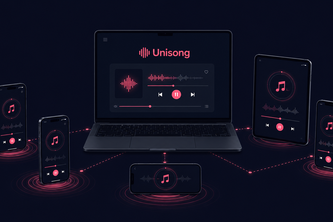
What it appears to be: A proof-of-concept application that enables multiple consumer devices (laptops, phones, tablets) to function as a synchronized multi-speaker audio system over Wi-Fi. It allows one device to act as a host and others to join via QR code or browser client, with shared playlist control and synchronized playback.
What changed: The author states that this submission covers only meaningful extensions completed during the OpenAI Build Week hackathon period. These include improvements in readiness-gated playback, catch-up behavior for reconnecting devices, safer next-track preloading, and expanded automated tests.
Single most important open question: Is there evidence of any commercial traction or user adoption beyond the author's own development work? The description makes no claims about revenue, customers, or usage beyond the hackathon context.
What The Product Actually Is
The description states that Unisong:
- Runs a host application on macOS or Windows
- Allows devices on the same Wi-Fi network to join via QR code through a browser or mobile client
- Enables the host to add music, create playlists, and control playback for the room
- Prepares tracks in advance and schedules a shared start time so devices begin together
- Supports local music folders, macOS Music-library imports, saved playlists, public-domain sample tracks, lyrics, cover art, per-device controls, audio extraction from local videos or supported links, and light/dark themes
Inference: The product is a multi-device audio synchronization tool built for personal use in shared spaces. It appears to be a prototype or early-stage product with no evidence of commercial deployment.
Positioning & Claim Evolution
The author states:
- Unisong makes existing devices work together as one listening system
- It addresses the need for immersive, room-filling audio without dedicated speakers or wiring
- Music is inherently social, and the tool supports that by enabling shared listening experiences
Inference: The positioning is centered on personal use in shared environments (e.g., homes, offices) where people want to enjoy synchronized music across multiple devices. It does not claim to be a commercial product or enterprise solution.
Target Customer & ICP
The description states:
- The tool targets users who already have laptops, phones, and tablets
- It is designed for personal use in shared spaces
- It supports macOS and Windows hosts, with browser and mobile clients
Inference: The target customer appears to be individual consumers or small groups looking to enhance their audio experience using existing devices. No evidence of a defined ICP beyond this.
Business Model & Pricing Evidence
The description states:
- No pricing information is provided
- The project was submitted as part of a hackathon
- There is no mention of monetization, subscriptions, or paid features
Inference: No business model or pricing evidence is available. The product appears to be non-commercial in nature.
Technical & Delivery Signals
The description states:
- Desktop host built with Electron
- Python gRPC core for authoritative room time and scheduled events
- FastAPI gateway serving HTTP APIs, WebSockets, local media, and browser clients
- Clients estimate offset from room clock, prepare audio, report readiness, and route latency
- Codex was used as a development collaborator during Build Week
Inference: The technical stack suggests a hybrid desktop/browser/mobile application with strong synchronization logic. However, no evidence of production deployment or scalability.
Traction & Maturity Signals
The description states:
- This submission covers only extensions completed during the OpenAI Build Week hackathon
- Pre-event baseline is Git commit 306d361
- More than 80 dated commits in 306d361..HEAD
- Accomplishments include readiness-gated playback, reconnect and foreground catch-up, safer preloaded next-track handoff, FIFO device admission, complete macOS/Windows host experience, browser onboarding via QR codes, focused regression tests, clearer architecture
Inference: The project is a hackathon prototype with no evidence of user adoption or production use. It shows development maturity but not commercial traction.
Competitive Context
The description does not mention any competitors or market positioning beyond its own functionality.
Inference: No competitive analysis is provided. The author does not state whether similar tools exist, nor how Unisong differentiates from them.
Open Questions & Risks
- No commercial traction: The product was submitted as a hackathon project with no evidence of users or revenue.
- Single-person team: Only one developer (Azer Alekberov) is mentioned, which raises questions about scalability and long-term maintenance.
- No monetization strategy: No pricing, subscriptions, or business model are described.
- Unverified claims: All statements are self-reported and unverifiable.
Questions the description leaves open
- What is the current status of the product beyond the hackathon?
- Have you tested this with real users or in production environments?
- Are there plans to monetize or commercialize this tool?
- How do you intend to scale beyond a single developer?
- What are your thoughts on long-term maintenance and updates?
Overall Assessment
Not evidenced: There is no evidence of revenue, customers, or traction to support an investment or partnership decision.
The description indicates this is a hackathon project with no commercial use or adoption beyond the author’s own development. It lacks any indication of product-market fit, scalability, or monetization strategy.
Confidence level: Low — based entirely on self-reported content with no external validation or data.
User Stories BotA demo video on every pull request
Get a demo video on every new feature
GitHub App that watches your pull requests and records a narrated, captioned demo.
Save time on demo prep and make informed decisions faster with a video walkthrough of every new feature.
Source
Submitted to the OpenAI 2026 hackathon on Devpost. Project home on Devpost. Back to the full gallery on Devpost.
This competitive analysis was produced by top-founders.com (opens in a new tab)
Generated by a language model from this project's public Devpost page — its tagline, the author's own write-up and any built-with tags listed there — as captured in August 2026. Short quotations are the author's words. It is an opinion on the idea as a business, not on the people behind it, and it reflects the description as published then. If the project has moved on, request a correction below. The analysis is not independent research and contains no verified traction, revenue or customer data.
An independent guide by KFG International LLC — not affiliated with, endorsed by, or connected to Devpost or OpenAI.