

Archive position — measured, not model output
0 likes on Devpost
2,263 of the 7,850 archived projects have more likes, and 5,587 share exactly 0 — so this project's #6,068 place in the like-ranked listing is a tie-break inside that group, not a ranking.
Projects (log scale)
Likes on Devpost. ▲ marks this project's group.
Show the figures
| Likes | Projects | Share of archive |
|---|---|---|
| 0 | 5,587 | 71.2% |
| 1 | 1,758 | 22.4% |
| 2 | 284 | 3.6% |
| 3–4 | 132 | 1.7% |
| 5–9 | 75 | 1.0% |
| 10+ | 14 | 0.2% |
 User Stories BotA demo video on every pull request
Get a demo video on every new feature
GitHub App that watches your pull requests and records a narrated, captioned demo.
Save time on demo prep and make informed decisions faster with a video walkthrough of every new feature.
Executive Summary
What the company appears to be
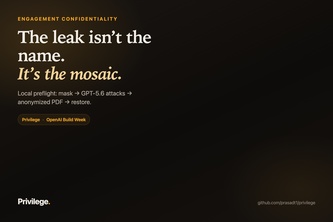
Privilege is a local-first tool for protecting sensitive information in documents before sending them to AI systems. The author states it uses a deterministic masking layer locally, then runs a frontier model (GPT-5.6) as an attacker on the sanitized document to detect re-identification risks. If the model identifies the client, the send is blocked or transformed.
What changed
The project was submitted by one developer (Prasad Tilloo) for the OpenAI 2026 hackathon. It is described as a prototype built during OpenAI Build Week, using Codex and GPT-5.6 in its core logic. The author emphasizes that this is not a compliance certification but a data minimization control.
Single most important open question
Is the local masking sufficient to prevent re-identification by GPT-5.6, or does the attack layer (GPT-5.6) remain the primary defense? The description states that deterministic matching can't beat all of Unicode and that the GPT-5.6 layer is load-bearing — but how effective is this in practice beyond a demo?
What The Product Actually Is
The description states that Privilege is a local-first confidentiality preflight for documents intended for AI systems. It works by:
- Locally masking confidential terms using deterministic rules.
- Running GPT-5.6 as an attacker on the sanitized document to attempt re-identification.
- Blocking or transforming the send if re-identification occurs.
- Allowing users to restore names from AI replies locally, without exposing sensitive data.
The tool is described as a preflight-and-attack loop, with a web UI and support for local PDF processing. It includes a vault system (SQLite-based) that stores engagement metadata and receipts.
Evidence
- “Privilege is a local-first confidentiality preflight.”
- “Mask → attack with GPT-5.6 — the sanitized candidate plus prior disclosures; one job: re-identify the client.”
- “The core was built in Codex with GPT-5.6 across four sessions.”
Inference It appears to be a proof-of-concept prototype, not a production-grade solution.
Positioning & Claim Evolution
The author positions Privilege as a solution for consultants and enterprises who need AI assistance on sensitive documents without exposing client identities. The core claim is that traditional redaction fails because context reveals identity — and that a model-based attack layer is necessary to detect such leaks.
Evidence
- “Redaction looks like the answer, until you notice the name was never the leak.”
- “Privilege doesn’t just redact and hope. It masks locally, then turns GPT-5.6 into an attacker...”
- “It isn't only a client problem — I'd like AI on my own financial and personal records too.”
Inference The positioning is evolving from a niche use case (consultants) to broader privacy needs (personal and enterprise), but no evidence of market traction or adoption exists.
Target Customer & ICP
The author states that Privilege targets:
- Consultants working with client documents.
- Enterprises with confidentiality obligations at scale.
- Anyone who wants AI on sensitive documents without giving up the sensitive part.
Evidence
- “I'm a consultant, and I want AI help on client documents.”
- “Same tool, same need: for consultants, for enterprises with the same obligation at scale.”
Inference The ICP is not clearly defined beyond self-reported use cases. No evidence of customer segments or personas.
Business Model & Pricing Evidence
There is no evidence of a business model or pricing structure in the description.
Evidence
- “Try it in 60 seconds (no API key, no spend)”
- “No fixed rule beats a creative adversary.”
Inference The tool appears to be open-source and self-hosted. No monetization strategy is described.
Technical & Delivery Signals
Privilege is built as a local-first application, using Python, SQLite, and GPT-5.6. It includes:
- A deterministic sanitizer.
- An attack loop with GPT-5.6.
- A web UI for engagement management.
- Support for MCP (Model Control Protocol) adapter.
- A demo vault with live receipts.
Evidence
- “Built with (author-declared): codex, css, gpt-5.6, html, javascript, mcp, openai, pypdf, pytest, python, python-docx, sqlite, vanilla”
- “The core was built in Codex with GPT-5.6 across four sessions.”
- “Everything fails closed: a bad file, a missing key, or an exhausted repair round becomes Block, never a silent send.”
Inference It is a prototype with strong local-first design and security-by-design principles, but not yet production-ready.
Traction & Maturity Signals
There is no evidence of traction, customers, revenue, or adoption beyond the author’s own demo and evaluation.
Evidence
- “The numbers (frozen, reproducible)” — refers to a demo run.
- “Ten scenarios were frozen and committed before the runner...”
- “A prefilled vault from a real GPT-5.6 run ships in the repo.”
Inference This is a prototype with limited validation beyond internal testing.
Competitive Context
The description does not mention any direct competitors or market positioning relative to existing tools for document redaction or AI privacy.
Evidence
- No mention of similar tools.
- No comparison to existing solutions in the market.
Inference No competitive landscape is evident from the provided description.
Open Questions & Risks
- Dependency on GPT-5.6: The system relies heavily on a frontier model for attack detection, which may not be scalable or consistent.
- Local masking limitations: The author admits that deterministic matching cannot beat all of Unicode and that the GPT-5.6 layer is load-bearing.
- Prototype nature: The tool is described as a hackathon submission and demo, with no evidence of production use or scalability.
- No monetization strategy: No business model is evident.
Evidence
- “The threat is frontier-model inference, so I measure the risk by pointing a frontier model at the sanitized document.”
- “Deterministic matching can’t beat all of Unicode.”
- “This is a data-minimisation control, not a compliance certification.”
Questions the description leaves open
- What are the specific use cases where this tool has been tested beyond the demo?
- How does the GPT-5.6 attack layer perform in real-world scenarios with larger and more complex documents?
- Are there plans to support offline or local model inference for users who cannot send data to OpenAI?
- What is the long-term vision for Privilege — is it intended as a standalone tool or part of a broader platform?
- How does the tool handle edge cases like multi-language documents, complex layouts, or non-text elements?
Overall Assessment
Not evidenced.
The description provides no information about funding rounds, valuation, team size beyond one person, or any commercial traction. The project is described as a solo developer’s hackathon submission and demo.
Inference This is not a viable investment or partnership opportunity at this stage — it is a prototype with limited evidence of market demand or scalability. It may be of interest for early-stage R&D or strategic partnerships, but no commercial due-diligence signals are present.
User Stories BotA demo video on every pull request
Get a demo video on every new feature
GitHub App that watches your pull requests and records a narrated, captioned demo.
Save time on demo prep and make informed decisions faster with a video walkthrough of every new feature.
Source
Submitted to the OpenAI 2026 hackathon on Devpost. Project home on Devpost. Back to the full gallery on Devpost.
This competitive analysis was produced by top-founders.com (opens in a new tab)
Generated by a language model from this project's public Devpost page — its tagline, the author's own write-up and any built-with tags listed there — as captured in August 2026. Short quotations are the author's words. It is an opinion on the idea as a business, not on the people behind it, and it reflects the description as published then. If the project has moved on, request a correction below. The analysis is not independent research and contains no verified traction, revenue or customer data.
An independent guide by KFG International LLC — not affiliated with, endorsed by, or connected to Devpost or OpenAI.