

Archive position — measured, not model output
0 likes on Devpost
2,263 of the 7,850 archived projects have more likes, and 5,587 share exactly 0 — so this project's #4,105 place in the like-ranked listing is a tie-break inside that group, not a ranking.
Projects (log scale)
Likes on Devpost. ▲ marks this project's group.
Show the figures
| Likes | Projects | Share of archive |
|---|---|---|
| 0 | 5,587 | 71.2% |
| 1 | 1,758 | 22.4% |
| 2 | 284 | 3.6% |
| 3–4 | 132 | 1.7% |
| 5–9 | 75 | 1.0% |
| 10+ | 14 | 0.2% |
 User Stories BotA demo video on every pull request
Get a demo video on every new feature
GitHub App that watches your pull requests and records a narrated, captioned demo.
Save time on demo prep and make informed decisions faster with a video walkthrough of every new feature.
Executive Summary
What the company appears to be
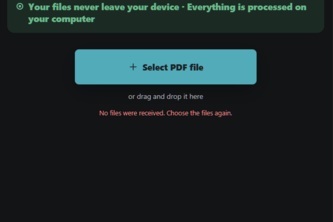
FinishPDF is a browser-based PDF toolset that performs common document operations (merge, split, compress, rotate, etc.) without uploading files to any server. The product is built as a single-person project using modern web technologies and AI assistance.
What changed
The project was submitted to the OpenAI 2026 hackathon, indicating it was developed during a short timeframe (Build Week) with AI collaboration. It is described as a complete working product with mobile support, localization, and automated testing.
Single most important open question
Is there any evidence of user adoption or commercial traction beyond the hackathon submission?
What The Product Actually Is
The description states that FinishPDF is "a collection of focused, browser-local PDF tools" that includes:
- Merge PDF
- Split PDF
- Extract pages
- Organize PDF
- Rotate PDF
- Delete pages
- Watermark PDF
- Add page numbers
- Compress PDF
Each workflow follows a consistent process: choose local files, perform one recognizable task, and download the result.
The product is described as running entirely in the browser using Web Workers for processing, with no document bytes uploaded to servers. It uses libraries like pdf.js, pdf-lib, and qpdf (via WebAssembly) for PDF operations.
Evidence The author's own write-up describes these features and technical implementation details.
Inference The product is a web application that enables local PDF editing without cloud processing.
Positioning & Claim Evolution
The description states that FinishPDF was created around the idea: "make common PDF work free and easy without sending the document to a processing server."
It positions itself as a privacy-focused alternative to online PDF editors, emphasizing:
- No uploads
- No accounts
- No complicated editor
- Local processing only
The product is described as being built with AI (Codex + GPT-5.6) to help define scope and implement features.
Evidence The author's own write-up contains these claims about positioning and evolution.
Inference This is a privacy-first, no-upload PDF toolset aimed at people who want simple, local document manipulation.
Target Customer & ICP
The description states that FinishPDF was designed for people who:
- Want to complete specific PDF tasks quickly
- Do not need a complicated editor
- Are concerned about privacy and do not want to upload documents online
- Use mobile devices or desktops
It is described as being built with mobile support from the beginning, targeting users across different device types.
Evidence The author's own write-up describes target users and device support.
Inference The ICP appears to be privacy-conscious individuals who perform simple PDF tasks on various devices without relying on cloud services.
Business Model & Pricing Evidence
The description does not contain any information about pricing, monetization, or business model. It only states that the product is "free and easy" to use and emphasizes its local processing capabilities.
Evidence Not evidenced.
Inference No commercial model or pricing structure is described; it appears to be a free tool with no stated revenue path.
Technical & Delivery Signals
The project was built using:
- Astro (for rendering)
- React (for UI components)
- TypeScript (for type safety)
- PDF.js, pdf-lib, qpdf (for PDF operations)
- Web Workers (for processing)
- Playwright and Vitest (for testing)
It uses a self-hosted qpdf WebAssembly runtime for compression and handles password-protected inputs locally.
The system is described as having responsive design, mobile support, localization in English and Spanish, and automated checks for output correctness, accessibility, and privacy.
Evidence The author's own write-up contains these technical details.
Inference The product is built with modern web technologies and has a clear focus on performance, security, and usability across platforms.
Traction & Maturity Signals
There is no evidence of revenue, customers, or user adoption beyond the hackathon submission. The project is described as being developed during Build Week, and the authors state they are preparing it for an open-source release.
Evidence Not evidenced.
Inference No traction signals are present; this appears to be a prototype or proof-of-concept submitted to a hackathon.
Competitive Context
The description does not mention any competitors. It focuses on how FinishPDF avoids uploading documents and provides local processing, but does not compare itself to existing PDF tools or platforms.
Evidence Not evidenced.
Inference No competitive positioning or market analysis is provided; the product seems to be positioned as a privacy-focused alternative to online PDF editors.
Open Questions & Risks
- No commercial traction or revenue model: The project is presented as a hackathon submission with no evidence of users or monetization.
- Single-person development team: The team size is listed as 1, which raises questions about scalability and long-term maintenance.
- Unverified claims: All claims are self-reported and unverified; there is no independent validation of the product's functionality or privacy promises.
- Limited testing scope: While mobile support was tested, it is unclear how extensive that testing was or whether real-world usage has been validated.
Evidence The description itself highlights these concerns without providing counterpoints.
Questions the description leaves open
- What is the current status of the product beyond the hackathon submission? Is there any user feedback or adoption?
- How does the product handle edge cases like malformed PDFs, very large files, or protected documents?
- Are there plans to monetize the tool or build a sustainable business model?
- What are the long-term maintenance and scalability challenges given the single-person development team?
- Has the AI-assisted development process been documented or can it be replicated by others?
Overall Assessment
Not evidenced.
The project is described as a hackathon submission with no evidence of commercial traction, revenue, or customer base. The product is presented as a privacy-focused, browser-based PDF toolset but lacks any indication of market validation or business sustainability.
Confidence level Low — based entirely on the self-reported description provided by the author.
User Stories BotA demo video on every pull request
Get a demo video on every new feature
GitHub App that watches your pull requests and records a narrated, captioned demo.
Save time on demo prep and make informed decisions faster with a video walkthrough of every new feature.
Source
Submitted to the OpenAI 2026 hackathon on Devpost. Project home on Devpost. Back to the full gallery on Devpost.
This competitive analysis was produced by top-founders.com (opens in a new tab)
Generated by a language model from this project's public Devpost page — its tagline, the author's own write-up and any built-with tags listed there — as captured in August 2026. Short quotations are the author's words. It is an opinion on the idea as a business, not on the people behind it, and it reflects the description as published then. If the project has moved on, request a correction below. The analysis is not independent research and contains no verified traction, revenue or customer data.
An independent guide by KFG International LLC — not affiliated with, endorsed by, or connected to Devpost or OpenAI.