

Archive position — measured, not model output
0 likes on Devpost
2,263 of the 7,850 archived projects have more likes, and 5,587 share exactly 0 — so this project's #4,106 place in the like-ranked listing is a tie-break inside that group, not a ranking.
Projects (log scale)
Likes on Devpost. ▲ marks this project's group.
Show the figures
| Likes | Projects | Share of archive |
|---|---|---|
| 0 | 5,587 | 71.2% |
| 1 | 1,758 | 22.4% |
| 2 | 284 | 3.6% |
| 3–4 | 132 | 1.7% |
| 5–9 | 75 | 1.0% |
| 10+ | 14 | 0.2% |
 User Stories BotA demo video on every pull request
Get a demo video on every new feature
GitHub App that watches your pull requests and records a narrated, captioned demo.
Save time on demo prep and make informed decisions faster with a video walkthrough of every new feature.
Executive Summary
What the company appears to be
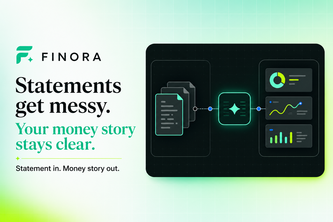
Finora is a personal finance application that processes bank, card, and UPI statements into a clean financial ledger. The description states it extracts, normalizes, categorizes, and analyzes transactions from various formats (PDFs, CSV, Excel, screenshots) and supports natural-language queries about finances. It includes an MCP server enabling AI agents to interact with financial data through 35 focused tools.
What changed
The author reports building a statement-first system that works without requiring direct bank connections, supporting multiple file types, large statements, and integrating with Google Sheets. A key evolution was adding an MCP server for agent-based workflows and authenticated Agent Skills.
Single most important open question
Does Finora have any revenue, customers or adoption beyond the author's own use case?
What The Product Actually Is
The description states that Finora:
- Processes bank, credit-card, and UPI statements into a clean financial ledger
- Accepts PDFs, CSV or Excel files, screenshots, receipt images, and transaction histories
- Extracts and normalizes transactions into one consistent format
- Cleans noisy merchant names
- Separates consumption, income, investments, and person-to-person transfers
- Categorizes transactions with confidence scores and explanations
- Detects subscriptions, possible duplicate charges, unusual transactions, and spending changes
- Calculates cash flow, savings rate, budgets, forecasts, and monthly comparisons
- Answers natural-language questions about the user’s finances
- Creates and incrementally updates a Google Sheets financial dashboard
The product is described as a statement-first personal finance app that goes beyond an ordinary expense tracker.
Positioning & Claim Evolution
The description states:
- Finora was inspired by the author's own frustration with scattered financial data across multiple providers
- It aims to be more than just a statement parser or chart collection
- The product evolved from a basic expense tracker into a system supporting complete financial workflows from messy statements to reviewed ledgers, insights, natural-language answers, and agent-driven actions
Positioning claims:
- "Finora turns messy bank, card, and UPI statements into an intelligent financial memory you can question, understand, and act on"
- "It now supports the complete journey from a messy statement to a reviewed ledger, understandable insights, natural-language answers, Google Sheets reports, and agent-driven workflows"
The evolution shows movement from basic parsing toward AI-assisted financial management with agent integration.
Target Customer & ICP
The description states:
- The primary user is someone who makes frequent payments (close to 100 UPI, bank, and card payments per week)
- This person often wonders "Where did my salary go?" after reviewing their balance
- Users are frustrated with scattered financial data across different providers using inconsistent formats
- The author built it for personal use but intended for others facing similar challenges
No explicit customer segments or personas beyond the author's own experience are described.
Business Model & Pricing Evidence
Not evidenced. The description does not mention any pricing structure, monetization strategy, or business model details.
Technical & Delivery Signals
The description states:
- Built with Next.js, React, TypeScript running on Cloudflare Workers
- Uses Cloudflare D1 for storage of accounts, sessions, normalized ledgers, budgets, report settings, chat history, and agent access data
- Statement pipeline uses different strategies for file types:
- CSV and Excel files use deterministic parsers
- Text-based PDFs are extracted before being divided along page and row boundaries
- Scanned PDFs, screenshots, and unfamiliar layouts use a multimodal fallback
- Large statements processed in bounded parallel chunks, retried by failed section, merged in document order, validated, and deduplicated
- Financial calculations kept deterministic; AI helps interpret formats and explain results but does not invent totals
- MCP server implemented in mcp/server.mjs with 35 focused tools including sync_statement, analyze_finances, find_savings, financial_health_report
- Includes authenticated Agent Skill connecting agents to cloud Finora accounts with revocable token
Traction & Maturity Signals
Not evidenced. The description does not provide any data on users, customers, revenue, or adoption beyond the author's own use case.
Competitive Context
Not evidenced. The description does not mention competitors, market positioning, or competitive landscape.
Open Questions & Risks
Inferences based on self-reported information:
- Single-person team (1 member) may limit scalability and feature development
- No revenue or customer data suggests early-stage product with unproven commercial viability
- Heavy reliance on AI tools like GPT-5.6 and Codex raises questions about dependency risks and reproducibility
- The product appears to be a personal tool rather than a commercial offering, which may indicate limited market appeal
- Lack of explicit monetization strategy or pricing model
Questions the description leaves open
- What is the actual user base beyond the author?
- How does Finora plan to scale beyond one-person development?
- Are there any revenue streams or monetization plans currently in place?
- What are the technical dependencies on AI models and how might they change?
- How does the product handle data privacy and security for financial information?
- What is the roadmap for expanding beyond personal finance use cases?
- How will Finora differentiate itself from existing personal finance tools?
Overall Assessment
Not evidenced. The description provides no information on valuation, funding rounds, or investment interest.
The author states this is a hackathon submission and that "no revenue, customer or traction data is available beyond what they state." The product appears to be an early-stage personal finance tool with no demonstrated commercial traction or business model.
User Stories BotA demo video on every pull request
Get a demo video on every new feature
GitHub App that watches your pull requests and records a narrated, captioned demo.
Save time on demo prep and make informed decisions faster with a video walkthrough of every new feature.
Source
Submitted to the OpenAI 2026 hackathon on Devpost. Project home on Devpost. Back to the full gallery on Devpost.
This competitive analysis was produced by top-founders.com (opens in a new tab)
Generated by a language model from this project's public Devpost page — its tagline, the author's own write-up and any built-with tags listed there — as captured in August 2026. Short quotations are the author's words. It is an opinion on the idea as a business, not on the people behind it, and it reflects the description as published then. If the project has moved on, request a correction below. The analysis is not independent research and contains no verified traction, revenue or customer data.
An independent guide by KFG International LLC — not affiliated with, endorsed by, or connected to Devpost or OpenAI.