

Archive position — measured, not model output
1 like on Devpost
505 of the 7,850 archived projects have more likes, and 1,758 share exactly 1 — so this project's #2,054 place in the like-ranked listing is a tie-break inside that group, not a ranking.
Projects (log scale)
Likes on Devpost. ▲ marks this project's group.
Show the figures
| Likes | Projects | Share of archive |
|---|---|---|
| 0 | 5,587 | 71.2% |
| 1 | 1,758 | 22.4% |
| 2 | 284 | 3.6% |
| 3–4 | 132 | 1.7% |
| 5–9 | 75 | 1.0% |
| 10+ | 14 | 0.2% |
 User Stories BotA demo video on every pull request
Get a demo video on every new feature
GitHub App that watches your pull requests and records a narrated, captioned demo.
Save time on demo prep and make informed decisions faster with a video walkthrough of every new feature.
Executive Summary
What the company appears to be
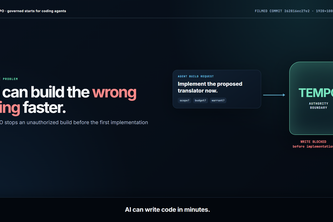
TEMPO is a self-reported project that claims to help teams answer “should we build?” with evidence-based decision-making and bounded starts. It was submitted to the OpenAI 2026 hackathon by a single founder, Junxian Wu.
What changed
The description does not indicate any prior version or evolution of the product — it is presented as a new submission to a hackathon.
The single most important open question
What is the actual mechanism by which TEMPO turns “should we build?” into evidence and bounded start? The author provides no functional details, architecture, or user flow.
Commercial due-diligence read
This is a self-reported, unverified project submitted as a hackathon entry. There is no evidence of revenue, customers, traction, or even a working prototype. It is unclear whether TEMPO is a tool, a framework, or an idea. The description lacks any commercial or technical substance to assess viability or scalability.
What The Product Actually Is
The description states that TEMPO is a project submitted to the OpenAI 2026 hackathon. It is described as turning “should we build?” into evidence, a human decision, and a bounded start.
- Claim: TEMPO helps teams make decisions about building products.
- Inference: The product may be a tool or framework for evaluating whether to proceed with development.
- Evidence: Not evidenced. The description does not define the product's form, function, or interface.
Positioning & Claim Evolution
The tagline is: “Turn ‘should we build?’ into evidence, a human decision, and a bounded start.”
- Claim: TEMPO positions itself as a decision-making tool for product development.
- Inference: It may be aimed at product managers, engineering teams, or startup founders.
- Evidence: Not evidenced. No prior version, evolution, or positioning history is provided.
Target Customer & ICP
The description does not state who the target customer is or what the ideal customer profile (ICP) might be.
- Claim: The product targets teams or individuals making decisions about building.
- Inference: Likely relevant to startups, engineering teams, or product leaders.
- Evidence: Not evidenced. No customer segment or persona described.
Business Model & Pricing Evidence
There is no mention of pricing, monetization, or business model in the description.
- Claim: The project may be a tool for internal use or a SaaS offering.
- Inference: If it's a product, it likely has a freemium or enterprise model.
- Evidence: Not evidenced. No indication of how TEMPO would make money.
Technical & Delivery Signals
The author states that the project was built with:
- Codex
- Docker
- GitHub Actions
- GPT-5.6
- JSON Schema
- Python
- TypeScript
- Claim: The tool uses AI and automation for decision-making.
- Inference: It may involve LLMs, data processing, or workflow orchestration.
- Evidence: Not evidenced. No details on how these tools are integrated or what the output looks like.
Traction & Maturity Signals
The project is described as a hackathon submission and has no evidence of traction or maturity.
- Claim: TEMPO is a new idea or prototype.
- Inference: It likely lacks users, revenue, or product-market fit.
- Evidence: Not evidenced. No mention of usage, adoption, or growth metrics.
Competitive Context
No competitive analysis or positioning relative to other tools is provided.
- Claim: TEMPO may compete with decision-making frameworks or AI-assisted planning tools.
- Inference: It could be in the space of product discovery, ideation, or development prioritization.
- Evidence: Not evidenced. No mention of competitors or market context.
Open Questions & Risks
- The project is a hackathon submission with no evidence of prior work or traction.
- There is no functional description, user flow, or technical architecture.
- The use of terms like “GPT-5.6” and “bounded start” are not defined or substantiated.
- No team, funding, or roadmap information is provided.
Questions the description leaves open
- What exactly does TEMPO do in practice? How does it turn “should we build?” into evidence?
- Is this a prototype or a working product? If so, what does it look like?
- Who are the intended users of TEMPO?
- How is the decision-making process implemented — is it AI-driven, human-in-the-loop, or both?
- What is the mechanism for “bounded start”?
- Are there any early adopters or pilot users?
Overall Assessment
Assessment Not evidenced.
- The description is a self-reported hackathon submission with no commercial or technical substance.
- There is no evidence of product-market fit, revenue, traction, or even a working prototype.
- Any potential value or scalability is speculative and not supported by the provided information.
This project is at an early idea stage and lacks any due-diligence-ready signals. It cannot be evaluated for investment or partnership without further detail.
User Stories BotA demo video on every pull request
Get a demo video on every new feature
GitHub App that watches your pull requests and records a narrated, captioned demo.
Save time on demo prep and make informed decisions faster with a video walkthrough of every new feature.
Source
Submitted to the OpenAI 2026 hackathon on Devpost. Project home on Devpost. Back to the full gallery on Devpost.
This competitive analysis was produced by top-founders.com (opens in a new tab)
Generated by a language model from this project's public Devpost page — its tagline and any built-with tags listed there, since the author published no write-up — as captured in August 2026. Short quotations are the author's words. It is an opinion on the idea as a business, not on the people behind it, and it reflects the description as published then. If the project has moved on, request a correction below. The analysis is not independent research and contains no verified traction, revenue or customer data.
An independent guide by KFG International LLC — not affiliated with, endorsed by, or connected to Devpost or OpenAI.