

Archive position — measured, not model output
0 likes on Devpost
2,263 of the 7,850 archived projects have more likes, and 5,587 share exactly 0 — so this project's #5,980 place in the like-ranked listing is a tie-break inside that group, not a ranking.
Projects (log scale)
Likes on Devpost. ▲ marks this project's group.
Show the figures
| Likes | Projects | Share of archive |
|---|---|---|
| 0 | 5,587 | 71.2% |
| 1 | 1,758 | 22.4% |
| 2 | 284 | 3.6% |
| 3–4 | 132 | 1.7% |
| 5–9 | 75 | 1.0% |
| 10+ | 14 | 0.2% |
 User Stories BotA demo video on every pull request
Get a demo video on every new feature
GitHub App that watches your pull requests and records a narrated, captioned demo.
Save time on demo prep and make informed decisions faster with a video walkthrough of every new feature.
Executive Summary
What the company appears to be
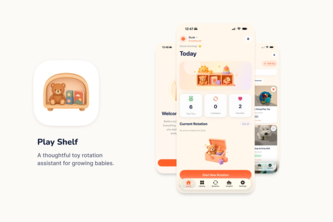
Play Shelf is a self-reported toy rotation app for parents, built by a single UI/UX designer and developer (Manuela Mira) as part of an OpenAI hackathon submission. The app allows users to catalog toys via photo, AI-assisted data entry, and manage toy rotations with notifications and engagement tracking.
What changed
The project was submitted as a hackathon entry, indicating it is in early development or prototype stage. No commercial traction, revenue, or user base is evidenced.
Single most important open question
Is there any evidence of actual parental adoption or usage beyond the author’s personal use and intention to publish?
What The Product Actually Is
The description states:
- Play Shelf is a toy rotation app for parents.
- It allows users to add toys with photo, category, skills, age recommendation, storage info, and notes.
- Users can create random rotations of toys over time, with notifications and engagement ratings.
- AI features are used to analyze photos and auto-fill toy details.
- The app is built for iPhone using SwiftUI.
Inference The app appears to be a personal project designed to solve the author’s own problem as a parent of twins, not yet validated in the market or with users beyond the creator.
Positioning & Claim Evolution
The description states:
- The app was built to help manage toy rotation for babies and kids.
- It aims to “remember what’s been used,” suggest balanced age-appropriate rotations, and allow instant toy addition from a photo.
- The author emphasizes that the app solves a personal problem related to ADHD and toy tracking.
Inference The positioning is rooted in solving a niche parenting challenge. No evidence of broader market positioning or branding beyond the author’s personal experience.
Target Customer & ICP
The description states:
- The target customer is parents, particularly those with young children (e.g., twins).
- The app is intended for use by parents who want to rotate toys in a balanced way.
Inference The ICP appears to be parents managing toy rotation for toddlers or infants, but no evidence of market segmentation, user personas, or customer validation.
Business Model & Pricing Evidence
The description states:
- No pricing model is mentioned.
- The app is described as a personal tool, not yet published or monetized.
- The author intends to redesign and possibly publish it.
Inference No evidence of a business model or pricing strategy exists in the self-reported description.
Technical & Delivery Signals
The description states:
- Built with Swift, SwiftUI, and AI tools (ChatGPT, Codex).
- The app is iPhone-only.
- The author used AI to help with image analysis and data entry.
- The design was quick and “ugly” due to time constraints.
Inference The technical stack is standard for iOS development, and the use of AI tools suggests early-stage experimentation. No evidence of scalability or production-grade delivery.
Traction & Maturity Signals
The description states:
- The app was built in one day as a hackathon submission.
- It is not yet published or used beyond the author’s personal experience.
- The author intends to redesign it and possibly publish it.
Inference No evidence of user adoption, revenue, or product-market fit. The project is at an early prototype stage.
Competitive Context
The description states:
- No mention of competitors or existing solutions in the toy rotation space.
- The author does not reference any similar apps or platforms.
Inference No competitive analysis or positioning against other tools is evident. The app appears to be a standalone idea, with no indication of market research or competitive landscape awareness.
Open Questions & Risks
The description states:
- The project was built in one day and submitted as a hackathon entry.
- No revenue, customers, or traction are evidenced.
- The author is a single person (1-person team).
- AI tools were used but not fully implemented due to time and technical constraints.
Inference Key risks include lack of product-market fit, limited team capacity, unproven commercial viability, and no evidence of user validation or monetization strategy.
Questions the description leaves open
- What is the actual problem you're solving, and how did you identify it?
- Have you validated this with other parents beyond yourself?
- How do you plan to monetize the app if at all?
- What are your plans for scaling or growing the product beyond a personal tool?
- Are there any existing toy rotation tools in the market that you’re aware of, and how does Play Shelf differ?
- How much time and effort will it take to move from prototype to a publishable version?
Overall Assessment
The description states:
- Play Shelf is a personal project built as a hackathon submission.
- It has no evidence of traction, revenue, or customer base.
- The author intends to redesign and possibly publish it.
Inference At this stage, there is no commercial due-diligence case for investment or partnership. The project is in early prototype form with no demonstrated market need or business model. The lack of evidence of adoption or monetization makes any strategic move premature.
User Stories BotA demo video on every pull request
Get a demo video on every new feature
GitHub App that watches your pull requests and records a narrated, captioned demo.
Save time on demo prep and make informed decisions faster with a video walkthrough of every new feature.
Source
Submitted to the OpenAI 2026 hackathon on Devpost. Project home on Devpost. Back to the full gallery on Devpost.
This competitive analysis was produced by top-founders.com (opens in a new tab)
Generated by a language model from this project's public Devpost page — its tagline, the author's own write-up and any built-with tags listed there — as captured in August 2026. Short quotations are the author's words. It is an opinion on the idea as a business, not on the people behind it, and it reflects the description as published then. If the project has moved on, request a correction below. The analysis is not independent research and contains no verified traction, revenue or customer data.
An independent guide by KFG International LLC — not affiliated with, endorsed by, or connected to Devpost or OpenAI.