

Archive position — measured, not model output
0 likes on Devpost
2,263 of the 7,850 archived projects have more likes, and 5,587 share exactly 0 — so this project's #5,981 place in the like-ranked listing is a tie-break inside that group, not a ranking.
Projects (log scale)
Likes on Devpost. ▲ marks this project's group.
Show the figures
| Likes | Projects | Share of archive |
|---|---|---|
| 0 | 5,587 | 71.2% |
| 1 | 1,758 | 22.4% |
| 2 | 284 | 3.6% |
| 3–4 | 132 | 1.7% |
| 5–9 | 75 | 1.0% |
| 10+ | 14 | 0.2% |
 User Stories BotA demo video on every pull request
Get a demo video on every new feature
GitHub App that watches your pull requests and records a narrated, captioned demo.
Save time on demo prep and make informed decisions faster with a video walkthrough of every new feature.
Executive Summary
What the company appears to be
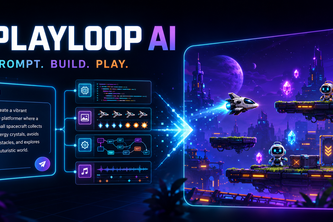
PlayLoop AI is a self-reported platform that enables users to create 2D games from text prompts using an agentic development workflow. The description states it uses AI agents for planning, developing, testing, and repairing game projects, with a focus on transparency and user control through a two-pane interface.
What changed
The project was submitted as part of the OpenAI 2026 hackathon. It represents a prototype or proof-of-concept build rather than a commercial product, based on the author's own account.
The single most important open question
Is there evidence that PlayLoop AI has achieved any meaningful traction, revenue, or customer adoption beyond its initial development and hackathon submission?
What The Product Actually Is
The description states that PlayLoop AI is a prompt-first game-building platform designed to convert user ideas into playable 2D games through an agentic workflow. It includes:
- A planning agent that transforms prompts into structured GameSpecs.
- A development workflow using mechanic kits for different genres.
- An agent panel showing build activity and a live preview of the game.
- Automated testing to identify build and gameplay failures.
- A repair workflow to patch validated problems.
The platform is described as having a two-pane interface: one side shows what the AI developer is doing, while the other shows the evolving game preview. It supports genre families such as platformers, racing games, space shooters, and more.
It also includes:
- Authentication and personal project accounts
- Persistent project and game-state storage
- Cloud saves and shareable experiences
The system uses AI tools like OpenAI Responses API, Codex, and GPT for orchestration and code generation. It is built with technologies including Next.js, React, Phaser.js, PostgreSQL, and Playwright.
Inference The product appears to be a prototype or MVP built for a hackathon, not yet commercialized.
Positioning & Claim Evolution
The description states that PlayLoop AI aims to make game creation feel more like collaborating with a development team, by removing the need for users to understand repositories, frameworks, terminals, and deployment.
It positions itself as:
- A prompt-first game-building workflow.
- A transparent workspace where users can see what the AI is doing.
- A platform that preserves user control through an approval gate before development begins.
The author claims it was designed to be approachable for users without traditional development experience, and that it introduces a human approval gate as a key architectural decision.
Inference The positioning emphasizes accessibility, transparency, and user agency in AI-assisted game creation. It is not yet clear if this approach has been validated with real users or markets beyond the hackathon context.
Target Customer & ICP
The description states that PlayLoop AI is designed for users who want to create 2D games from text prompts, particularly those without traditional development experience.
It targets:
- Game creators who are not developers.
- People exploring game ideas and want to quickly prototype them.
- Users who value transparency in the development process.
The platform supports genre families such as platformers, racing games, space shooters, and more — suggesting a broad appeal across casual and hobbyist game makers.
Inference The ICP appears to be individuals or small teams looking for an easy way to prototype 2D games without needing technical skills. No evidence of specific customer segments or personas is provided.
Business Model & Pricing Evidence
The description does not state anything about a business model or pricing structure.
It mentions:
- Account-based project persistence
- Cloud saves and shareable experiences
- Project versioning, rollback, and remixing
But no details are given on monetization, subscription tiers, usage fees, or any commercial offering.
Inference There is no evidence of a business model or pricing strategy in the provided description.
Technical & Delivery Signals
The platform uses:
- AI tools: OpenAI Responses API, OpenAI Agents SDK, Codex, GPT
- Frameworks and libraries: Next.js, React, Phaser.js, TypeScript, Tailwind CSS
- Infrastructure: PostgreSQL, Cloudflare, Playwright, Vitest, Vite, Server-Sent Events
- Testing and validation: JSON Schema, Zod, automated gameplay testing
It is designed around:
- Five specialized agents: Planner, Developer, Art Director, QA Agent, Repair Agent
- Modular mechanic kits for genre families
- Isolated sandboxes to run generated code safely
- Structured GameSpecs as a contract between user idea and implementation
The system supports:
- Real-time build event streaming
- File and build event tracking
- Browser-based gameplay testing
- Secure generation, testing, and repair pipeline
Inference The technical architecture suggests a sophisticated, modular approach to AI-assisted development. However, this is based on the author's own account and not independently verified.
Traction & Maturity Signals
The description states that PlayLoop AI was built for the OpenAI 2026 hackathon and includes accomplishments such as:
- Creating a prompt-first game-builder experience
- Introducing a human approval gate before development
- Building multiple playable 2D game prototypes
- Adding account-based project persistence
- Supporting cloud saves and shareable experiences
It also mentions that the team is working on:
- Production OpenAI model integration
- Isolated per-project build sandboxes
- Automatic browser gameplay testing
- Expansion of tested genre kits
However, there is no evidence of revenue, customers, user adoption, or product-market fit beyond the hackathon submission.
Inference The project appears to be in early development and has not yet demonstrated traction or commercial viability.
Competitive Context
The description does not provide any information about competitors or market positioning relative to existing tools.
It does not mention:
- Other AI-powered game creation platforms
- Traditional game engines (e.g., Unity, Unreal)
- No-code game builders
- Existing AI coding tools used in game development
Inference There is no evidence of competitive analysis or awareness of the broader marketplace in the description.
Open Questions & Risks
Key risks and open questions based on the self-reported description:
- No revenue, customers, or traction: The product is described as a hackathon submission with no evidence of monetization or user adoption.
- Unverified claims about AI capabilities: The platform relies heavily on AI tools (e.g., OpenAI agents), but there’s no demonstration of real-world performance or reliability.
- Limited scope and maturity: The system appears to be a prototype, not a production-ready product.
- No business model or pricing: No indication of how the company intends to monetize the platform.
- High technical complexity without validation: The architecture is complex (sandboxes, agent orchestration, etc.), but there’s no evidence that it works reliably at scale.
Inference The project lacks commercial viability indicators and appears to be in a very early stage of development.
Questions the description leaves open
- What is the current status of PlayLoop AI beyond the hackathon? Is it being used by anyone outside of the team?
- How does PlayLoop AI handle edge cases or failures during gameplay testing?
- Has the platform been tested with real users, and what feedback has been received?
- What are the plans for monetization and scaling the platform?
- Are there any partnerships or integrations in place with AI providers like OpenAI?
- How does PlayLoop AI ensure consistent quality across different genres and mechanic kits?
- What is the roadmap for moving from prototype to a production-ready product?
Overall Assessment
The description states that PlayLoop AI was built as part of the OpenAI 2026 hackathon, and there is no evidence of any commercial traction, revenue, or customer base.
It is described as a prototype with ambitious technical goals but no indication of market validation or product-market fit.
Inference Based on the self-reported information alone, PlayLoop AI does not yet demonstrate sufficient commercial readiness or traction to warrant investment or partnership consideration. It remains in an exploratory phase and requires further evidence of user adoption, revenue, or scalability before any strategic move can be justified.
User Stories BotA demo video on every pull request
Get a demo video on every new feature
GitHub App that watches your pull requests and records a narrated, captioned demo.
Save time on demo prep and make informed decisions faster with a video walkthrough of every new feature.
Source
Submitted to the OpenAI 2026 hackathon on Devpost. Project home on Devpost. Back to the full gallery on Devpost.
This competitive analysis was produced by top-founders.com (opens in a new tab)
Generated by a language model from this project's public Devpost page — its tagline, the author's own write-up and any built-with tags listed there — as captured in August 2026. Short quotations are the author's words. It is an opinion on the idea as a business, not on the people behind it, and it reflects the description as published then. If the project has moved on, request a correction below. The analysis is not independent research and contains no verified traction, revenue or customer data.
An independent guide by KFG International LLC — not affiliated with, endorsed by, or connected to Devpost or OpenAI.