

Archive position — measured, not model output
1 like on Devpost
505 of the 7,850 archived projects have more likes, and 1,758 share exactly 1 — so this project's #2,057 place in the like-ranked listing is a tie-break inside that group, not a ranking.
Projects (log scale)
Likes on Devpost. ▲ marks this project's group.
Show the figures
| Likes | Projects | Share of archive |
|---|---|---|
| 0 | 5,587 | 71.2% |
| 1 | 1,758 | 22.4% |
| 2 | 284 | 3.6% |
| 3–4 | 132 | 1.7% |
| 5–9 | 75 | 1.0% |
| 10+ | 14 | 0.2% |
 User Stories BotA demo video on every pull request
Get a demo video on every new feature
GitHub App that watches your pull requests and records a narrated, captioned demo.
Save time on demo prep and make informed decisions faster with a video walkthrough of every new feature.
Executive Summary
What the company appears to be
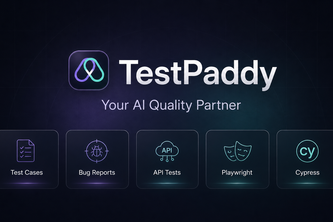
TestPaddy is an AI-powered QA engineering workspace, self-described as a tool that transforms requirements into structured QA deliverables such as test cases, bug reports, API tests, and runnable Playwright or Cypress projects. It is built by one person (Chimezie Sunday) and uses OpenAI’s GPT-5.6 via the Responses API.
What changed
This is a self-reported project submitted to the OpenAI 2026 hackathon. The author describes it as an experiment in applying AI to QA engineering workflows, with a focus on structured outputs and integration into existing tools like Playwright, Cypress, Postman, and GitHub Actions.
Single most important open question
Is there evidence of real-world usage or adoption by QA engineers beyond the author’s own development environment?
What The Product Actually Is
The description states that TestPaddy is an AI-powered QA engineering workspace. It claims to generate five types of outputs:
- Test Cases
- Bug Reports
- API Tests (including Postman collections, Playwright, and Cypress)
- Playwright Generator (TypeScript starter projects with Page Object Models, configuration, documentation, GitHub Actions)
- Cypress Generator (TypeScript starter projects with helpers, fixtures, CI workflows)
It also claims to use structured JSON outputs from GPT-5.6 via OpenAI Responses API, and that it supports deterministic demo mode when no API key is available.
Inference The tool appears designed for QA engineers who want to automate repetitive tasks like writing test cases or generating automation scripts from requirements or documentation.
Positioning & Claim Evolution
The author positions TestPaddy as an AI quality partner, not a replacement for testers. It aims to accelerate repetitive work while keeping testers in control of decisions.
Claim
TestPaddy works the way software testers work, not the other way around.
Inference This suggests a niche positioning within QA tooling — focused on improving workflow efficiency rather than broad AI generalization.
Target Customer & ICP
The description states that TestPaddy is built for QA engineers who convert user stories, product requirements, API documentation, and defect reports into structured QA deliverables.
Claim
It targets software testers who need to produce practical outputs like test cases, bug reports, and automation code.
Inference The target customer likely includes individual QA engineers or small teams working in agile environments where rapid test creation is critical.
Business Model & Pricing Evidence
There is no mention of pricing, business model, monetization strategy, or revenue streams in the description. The project is presented as a hackathon submission.
Not evidenced
Technical & Delivery Signals
The project was built using:
- Next.js
- React
- TypeScript
- OpenAI Responses API (powered by GPT-5.6)
- Structured JSON outputs
- Server-side processing to avoid exposing API keys
- Demo mode without API key access
It supports integrations with:
- GitHub Actions
- Playwright
- Cypress
- Postman
- Codex (for engineering collaboration)
Inference The architecture suggests a lightweight, server-rendered web application with AI-driven generation and structured output formats.
Traction & Maturity Signals
There is no evidence of traction, customers, or usage beyond the author’s own development process. The project was submitted to a hackathon and has no archived history or external validation.
Not evidenced
Competitive Context
The description does not list competitors or reference existing tools in this space. However, it implies that current solutions lack domain-specific reasoning for QA engineering tasks.
Inference It likely competes with general-purpose AI assistants (e.g., ChatGPT), but also potentially with tools like TestRail, Jira, or Postman for test case management and API testing automation.
Open Questions & Risks
- Single-person team: No evidence of scaling beyond one developer.
- No traction or adoption: No mention of users, customers, or real-world usage.
- Unverified claims: All features are self-reported without external validation.
- Limited commercialization path: No pricing, monetization, or go-to-market strategy described.
- Dependency on AI provider (OpenAI): Reliance on a third-party API may pose risks if access changes.
Questions the description leaves open
- What specific QA workflows does TestPaddy currently support?
- How does it handle incomplete or ambiguous inputs from users?
- Are there any existing users or pilot programs?
- What is the plan for monetization and customer acquisition?
- How does TestPaddy ensure quality of generated outputs?
- Has the team considered integrating with major QA platforms like Jira or Azure DevOps?
Overall Assessment
Not evidenced
The project is described as a hackathon submission with no evidence of traction, revenue, or customer base. The author’s own account describes it as an experiment in applying AI to QA engineering workflows.
Given the lack of verified data on usage, adoption, or business model, and the single-person team structure, there is insufficient basis for investment or partnership consideration at this stage.
This analysis is based entirely on self-reported information from the project description. No external verification or historical data were provided.
User Stories BotA demo video on every pull request
Get a demo video on every new feature
GitHub App that watches your pull requests and records a narrated, captioned demo.
Save time on demo prep and make informed decisions faster with a video walkthrough of every new feature.
Source
Submitted to the OpenAI 2026 hackathon on Devpost. Project home on Devpost. Back to the full gallery on Devpost.
This competitive analysis was produced by top-founders.com (opens in a new tab)
Generated by a language model from this project's public Devpost page — its tagline, the author's own write-up and any built-with tags listed there — as captured in August 2026. Short quotations are the author's words. It is an opinion on the idea as a business, not on the people behind it, and it reflects the description as published then. If the project has moved on, request a correction below. The analysis is not independent research and contains no verified traction, revenue or customer data.
An independent guide by KFG International LLC — not affiliated with, endorsed by, or connected to Devpost or OpenAI.