

Archive position — measured, not model output
1 like on Devpost
505 of the 7,850 archived projects have more likes, and 1,758 share exactly 1 — so this project's #2,059 place in the like-ranked listing is a tie-break inside that group, not a ranking.
Projects (log scale)
Likes on Devpost. ▲ marks this project's group.
Show the figures
| Likes | Projects | Share of archive |
|---|---|---|
| 0 | 5,587 | 71.2% |
| 1 | 1,758 | 22.4% |
| 2 | 284 | 3.6% |
| 3–4 | 132 | 1.7% |
| 5–9 | 75 | 1.0% |
| 10+ | 14 | 0.2% |
 User Stories BotA demo video on every pull request
Get a demo video on every new feature
GitHub App that watches your pull requests and records a narrated, captioned demo.
Save time on demo prep and make informed decisions faster with a video walkthrough of every new feature.
Executive Summary
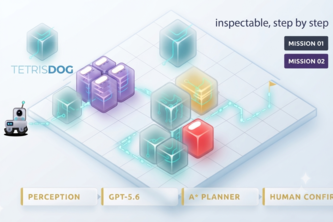
What the company appears to be: TetrisDog is a self-reported Physical AI Education Kit built as a hackathon project (Devpost submission). It presents an interactive 3D sandbox where learners can observe and interact with AI reasoning, planning, and robot motion in real time. The system uses a constrained GPT-5.6 layer for semantic intent classification, A* for deterministic path planning, and a modular architecture that separates perception, reasoning, planning, and execution.
What changed: The project is described as a working prototype built within 10 hours during a hackathon. It includes a multimodal interface (touch/text/voice), real-time visualization, structured logging of episodes, and safety boundaries around motor control.
Single most important open question: Is there any evidence of traction, revenue, or customer adoption beyond the author’s own demonstration? The description states no such data exists.
Note: This analysis is based entirely on the self-reported project description provided by the caller. It contains no verified facts about customers, revenue, funding, or operational history. All claims are stated by the author and not independently confirmed.
What The Product Actually Is
The description states that TetrisDog is a Physical AI education kit designed to make the normally hidden pipeline from human intent to robot action fully inspectable. It allows users to:
- Place obstacles on a live 3D grid.
- Set goals for an AI "dog".
- Express intent through touch, text, or voice.
- Use a constrained GPT-5.6 layer to classify perception events into one of four allowlisted grid intents (CONTINUE / STOP / REQUEST_REPLAN / MARK_OBSTACLE).
- Use an A* planner to compute and replan routes when the grid changes.
- Inspect plans, confirm them, and watch simulated trajectories execute.
- Record every run as a structured JSONL episode for future research.
The system is described as having independent, testable layers, including:
- Python logic engine (asyncio + websockets)
- Constrained semantic layer using GPT-5.6
- A* global planner
- Three.js + Vite frontend rendering the grid and agent
- WebSocket protocol for communication between components
- Dry-run-only hardware adapter with safety boundary
Inference: The product appears to be a simulation-based educational tool, not a commercial robot platform or production-ready system. It is built to demonstrate AI reasoning in a safe, inspectable way.
Positioning & Claim Evolution
The author states that the project was inspired by playing Tetris and thinking about how spatial decisions translate into robot learning — turning abstract theory into an interactive sandbox.
Positioning claim:
“AI education is often trapped between abstract theory and inaccessible hardware.”
Evolution of claims:
- The product aims to bridge this gap by offering a visual, hands-on environment where learners can see how intent becomes action.
- It positions itself as a human-in-the-loop system, emphasizing transparency and safety.
- The author emphasizes that the GPT-5.6 layer is strictly constrained — it does not issue motor commands directly.
Claim vs Fact: These are self-stated positioning and intent, not proof of traction or adoption.
Target Customer & ICP
The description states that TetrisDog is an AI education kit, intended for learners who want to understand how AI systems reason, plan, and act in physical environments.
It targets:
- Students learning about AI and robotics
- Educators looking for interactive tools
- Researchers interested in embodied AI or human-AI interaction
No specific customer segments or personas are named. The system is described as a sandbox environment, not a product sold to institutions or individuals.
Inference: The ICP likely includes educators, students, and researchers working in AI/robotics education or research labs — but no evidence of actual users or institutional adoption.
Business Model & Pricing Evidence
There is no mention of pricing, monetization, or business model in the description.
The project is described as a hackathon prototype submitted to the OpenAI 2026 hackathon. No indication exists that it has moved beyond this stage or has any revenue-generating mechanism.
Not evidenced: No evidence of a business model, pricing structure, or customer acquisition strategy.
Technical & Delivery Signals
The system is built with:
- Technology stack: JavaScript, Python, OpenAI API (GPT-5.6), A* algorithm, reinforcement learning, Three.js, Vite, WebSockets, asyncio
- Architecture: Modular, layered design separating perception, reasoning, planning, and execution
- Safety features:
- GPT-5.6 is constrained to a fixed intent schema
- Motor control is kept behind a safety boundary
- Hardware adapter is dry-run only
- Protocol: Versioned WebSocket JSON protocol ("neural highway")
- Data handling: Structured episode logs (JSONL) for research use
Inference: The architecture suggests a focus on modularity, safety, and traceability, which may be valuable in educational or research contexts.
Traction & Maturity Signals
The description states that the project was built within a 10-hour window during a hackathon. It includes:
- A fully runnable demo
- Structured logging of episodes
- Modular components that can be inspected and debugged
- Clear separation between AI reasoning and execution
However, there is no evidence of:
- Customer adoption or usage
- Revenue generation
- Product iteration beyond the MVP
- Institutional partnerships or deployments
Not evidenced: No traction, revenue, or user data.
Competitive Context
The description does not provide any information about competitors or market positioning. It does not reference similar tools or platforms in AI education or robotics simulation.
Not evidenced: No competitive landscape or differentiation analysis.
Open Questions & Risks
- Prototype-only status: The system is described as a hackathon MVP, with no indication of further development or commercialization.
- No safety validation beyond sandboxing: While the system includes safety boundaries, there is no evidence that these have been tested in real-world conditions.
- Unverified GPT-5.6 constraints: The author claims strict control over GPT-5.6 outputs, but this is self-reported and unverified.
- No data on user feedback or usability testing: No mention of how learners interacted with the system beyond the demo.
Inference: The project lacks evidence of real-world use cases, scalability, or long-term viability as a product.
Questions the description leaves open
- What is the current status of the project? Is it still under active development?
- Have you tested this system with actual learners or educators?
- How do you plan to scale beyond the hackathon prototype?
- Are there any technical limitations in how GPT-5.6 is constrained in practice?
- What are your plans for data collection, privacy, and consent in educational settings?
- Do you have any interest in partnering with schools or research institutions?
Note: These questions aim to uncover whether the project has evolved beyond a demo or if it remains a proof-of-concept.
Overall Assessment
The description states that TetrisDog is a hackathon submission and does not contain any evidence of:
- Revenue
- Customers
- Product-market fit
- Commercial traction
- Team expansion or funding
It is presented as an educational prototype, not a commercial product.
Assessment: Not ready for investment or partnership at this stage. The project shows potential in educational AI simulation but lacks any evidence of real-world adoption, scalability, or monetization strategy.
User Stories BotA demo video on every pull request
Get a demo video on every new feature
GitHub App that watches your pull requests and records a narrated, captioned demo.
Save time on demo prep and make informed decisions faster with a video walkthrough of every new feature.
Source
Submitted to the OpenAI 2026 hackathon on Devpost. Project home on Devpost. Back to the full gallery on Devpost.
This competitive analysis was produced by top-founders.com (opens in a new tab)
Generated by a language model from this project's public Devpost page — its tagline, the author's own write-up and any built-with tags listed there — as captured in August 2026. Short quotations are the author's words. It is an opinion on the idea as a business, not on the people behind it, and it reflects the description as published then. If the project has moved on, request a correction below. The analysis is not independent research and contains no verified traction, revenue or customer data.
An independent guide by KFG International LLC — not affiliated with, endorsed by, or connected to Devpost or OpenAI.