

Archive position — measured, not model output
0 likes on Devpost
2,263 of the 7,850 archived projects have more likes, and 5,587 share exactly 0 — so this project's #5,985 place in the like-ranked listing is a tie-break inside that group, not a ranking.
Projects (log scale)
Likes on Devpost. ▲ marks this project's group.
Show the figures
| Likes | Projects | Share of archive |
|---|---|---|
| 0 | 5,587 | 71.2% |
| 1 | 1,758 | 22.4% |
| 2 | 284 | 3.6% |
| 3–4 | 132 | 1.7% |
| 5–9 | 75 | 1.0% |
| 10+ | 14 | 0.2% |
 User Stories BotA demo video on every pull request
Get a demo video on every new feature
GitHub App that watches your pull requests and records a narrated, captioned demo.
Save time on demo prep and make informed decisions faster with a video walkthrough of every new feature.
Executive Summary
The company appears to be a solo developer project named Playwright Automation Studio, self-described as an AST-first platform that converts Playwright Codegen scripts into governed, reusable automation artifacts with optional AI review. The author states this is a hackathon submission for the OpenAI 2026 hackathon.
What changed: The project description indicates a shift from raw Playwright Codegen output to a structured, reviewed workflow that includes AST-based extraction, governance checks, and GitHub PR integration. It introduces an optional AI review layer while maintaining deterministic local analysis as core.
The single most important open question: Is there any evidence of actual usage or adoption beyond the author’s own development? The description contains no claims about revenue, customers, or product-market fit — only self-reported features and design decisions.
What The Product Actually Is
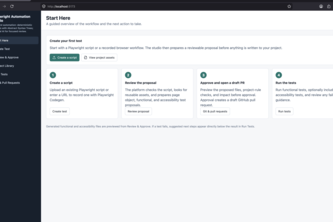
- The description states that Playwright Automation Studio converts uploaded or locally recorded Playwright Codegen scripts into automation proposals.
- It uses Abstract Syntax Trees (ASTs) to extract actions, locators, navigation, and assertions from the input script.
- The platform proposes page objects, functional tests, and accessibility tests, showing exact generated files.
- It supports pre-approval test execution without permanently writing files.
- After approval, it can create or update a draft GitHub pull request containing only approved automation files.
- The system includes optional AI review using Gemini or Ollama, but emphasizes that raw repository source is not sent to AI.
- It integrates with GitHub CLI and Actions, enabling workflow automation within existing development environments.
This is a self-reported description of a tool for transforming Playwright automation scripts into governed, reusable components. No evidence of actual deployment, usage, or customer feedback exists beyond the author's account.
Positioning & Claim Evolution
- The project positions itself as an enhancement to Playwright Codegen, addressing its limitation of producing only a starting point.
- It claims to make the transition from recorded actions to maintainable code clearer and safer.
- The platform is described as AST-first, emphasizing deterministic behavior over AI-driven generation.
- It introduces governance features: review workflows, confidence scoring, change scope, impact information, and pre-approval testing.
- The author notes that AI is optional, not central to the core functionality.
- The evolution appears to be from a simple script recorder to a structured, governed automation pipeline.
These are claims made by the author about intent and design. There is no evidence of market positioning, competitive differentiation, or traction.
Target Customer & ICP
- The description implies that the target user is someone working with Playwright automation, likely in software development teams.
- It targets users who record browser actions using Playwright Codegen and want to turn those into maintainable page objects and tests.
- The platform supports teams needing governance over automation changes, such as through pull request workflows.
- It is designed for developers or QA engineers looking to improve the quality and reusability of their Playwright scripts.
No explicit customer personas, segment definitions, or market targeting data are provided. The description does not indicate whether this addresses internal teams, external clients, or specific verticals.
Business Model & Pricing Evidence
- There is no evidence in the description of any pricing model, monetization strategy, or business model.
- The project is described as a hackathon submission, suggesting it may be experimental or non-commercial at this stage.
- No mention of subscriptions, usage fees, enterprise licensing, or freemium tiers.
Not evidenced. This is a self-reported tool with no indication of how it would generate revenue or be monetized.
Technical & Delivery Signals
- Built as a TypeScript monorepo using:
- React and Vite for the browser interface
- Express.js for API and orchestration layer
- Playwright for functional testing, screenshots, videos, traces, and accessibility testing
- AST-based analysis for deterministic extraction
- Optional AI via Gemini or Ollama
- GitHub CLI integration for draft PR workflows
- Deployment uses Docker and Render for a single frontend-and-backend setup.
- The system separates business steps and verification steps into page objects.
- It supports graceful fallback behavior when AI is unavailable or rate-limited.
- It shows failure artifacts like screenshots, videos, error context, and traces in the UI.
These are technical claims from the author. No evidence of production deployment, scalability, or performance metrics exists.
Traction & Maturity Signals
- The project is described as a hackathon submission (OpenAI 2026).
- It was built by one person: pavan h.
- There are no mentions of users, customers, downloads, or adoption.
- No evidence of revenue, ARR, funding rounds, or headcount beyond the single developer.
Not evidenced. The project is not shown to have any traction or maturity indicators beyond its own description.
Competitive Context
- The project builds on Playwright Codegen, which is a known tool for browser automation.
- It competes with tools that help developers transform recorded actions into maintainable test code.
- It introduces governance and AI review features, which may differentiate it from basic Playwright workflows or other low-code automation platforms.
- However, the description does not compare directly to existing products or market offerings.
No competitive analysis is provided. The author does not reference competitors or market positioning beyond self-description.
Open Questions & Risks
- Solo developer project: With only one member (pavan h), there are risks around scalability, long-term maintenance, and team capacity.
- No commercial traction: As a hackathon submission, it lacks evidence of real-world usage or product-market fit.
- Limited scope: The platform is described as focused on Playwright automation and GitHub workflows — this may limit broader appeal.
- AI dependency risk: While optional, the presence of AI review introduces potential risks if providers become unavailable or rate-limited.
- Unproven value proposition: There is no evidence that teams actually need or use this type of governance workflow for Playwright automation.
These are inferences based on the self-reported nature and limited scope of the project. No external validation exists.
Questions the description leaves open
- What specific problems are you solving for users beyond what existing Playwright tools already do?
- How many developers or teams have tried this tool? Have they provided feedback?
- Is there a plan to support more AI providers, and how does that affect the core workflow?
- What is your roadmap for moving from a hackathon prototype to a production-ready product?
- Do you have any early adopters or pilot customers who are using it in real workflows?
- How do you intend to monetize this platform if at all?
These questions aim to uncover whether the described features translate into actual user needs and commercial viability.
Overall Assessment
- The project is a self-reported hackathon submission with no evidence of traction, revenue, or customer adoption.
- It is built by one developer and lacks any indication of scalability or long-term business intent.
- While the technical approach shows some sophistication (AST-based analysis, optional AI), it remains unproven in real-world use.
- There is no commercial due-diligence evidence to support a conclusion about investment potential or partnership viability.
Not evidenced. This is a solo developer prototype with no demonstrated market traction or business model. Any future value depends on whether the author scales beyond the current scope and gains real-world usage.
User Stories BotA demo video on every pull request
Get a demo video on every new feature
GitHub App that watches your pull requests and records a narrated, captioned demo.
Save time on demo prep and make informed decisions faster with a video walkthrough of every new feature.
Source
Submitted to the OpenAI 2026 hackathon on Devpost. Project home on Devpost. Back to the full gallery on Devpost.
This competitive analysis was produced by top-founders.com (opens in a new tab)
Generated by a language model from this project's public Devpost page — its tagline, the author's own write-up and any built-with tags listed there — as captured in August 2026. Short quotations are the author's words. It is an opinion on the idea as a business, not on the people behind it, and it reflects the description as published then. If the project has moved on, request a correction below. The analysis is not independent research and contains no verified traction, revenue or customer data.
An independent guide by KFG International LLC — not affiliated with, endorsed by, or connected to Devpost or OpenAI.