

Archive position — measured, not model output
0 likes on Devpost
2,263 of the 7,850 archived projects have more likes, and 5,587 share exactly 0 — so this project's #5,987 place in the like-ranked listing is a tie-break inside that group, not a ranking.
Projects (log scale)
Likes on Devpost. ▲ marks this project's group.
Show the figures
| Likes | Projects | Share of archive |
|---|---|---|
| 0 | 5,587 | 71.2% |
| 1 | 1,758 | 22.4% |
| 2 | 284 | 3.6% |
| 3–4 | 132 | 1.7% |
| 5–9 | 75 | 1.0% |
| 10+ | 14 | 0.2% |
 User Stories BotA demo video on every pull request
Get a demo video on every new feature
GitHub App that watches your pull requests and records a narrated, captioned demo.
Save time on demo prep and make informed decisions faster with a video walkthrough of every new feature.
Executive Summary
What the company appears to be
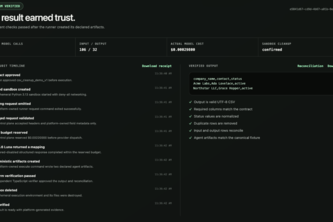
PLSBRO is a self-reported platform that introduces a contract-based execution model for AI agents. The author states it provides a sandboxed environment where tasks are defined with explicit constraints, budgets, and verification steps before execution begins. It uses isolated environments (e.g., Vercel Sandbox), structured outputs, and independent artifact verification to ensure trustworthiness in agent workflows.
What changed
The project description reflects an evolution from general AI-agent concerns (e.g., lack of control or transparency) into a specific technical solution involving task contracts, sandboxed execution, and audit trails. It builds on the idea that prompt quality alone is insufficient when agents gain access to sensitive data or systems.
Single most important open question
Is there evidence of real-world usage or adoption beyond the author’s demonstration? The description does not indicate any customers, revenue, or traction — only a proof-of-concept workflow.
What The Product Actually Is
The description states that PLSBRO is a system for executing AI tasks under strict constraints. It includes:
- A control plane built with Next.js and TypeScript
- An agent runner in Python 3.13 inside a Vercel Sandbox
- Structured input/output handling via OpenAI Responses API
- JSON Schema-based contracts
- Independent verification using TypeScript checks
- Budget reservation and accounting
- Audit trail generation through hash-linked evidence
It is described as a platform-owned CSV-cleanup agent that runs in an isolated environment with no external network access or secrets.
Inference This appears to be a prototype or demonstration of a broader architectural framework for secure, verifiable AI task execution. It is not yet a commercial product but rather a technical proof-of-concept.
Positioning & Claim Evolution
The author claims that most AI-agent products begin with a request like “please do this,” then ask users to trust what happens next. PLSBRO aims to replace that model with one based on enforceable contracts and verifiable execution.
Key claims
- Users need to know what an agent is allowed to do, what data it can access, how much it can spend, and whether the result was verified.
- PLSBRO turns those questions into an explicit, enforceable task contract before execution begins.
- It provides deterministic success criteria, deny-all network policy, one-model-call ceiling, and budget reservation.
Inference The positioning has evolved from a general concern about AI agent trustworthiness to a specific architectural approach involving contracts, sandboxing, and verification. The author frames this as a response to increasing risks around data exposure, cost overruns, and lack of accountability in agent workflows.
Target Customer & ICP
The description does not name specific customers or personas. However, it implies that PLSBRO targets developers or organizations who:
- Use AI agents for sensitive or automated tasks
- Require auditability and control over agent behavior
- Want to limit spending and access during execution
- Are concerned about data leakage or unintended consequences
Inference The likely ICP includes enterprise developers, DevOps teams, or internal tooling teams working with AI agents in production-like environments. The focus is on trust, security, and compliance rather than end-user adoption.
Business Model & Pricing Evidence
There is no evidence of pricing, revenue streams, or monetization strategy in the description.
Inference The project is currently a demonstration and not yet commercialized. The author mentions budget reservation and accounting, but does not describe how this would scale into a paid service.
Technical & Delivery Signals
The description includes several technical details:
- Built with Next.js, TypeScript, Python 3.13, Docker, Vercel Sandbox
- Uses OpenAI Responses API with structured output
- Implements JSON Schema for contracts
- Employs sandboxed execution with deny-all network policy
- Verifies artifacts using a separate TypeScript checker
- Tracks costs and budgets via integer-based accounting
- Includes audit trails and hash-linked evidence
Inference The system shows strong engineering rigor, especially in sandboxing, verification, and cost control. It reflects deep understanding of secure execution environments and AI agent risks.
Traction & Maturity Signals
There is no evidence of traction, customers, or revenue. The project is described as a hackathon submission (Devpost entry for OpenAI 2026). The demo uses synthetic data and fixed workflows.
Inference This is a prototype or proof-of-concept with no demonstrated market adoption or user base. It lacks any indication of product-market fit or scalability beyond the author’s controlled environment.
Competitive Context
The description does not mention competitors directly, but it positions itself against general-purpose AI-agent platforms that lack transparency or control.
Inference PLSBRO likely competes with tools like AutoGen, LangChain, or other agent orchestration frameworks by offering a more secure and auditable execution model. However, no direct comparison or competitive analysis is provided.
Open Questions & Risks
- No evidence of real-world usage or adoption — only a demo.
- Limited scope — the current implementation focuses on CSV cleanup with synthetic inputs.
- Single-person team — raises questions about scalability and long-term maintenance.
- High engineering complexity — may be difficult to generalize without significant development effort.
- Unclear path to monetization — no pricing or business model described.
Questions the description leaves open
- What is the intended transition from this demo to a scalable, general-purpose platform?
- How would PLSBRO handle arbitrary file uploads or external API integrations without compromising security?
- Are there plans for marketplace-style distribution or third-party tool integration?
- Has the system been tested under adversarial conditions beyond the author’s controlled environment?
- What are the key assumptions about user behavior or workflow that might not hold in practice?
Overall Assessment
Confidence: Low
The description presents a technically sound and well-thought-out prototype for secure AI agent execution, but it is not yet a product with traction, customers, or revenue. It appears to be a hackathon submission with strong engineering foundations.
Assessment Not ready for investment or partnership at this stage. The idea has merit and shows potential for future development, but lacks evidence of commercial viability or market demand. A follow-up evaluation would require demonstration of real-world usage, scalability, and monetization strategy.
User Stories BotA demo video on every pull request
Get a demo video on every new feature
GitHub App that watches your pull requests and records a narrated, captioned demo.
Save time on demo prep and make informed decisions faster with a video walkthrough of every new feature.
Source
Submitted to the OpenAI 2026 hackathon on Devpost. Project home on Devpost. Back to the full gallery on Devpost.
This competitive analysis was produced by top-founders.com (opens in a new tab)
Generated by a language model from this project's public Devpost page — its tagline, the author's own write-up and any built-with tags listed there — as captured in August 2026. Short quotations are the author's words. It is an opinion on the idea as a business, not on the people behind it, and it reflects the description as published then. If the project has moved on, request a correction below. The analysis is not independent research and contains no verified traction, revenue or customer data.
An independent guide by KFG International LLC — not affiliated with, endorsed by, or connected to Devpost or OpenAI.