

Archive position — measured, not model output
4 likes on Devpost
89 of the 7,850 archived projects have more likes, and 39 share exactly 4 — so this project's #100 place in the like-ranked listing is a tie-break inside that group, not a ranking.
Projects (log scale)
Likes on Devpost. ▲ marks this project's group.
Show the figures
| Likes | Projects | Share of archive |
|---|---|---|
| 0 | 5,587 | 71.2% |
| 1 | 1,758 | 22.4% |
| 2 | 284 | 3.6% |
| 3–4 | 132 | 1.7% |
| 5–9 | 75 | 1.0% |
| 10+ | 14 | 0.2% |
 User Stories BotA demo video on every pull request
Get a demo video on every new feature
GitHub App that watches your pull requests and records a narrated, captioned demo.
Save time on demo prep and make informed decisions faster with a video walkthrough of every new feature.
Executive Summary
What the company appears to be
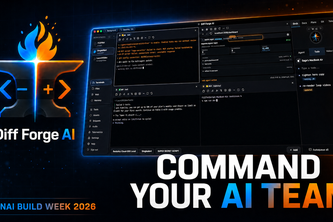
Diff Forge AI is described as an open-source Agentic Development Environment (ADE) for developers, built by a solo founder. The product enables developers to orchestrate AI agents using Codex, Claude Code, and OpenCode via voice, vision, and workflows, with local safety controls and secure remote access. It supports multi-terminal workspaces, audio dictation, screen capture snipping, and integrates with cloud services through a paid subscription model.
What changed
The founder reports that the landscape shifted from copy-pasting code from ChatGPT to using advanced AI tools like Codex, Claude Code, and Fable 5 for orchestrating subagents. This evolution led to an overnight build of a complex ADE using over 90 billion tokens in two months.
Single most important open question
Is there any evidence of actual user adoption or traction beyond the founder's personal use? The description does not contain data on customers, revenue, or usage metrics — only self-reported claims about development and tooling.
What The Product Actually Is
The description states that Diff Forge AI is an open-source Agentic Development Environment (ADE). It allows developers to:
- Direct Codex, Claude Code, and OpenCode in parallel via voice, vision, and workflows.
- Use a local safety kernel and secure control from any device.
- Keep code local while enabling remote access through web or cellular interfaces.
It includes features such as:
- Multi-terminal workspaces
- Audio dictation (via Whisper)
- Screen capture snipping (MacOS and Windows)
- Session history for 1-click return to previous sessions
The product is built using:
- Tauri (Rust backend, React frontend) for the native client
- NextJS for the web app
- Rust for cloud services
It also integrates with open-source projects like TSCircuit (for PCB design), Xterm (terminal rendering), Enigo Crate (audio dictation), and SCAP crate (screen capture/snipping).
Inference The product appears to be a hybrid local/cloud ADE that supports both AI-assisted development and remote agent management, but no evidence of actual deployment or user base exists.
Positioning & Claim Evolution
The author positions Diff Forge AI as:
- An open-source Agentic Development Environment
- A Vibe Coding Toolkit for Developers
- A platform for AI-assisted software development, including PCB design and video editing
- A tool that supports remote control of AI agents via web or cellular (Twilio integration)
- A future-oriented solution aimed at helping solopreneurs scale their businesses with AI
The founder mentions being inspired by "Bridgemind" and its CEO, Matt, who streams on YouTube and builds an Agentic Development Environment. This suggests a positioning aligned with the emerging trend of agentic coding environments.
Inference The positioning is aspirational — it claims to be a comprehensive ADE for developers but lacks evidence of market validation or competitive differentiation beyond self-description.
Target Customer & ICP
The description states that Diff Forge AI targets developers, particularly those working in software development, AI-assisted design (PCB), and video editing. It is positioned as a toolkit for solopreneurs aiming to scale their business with AI.
It also mentions support for:
- Remote control of AI agents
- Cellular communication via Twilio
- Customer management through email and contact lists
Inference The ICP seems to be individual developers or small teams looking to automate parts of their workflow using AI, but there is no evidence of actual customer segmentation or targeting strategy.
Business Model & Pricing Evidence
The description indicates that:
- The open-source client is free to use
- There is a paid subscription model for cloud services, including:
- Chat with an AI agent via web UI or terminal shell (web sockets)
- Cellular support via Twilio
- Notifications when AI agents complete tasks or require input
- Loopspace functionality for cron jobs, webhooks, and manual triggers
The founder also mentions working on AI Email, inbound/outbound customer management features.
Inference The business model appears to be freemium with paid cloud features, but there is no evidence of pricing tiers, revenue streams, or monetization strategy beyond the author’s own use case.
Technical & Delivery Signals
The project was built using:
- Tauri (Rust backend, React frontend)
- NextJS for web app
- Rust for cloud services
- Integration with open-source libraries like TSCircuit (PCB design), Xterm (terminal rendering), Enigo Crate (audio dictation), and SCAP crate (screen capture)
The author reports:
- Over 888k lines of code across 4 codebases in 2 months
- Use of over 90 billion tokens for development
- Native app development experience on both MacOS and Windows
- Custom CLI for installation via npm, Homebrew, etc.
- Support for background processes and headless execution
Inference The technical stack shows a strong focus on native apps and cross-platform compatibility. However, no evidence of QA/testing, performance benchmarks, or production deployment exists.
Traction & Maturity Signals
The description states:
- Over 888k lines of code in 2 months
- Rust-based client is over 550k lines of code
- Used multiple AI models (Codex, Fable 5, GPT-5.6 Sol) to build the system
- Has a BYOC (Bring Your Own Cloud) feature that allows users to connect cloud providers via API keys
However, there is no evidence of:
- Customer base or user adoption
- Revenue or monetization data
- Product-market fit validation
- Public usage or community engagement
Inference The project shows significant technical effort and ambition but lacks any measurable traction or maturity indicators.
Competitive Context
The author references "Bridgemind" as an inspiration, suggesting a competitive landscape involving:
- Agentic Development Environments (ADEs)
- AI-assisted coding platforms
- Tools for remote agent control and workflow automation
No specific competitors are named in the description. The author does not discuss market size, pricing strategies, or competitive positioning beyond personal admiration for another project.
Inference The competitive space is implied to be around agentic ADEs and AI-powered development tools, but no evidence of competitive analysis or differentiation exists.
Open Questions & Risks
- Solo founder: Only one team member listed (Syed-Mohammad Raza), raising concerns about scalability and execution capacity.
- No traction or revenue data: No mention of customers, users, or monetization — only self-reported development activity.
- Unverified claims: All statements are self-reported without external validation.
- High token consumption: Over 90 billion tokens used in two months raises questions about cost efficiency and sustainability.
- Limited testing/quality assurance: The author notes lack of QA/testing, which is critical for a native app with cross-platform support.
- Ambiguous monetization path: While there's a paid subscription model, no details on pricing or conversion rates are provided.
Inference The project is highly speculative and lacks commercial viability indicators. Risk of failure due to unproven market demand and execution challenges.
Questions the description leaves open
- What specific problems are you solving for developers? How do you know these problems exist?
- Have you validated your idea with real users or potential customers?
- Can you provide any data on token usage, costs, or performance metrics?
- What is the actual roadmap for monetization and scaling beyond the current open-source version?
- How do you plan to handle cross-platform compatibility and QA/testing at scale?
- Are there any existing partnerships or integrations with AI providers (e.g., Codex, Claude)?
- What are your plans for community building or user engagement around the open-source tool?
Overall Assessment
Not evidenced
The description provides no data on:
- Revenue
- Customers
- Market size
- Product-market fit
- Financials
- Team traction
All claims are self-reported and unverified.
This is a highly speculative project that appears to be an ambitious solo effort with strong technical execution, but lacks any commercial due-diligence signals. The founder has built a complex system using advanced AI tools, but there is no evidence of real-world adoption or monetization.
Confidence: Low
The entire analysis rests on the author’s own account — no third-party verification, no historical data, no performance metrics, and no user feedback. Any conclusion about commercial viability must be treated as an inference based on limited self-reporting.
User Stories BotA demo video on every pull request
Get a demo video on every new feature
GitHub App that watches your pull requests and records a narrated, captioned demo.
Save time on demo prep and make informed decisions faster with a video walkthrough of every new feature.
Source
Submitted to the OpenAI 2026 hackathon on Devpost. Project home on Devpost. Back to the full gallery on Devpost.
This competitive analysis was produced by top-founders.com (opens in a new tab)
Generated by a language model from this project's public Devpost page — its tagline, the author's own write-up and any built-with tags listed there — as captured in August 2026. Short quotations are the author's words. It is an opinion on the idea as a business, not on the people behind it, and it reflects the description as published then. If the project has moved on, request a correction below. The analysis is not independent research and contains no verified traction, revenue or customer data.
An independent guide by KFG International LLC — not affiliated with, endorsed by, or connected to Devpost or OpenAI.